
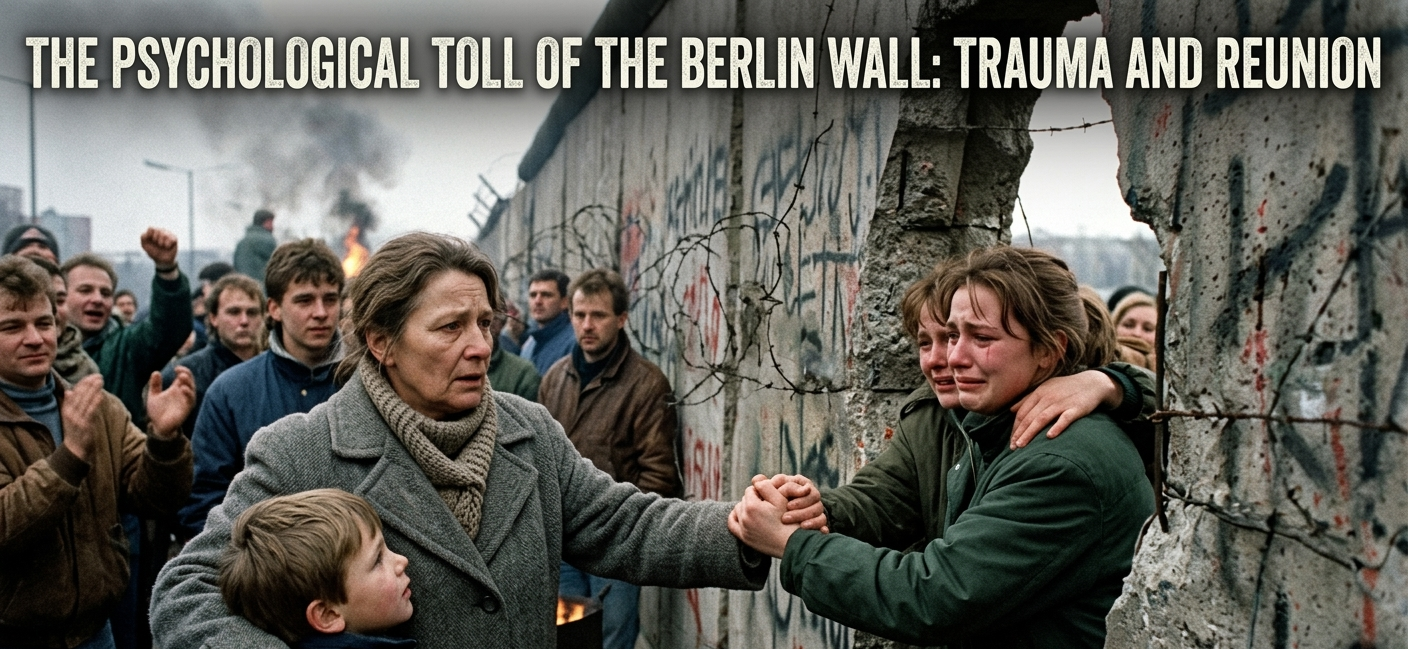

The Berlin Wall, erected in 1961 and dismantled in 1989, was far more than a physical barrier of concrete and barbed wire. It was a profound psychological boundary that fractured families, communities, and the collective psyche of a nation. For nearly three decades, the Wall dictated not only where people could move, but how they thought, felt, and interacted.
In this article from Formal Psychology, we will examine the deep psychological toll of the Berlin Wall, exploring the trauma of its sudden imposition, the pervasive paranoia cultivated by state surveillance, and the deeply complex emotional landscape of reunification.
The Trauma of Sudden Division
The abrupt construction of the Berlin Wall on August 13, 1961, created immediate and severe psychological shockwaves. Families were separated overnight without warning, leading to profound manifestations of grief, helplessness, and loss.
Mauerkrankheit (Wall Disease)
The psychological burden of living in the shadow of the Wall was so severe that East German psychiatrist Dietfried Müller-Hegemann coined the term “Mauerkrankheit” (Wall Disease) in the 1970s. This condition was characterized by a cluster of psychosomatic and depressive symptoms triggered specifically by the oppressive presence of the physical barrier and the feeling of claustrophobic confinement.
Symptoms of Mauerkrankheit frequently included:
- Chronic depression and despair.
- Severe anxiety and panic attacks.
- Phobias (particularly agoraphobia and claustrophobia).
- High rates of alcoholism and suicidal ideation.
- Psychosomatic ailments, such as hypertension and gastrointestinal distress.
Müller-Hegemann observed that these symptoms were most acute in individuals living in close proximity to the Wall, emphasizing how physical environments directly shape mental health.
The Psychology of the Stasi State
In East Germany (the GDR), the physical Wall was reinforced by an invisible wall of state surveillance. The Ministry for State Security, known as the Stasi, orchestrated one of the most pervasive surveillance networks in human history.
This environment cultivated severe psychological distress:
- Chronic Paranoia: Citizens lived with the constant, often justified, fear that their neighbors, friends, or even family members were informants (Inoffizielle Mitarbeiter or IMs).
- Zersetzung (Decomposition): The Stasi employed a psychological warfare technique known as Zersetzung, designed to secretly disrupt the private and professional lives of dissidents. This involved gaslighting, spreading rumors, and subtle sabotage, driving victims to extreme paranoia, nervous breakdowns, and sometimes suicide, all without leaving physical evidence of state interference.
- Self-Censorship: To survive, individuals developed a “split personality”—behaving one way in public (compliant to the state) and another in private, leading to severe cognitive dissonance and a fractured sense of identity.
The Complexities of Reunion
The fall of the Berlin Wall on November 9, 1989, was met with global euphoria. However, from a psychological standpoint, reunification was not an instant panacea. It ushered in a new era of complex psychological challenges.
The “Mauer im Kopf” (Wall in the Head)
While the physical concrete was removed, a psychological barrier—the “Mauer im Kopf”—persisted. Decades of living under diametrically opposed political, economic, and social systems created deep-seated cognitive and cultural divides between East Germans (Ossis) and West Germans (Wessis).
- Identity Crisis and Loss: Many East Germans experienced a profound sense of loss regarding their past. Their professional qualifications were frequently invalidated, and their social systems disappeared overnight. This led to an identity crisis and feelings of being second-class citizens in the newly unified Germany.
- Ostalgie: This sense of alienation gave rise to Ostalgie (nostalgia for the East)—a psychological coping mechanism where individuals romanticized certain aspects of GDR life, such as community solidarity and social security, to soothe the anxieties of adjusting to a fiercely competitive capitalist society.
- West German Attitudes: Conversely, some West Germans harbored resentments regarding the massive financial costs of reunification, leading to stereotypes and prejudice that further alienated their Eastern counterparts.
The Legacy of Intergenerational Trauma
The psychological toll of the Berlin Wall did not end with the generation that lived through it. Psychology today recognizes the impact of intergenerational trauma, where the psychological wounds of the parents are unconsciously transmitted to their children.
Children of families heavily monitored or persecuted by the Stasi often report higher levels of anxiety, difficulties with trust, and an inherited sense of systemic vigilance. Furthermore, the unresolved feelings of inferiority or loss of identity experienced by East German parents during the transition to a unified Germany have shaped the psychological development and political attitudes of the post-Wall generation.
Conclusion
The Berlin Wall remains a critical case study in the intersection of geopolitics and mental health. It starkly illustrates how state-imposed boundaries and pervasive surveillance can shatter human well-being, resulting in distinct clinical pathologies like Mauerkrankheit and the insidious trauma of Zersetzung.
Furthermore, the ongoing psychological echoes of the “Wall in the Head” remind us that while physical barriers can be torn down in a day, the psychological borders they create require generations of healing, empathy, and integration to truly dissolve.