Menu
Formal Psychology
Search
Menu
  • Home
  • Branches of Psychology
    • Introduction to Psychology
    • Clinical Psychology
    • Cognitive Psychology
    • Behavioral Psychology
    • Developmental Psychology
    • Social Psychology
    • Bio Psychology
    • Positive Psychology
    • Statistical Methods
    • Health Psychology
    • Mental Health

Formal PsychologyFormal Psychology
  • Articles
  • Resources
    • About Us
    • Contact Us
    • Psychology Colleges
    • Flash Cards
    • Career Opportunities
    • Audiobooks
    • Certificate Verification
  • Policies
    • Privacy Policy
    • Terms & Conditions
    • Medical Disclaimer
    • Editorial Policy
Search
close
Generic selectors
Exact matches only
Search in title
Search in content
Post Type Selectors
Formal PsychologyFormal Psychology

close
  • Home
  • Branches of Psychology
    • Introduction to Psychology
    • Clinical Psychology
    • Cognitive Psychology
    • Behavioral Psychology
    • Developmental Psychology
    • Social Psychology
    • Bio Psychology
    • Positive Psychology
    • Statistical Methods
    • Health Psychology
    • Mental Health
  • Articles
  • Resources
    • Psychology Colleges
    • Flash Cards
    • Career Opportunities
    • Audiobooks
    • Certificate Verification
  • About Us
  • Contact Us
  • Privacy Policy
  • Policies
    • Privacy Policy
    • Terms & Conditions
    • Medical Disclaimer
    • Editorial Policy

Join the conversation

  • youtube
  • instagram
  • email
  • linkedin
A split-panel photograph illustrating the contrast between scientific research and pseudoscience in the context of handwriting analysis. The left panel, labeled "SCIENCE," shows a researcher in a lab coat using a microscope and analyzing data charts. The right panel, labeled "PSEUDOSCIENCE," shows a person holding a pendulum over a handwritten document, surrounded by tarot cards and astrological charts. A large central text banner asks: "HANDWRITING ANALYSIS: SCIENCE OR PSEUDOSCIENCE?".

Handwriting Analysis (Graphology): Science or Pseudoscience?

  • Avatar photo
  • Posted byby Team Psychology
  • February 8, 2026
  • 3 min
  • Avatar photo
    • Share
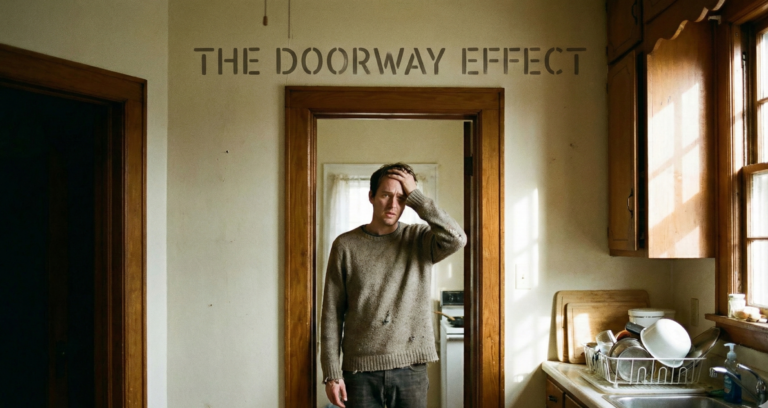
A person pauses in a doorway between a living room and a kitchen, holding a hand to their head with a confused expression, illustrating the psychological phenomenon of forgetting why they entered the room.

The Doorway Effect: Why You Forget What You Needed When You Enter a Room

  • Avatar photo
  • Posted byby Team Psychology
  • February 7, 2026
  • 4 min
  • Avatar photo
    • Share
A split photograph showing a cumulus cloud formation resembling a human profile on the left, and a close-up of a white electrical wall outlet that looks like a surprised face on the right.

The Science of Pareidolia: Why We See Faces in Clouds and Electrical Outlets

  • Avatar photo
  • Posted byby Team Psychology
  • February 7, 2026
  • 3 min
  • Avatar photo
    • Share
A person wearing headphones in a relaxed posture, listening to 60 BPM music therapy tracks on a tablet, while a smartwatch on their wrist displays a lowered resting heart rate.

The Synchronization Effect: How 60 BPM Music Therapy Lowers Heart Rates

  • Avatar photo
  • Posted byby Team Psychology
  • February 7, 2026
  • 3 min
  • Avatar photo
    • Share
A competent professional speaker smiling warmly at an audience after accidentally spilling a glass of water on a podium, illustrating the Pratfall Effect psychological phenomenon.

The Pratfall Effect: Why Making Small Mistakes Makes You More Likable

  • Avatar photo
  • Posted byby Team Psychology
  • February 7, 2026
  • 3 min
  • Avatar photo
    • Share
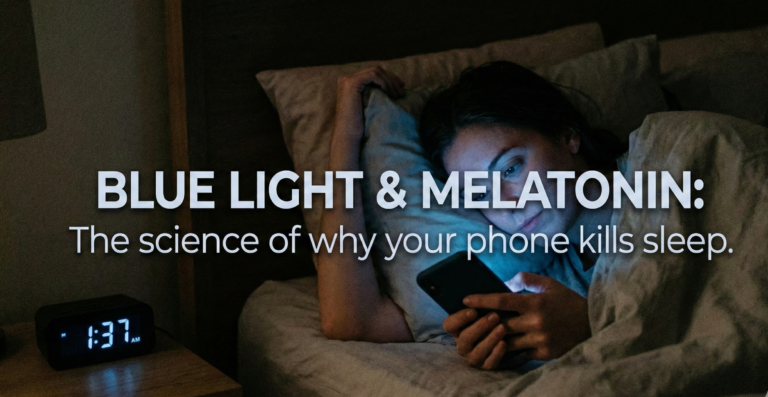
A person lying in bed at night with a smartphone illuminating their face with blue light, next to a digital clock reading 1:37 AM. Text overlay reads: "BLUE LIGHT & MELATONIN: The science of why your phone kills sleep."

Blue Light & Melatonin: The Science of Why Your Phone Kills Sleep

  • Avatar photo
  • Posted byby Team Psychology
  • February 7, 2026
  • 3 min
  • Avatar photo
    • Share
A realistic photo of a woman in a kitchen smiling warmly with her eyes closed as she smells a jar of spices. To her left, a faded, sepia-toned "memory" overlay appears, showing a young child baking with an elderly woman. The text "The Power of Scent: How certain smells trigger instant memories." is centered at the bottom in a clean, dark font.

The Power of Scent: Why Certain Smells Trigger Instant Memories

  • Avatar photo
  • Posted byby Team Psychology
  • February 7, 2026
  • 2 min
  • Avatar photo
    • Share
A tired man sitting at a desk late at night under a lamp, appearing overwhelmed by paperwork and digital devices, representing the psychological concept of decision fatigue.

The Twilight Toll: Why Your Brain Shuts Down After 6 PM

  • Avatar photo
  • Posted byby Team Psychology
  • February 7, 2026
  • 2 min
  • Avatar photo
    • Share
A high-quality lifestyle photograph of a woman sitting on a sofa with a laptop, smiling and stretching her arms during a break. Text overlay reads "The 20-20-20 Rule: Protecting your mental health during screen time."

The 20-20-20 Rule: Protecting Your Mental Health During Screen Time

  • Avatar photo
  • Posted byby Team Psychology
  • February 7, 2026
  • 3 min
  • Avatar photo
    • Share
Realistic photo of a male student yawning in a university library while looking at a laptop. A female student next to him holds an open book displaying the text "MIRROR NEURONS: WHY YOU YAWN WHEN YOU SEE SOMEONE ELSE YAWN".

Mirror Neurons: Why You Yawn When You See Someone Else Yawn

  • Avatar photo
  • Posted byby Team Psychology
  • February 7, 2026
  • 3 min
  • Avatar photo
    • Share
A person's hands are at a wooden desk with an open notebook showing "TO-DO: unfinished". A large sign on a corkboard behind them says "THE ZEIGARNIK EFFECT". A tablet with a paused video, an iced coffee, and a model airplane are also on the desk.

The Zeigarnik Effect: Why Your Brain Won’t Let You Forget Unfinished Tasks

  • Avatar photo
  • Posted byby Team Psychology
  • February 7, 2026
  • 4 min
  • Avatar photo
    • Share
A cinematic concept illustration for The Dark Triad personality traits, featuring symbols of a mirror for Narcissism, chess pieces for Machiavellianism, and a mask for Psychopathy, with the text "THE DARK TRIAD" overlaid in a professional font.

The Dark Triad: Understanding Narcissism, Machiavellianism, and Psychopathy

  • Avatar photo
  • Posted byby Team Psychology
  • February 6, 2026
  • 3 min
  • Avatar photo
    • Share
A realistic photo of a person writing in a journal on a wooden table, with the text overlay "Cognitive Behavioral Therapy (CBT): A beginner’s guide to reframing".

Cognitive Behavioral Therapy (CBT): A Beginner’s Guide to Reframing

  • Avatar photo
  • Posted byby Team Psychology
  • February 6, 2026
  • 3 min
  • Avatar photo
    • Share
A diverse group of professionals smiling and collaborating at a conference table in a modern office, illustrating emotional intelligence in careers. Overlay text reads: "EMOTIONAL INTELLIGENCE (EQ) IN CAREERS".

Emotional Intelligence (EQ): Why It Matters More Than IQ in Careers

  • Avatar photo
  • Posted byby Team Psychology
  • February 6, 2026
  • 3 min
  • Avatar photo
    • Share
A photograph of a woman rock climbing outdoors at sunset, intently focused on her next move on a craggy rock face. Below the image, there is a textured off-white panel with the text "The Flow State: The psychology of optimal performance" printed in a dark, typewriter-style font.

The Flow State Psychology: The Psychology of Optimal Performance

  • Avatar photo
  • Posted byby Team Psychology
  • February 6, 2026
  • 3 min
  • Avatar photo
    • Share
A photograph of a leather-bound book on a wooden desk with the title "DEFENSE MECHANISMS: FROM PROJECTION TO SUBLIMATION" embossed on its cover. To the left, a small sculpture casts a large, monstrous shadow on the wall, and to the right, a lump of clay and sculpting tools sit next to a finished oil painting. The background is a library filled with bookshelves.

Defense Mechanisms: From Projection to Sublimation

  • Avatar photo
  • Posted byby Team Psychology
  • February 6, 2026
  • 4 min
  • Avatar photo
    • Share
A realistic photograph of a smiling doctor and an elderly patient in an exam room. The patient is holding a single white pill with a look of hope. A framed sign on the wall reads "THE PLACEBO EFFECT: THE POWER OF BELIEF IN CLINICAL SETTINGS".

The Placebo Effect: The Power of Belief in Clinical Settings

  • Avatar photo
  • Posted byby Team Psychology
  • February 6, 2026
  • 3 min
  • Avatar photo
    • Share
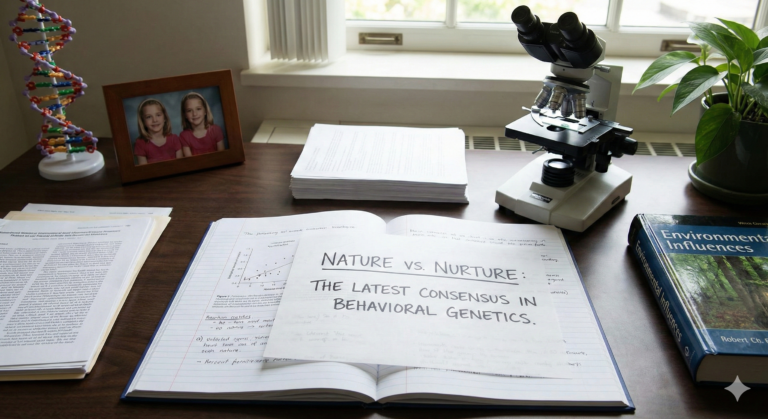
A realistic high-angle shot of a psychology researcher's wooden desk featuring a DNA double helix model, a microscope, a framed photo of identical twins, and an open notebook with handwritten text reading "Nature vs. Nurture: The Latest Consensus in Behavioral Genetics."

Nature vs Nurture in Behavioral Genetics: The Latest Consensus

  • Avatar photo
  • Posted byby Team Psychology
  • February 6, 2026
  • 3 min
  • Avatar photo
    • Share
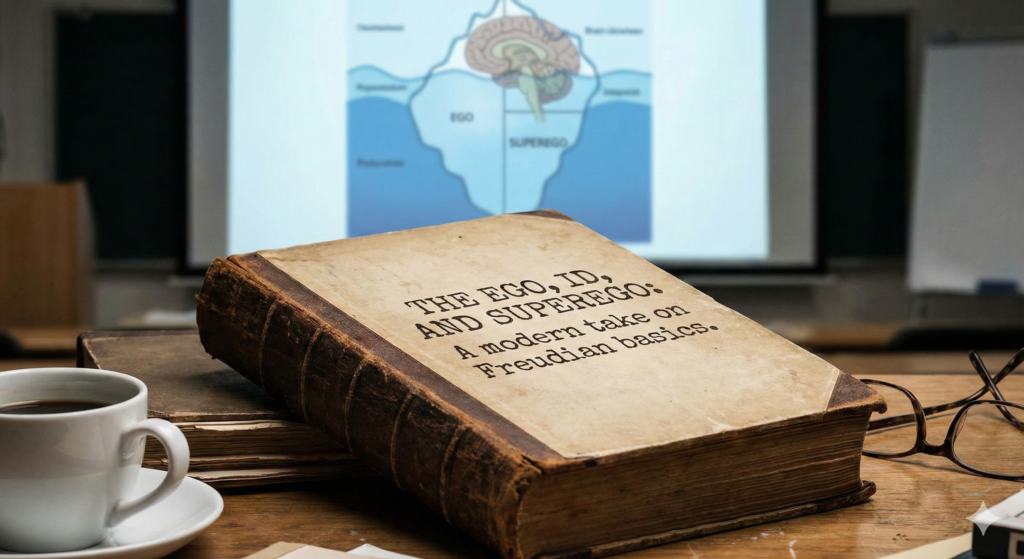
A vintage psychology textbook titled "The Ego, Id, and Superego" resting on a wooden desk, with a blurred diagram of Freud's iceberg model projected in the background.

The Ego, Id, and Superego: A Modern Take on Freudian Basics

  • Avatar photo
  • Posted byby Team Psychology
  • February 6, 2026
  • 3 min
  • Avatar photo
    • Share
A resilient tree growing on a rocky cliff overlooking a rough ocean as sunlight breaks through dark storm clouds. The text "POST-TRAUMATIC GROWTH: FINDING STRENGTH AFTER THE STORM" is displayed in white, sans-serif font across the top.

Post-Traumatic Growth: Finding Strength After the Storm

  • Avatar photo
  • Posted byby Team Psychology
  • February 6, 2026
  • 3 min
  • Avatar photo
    • Share
Cinematic recreation of the Stanford Prison Experiment showing a guard in sunglasses watching a prisoner, with the study title painted on the wall.

The Stanford Prison Experiment: Lessons Learned 50+ Years Later

  • Avatar photo
  • Posted byby Team Psychology
  • February 6, 2026
  • 3 min
  • Avatar photo
    • Share
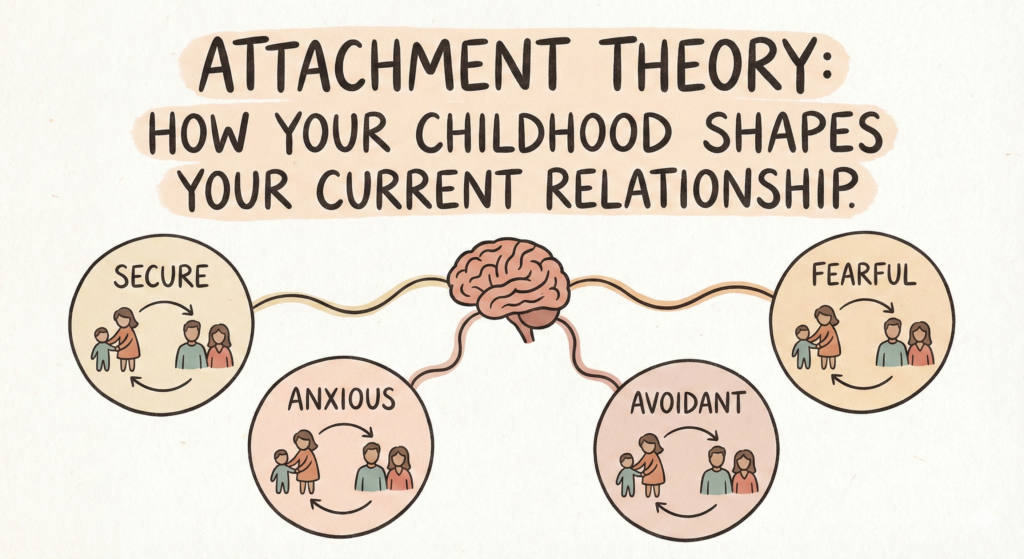
Hand-drawn infographic titled 'ATTACHMENT THEORY: HOW YOUR CHILDHOOD SHAPES YOUR CURRENT RELATIONSHIP.' A central brain connects via wavy lines to four circles labeled 'SECURE,' 'ANXIOUS,' 'AVOIDANT,' and 'FEARFUL,' each containing icons of a caregiver-child interaction and an adult couple with arrows showing relationship dynamics.

Attachment Theory: How Your Childhood Shapes Your Adult Relationships

  • Avatar photo
  • Posted byby Team Psychology
  • February 6, 2026
  • 3 min
  • Avatar photo
    • Share
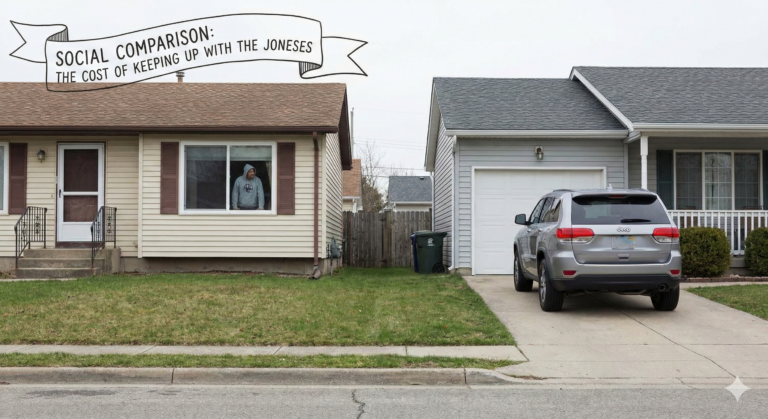
A realistic suburban scene illustrating Social Comparison Theory: a neighbor looking out their window at the luxury car in the driveway next door, representing the "Keeping up with the Joneses" psychological phenomenon.

Social Comparison Theory: The Cost of “Keeping Up with the Joneses”

  • Avatar photo
  • Posted byby Team Psychology
  • February 5, 2026
  • 4 min
  • Avatar photo
    • Share
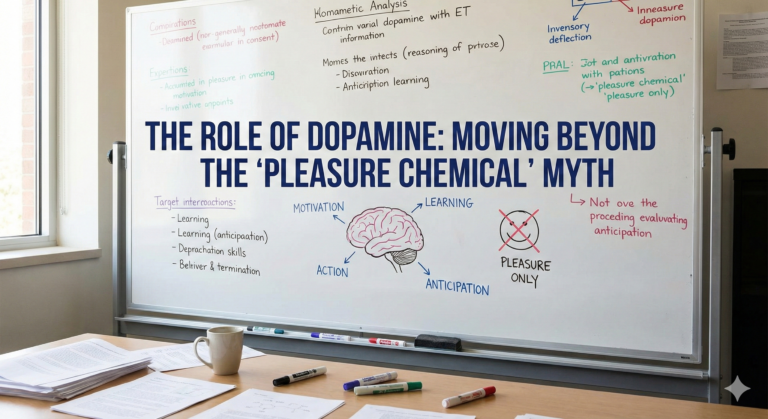
A white dry-erase board in a research setting, featuring the handwritten title "THE ROLE OF DOPAMINE: MOVING BEYOND THE 'PLEASURE CHEMICAL' MYTH". Below the title is a diagram of a brain with arrows pointing to "MOTIVATION," "LEARNING," "ACTION," and "ANTICIPATION," contrasting with a crossed-out smiley face labeled "PLEASURE ONLY". Other handwritten notes and definitions are visible around the main diagram.

The Role of Dopamine: Moving Beyond the “Pleasure Chemical” Myth.

  • Avatar photo
  • Posted byby Team Psychology
  • February 5, 2026
  • 3 min
  • Avatar photo
    • Share
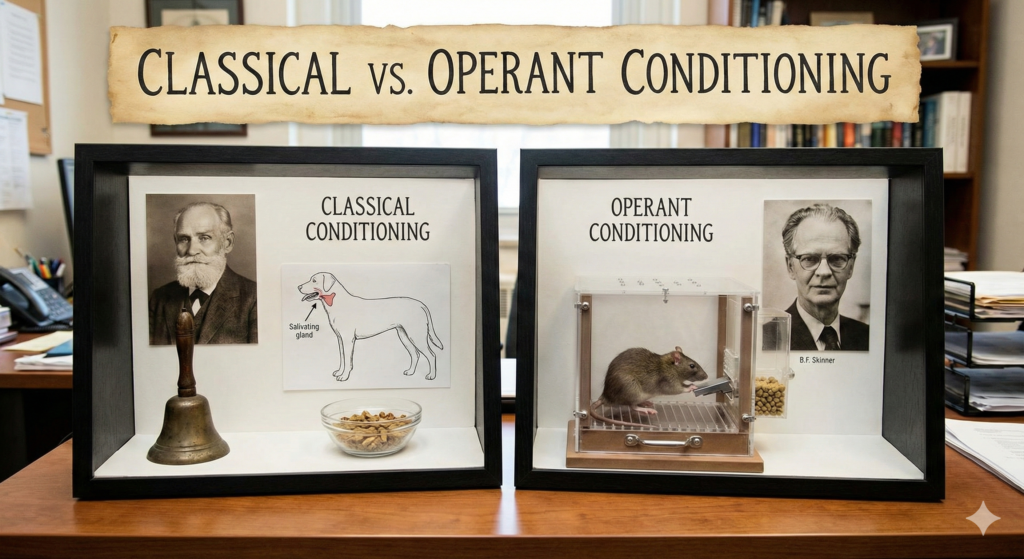
An image comparing two museum-style shadow boxes on a wooden desk, under a banner that reads "CLASSICAL VS. OPERANT CONDITIONING". The left box, labeled "CLASSICAL CONDITIONING," shows a portrait of Ivan Pavlov, a diagram of a dog with a salivating gland, a bell, and a bowl of food. The right box, labeled "OPERANT CONDITIONING," features a portrait of B.F. Skinner and a rat in a clear "Skinner box" pressing a lever for food pellets.

Classical vs. Operant Conditioning: How Our Habits Are Formed

  • Avatar photo
  • Posted byby Team Psychology
  • February 5, 2026
  • 3 min
  • Avatar photo
    • Share

Posts pagination

  • Newer Posts
  • 1
  • …
  • 21
  • 22
  • 23
  • 24
  • 25
  • …
  • 33
  • Older Posts

Trending

HOT RIGHT NOW

  • A woman sitting at a wooden desk looking contemplatively at a tablet screen. The image features a text overlay that reads: "AI and Empathy: Can a machine ever truly 'understand' us?"
    • Developmental Psychology
    Attachment in Infancy: Mary Ainsworth’s Strange Situation Protocol and Classification
    • Posted Team Psychology
    • 2 min
  • A realistic photograph of a home office setup featuring a laptop on a white desk, separated from a living room couch and bookshelf by a wooden slat room divider. A framed sign on the desk reads "WORK-FROM-HOME PSYCHOLOGY: MAINTAINING BOUNDARIES."
    • Developmental Psychology
    Language Acquisition: Noam Chomsky’s Universal Grammar vs. B.F. Skinner’s Verbal Behavior
    • Posted Team Psychology
    • 2 min
  • A woman smiling peacefully while washing dishes near a sunny window, illustrating the psychology of Mundane Joy and finding happiness in repetitive tasks.
    • Developmental Psychology
    Adolescent Brain Maturation: The Gap Between Limbic Reactivity and Prefrontal Executive Control
    • Posted Team Psychology
    • 2 min

Social

FOLLOW US

  • youtube
  • instagram
  • email
  • linkedin

Featured

Our best picks

  • A woman sitting at a wooden desk looking contemplatively at a tablet screen. The image features a text overlay that reads: "AI and Empathy: Can a machine ever truly 'understand' us?"
    • Developmental Psychology
    Attachment in Infancy: Mary Ainsworth’s Strange Situation Protocol and Classification
    • Posted Team Psychology
    • October 17, 2026
  • A realistic photograph of a home office setup featuring a laptop on a white desk, separated from a living room couch and bookshelf by a wooden slat room divider. A framed sign on the desk reads "WORK-FROM-HOME PSYCHOLOGY: MAINTAINING BOUNDARIES."
    • Developmental Psychology
    Language Acquisition: Noam Chomsky’s Universal Grammar vs. B.F. Skinner’s Verbal Behavior
    • Posted Team Psychology
    • October 17, 2026
  • A woman smiling peacefully while washing dishes near a sunny window, illustrating the psychology of Mundane Joy and finding happiness in repetitive tasks.
    • Developmental Psychology
    Adolescent Brain Maturation: The Gap Between Limbic Reactivity and Prefrontal Executive Control
    • Posted Team Psychology
    • October 17, 2026
before-footer-banner

Trending

Hot topics

  1. A woman sitting at a wooden desk looking contemplatively at a tablet screen. The image features a text overlay that reads: "AI and Empathy: Can a machine ever truly 'understand' us?"
    • Developmental Psychology
    Attachment in Infancy: Mary Ainsworth’s Strange Situation Protocol and Classification
    • Posted Team Psychology
    • October 17, 2026
  2. A realistic photograph of a home office setup featuring a laptop on a white desk, separated from a living room couch and bookshelf by a wooden slat room divider. A framed sign on the desk reads "WORK-FROM-HOME PSYCHOLOGY: MAINTAINING BOUNDARIES."
    • Developmental Psychology
    Language Acquisition: Noam Chomsky’s Universal Grammar vs. B.F. Skinner’s Verbal Behavior
    • Posted Team Psychology
    • October 17, 2026
  3. A woman smiling peacefully while washing dishes near a sunny window, illustrating the psychology of Mundane Joy and finding happiness in repetitive tasks.
    • Developmental Psychology
    Adolescent Brain Maturation: The Gap Between Limbic Reactivity and Prefrontal Executive Control
    • Posted Team Psychology
    • October 17, 2026

Popular

Top posts

  • A professional working from a home office looking at colleagues on a video conference call, with the title text "Remote Team Dynamics: Building trust through a screen" overlaid in the center.
    • Developmental Psychology
    Masked ADHD and Autism in Women: Gendered Camouflaging, Diagnostic Delay, and Mental Toll
    • Posted Team Psychology
    • 2 min
  • Gemini Generated Image 52u8fh52u8fh52u8 1
    • Developmental Psychology
    Diana Baumrind’s 4 Parenting Styles: Authoritative, Authoritarian, Permissive, and Neglectful Outcomes
    • Posted Team Psychology
    • 2 min
  • A person sits at a cluttered wooden desk with their head in their hands, appearing overwhelmed in front of an open laptop and notebooks. A whiteboard with handwritten tasks sits beside them. Large white text overlay reads: "The Psychology of Productivity: Why 'Busy' is not 'Effective.'"
    • Developmental Psychology
    Adverse Childhood Experiences (ACEs): Biological Embedding of Early Trauma in Adult Health
    • Posted Team Psychology
    • 2 min

Our Policies

  • Privacy Policy
  • Terms & Conditions
  • Medical Disclaimer
  • Editorial Policy
  • About Us
  • Contact Us

Our Products

  • Formal Psychology

  • PsiQ
  • Pavlov Shop
© Formal Psychology, All rights reserved | Powered by Novul Sphere