
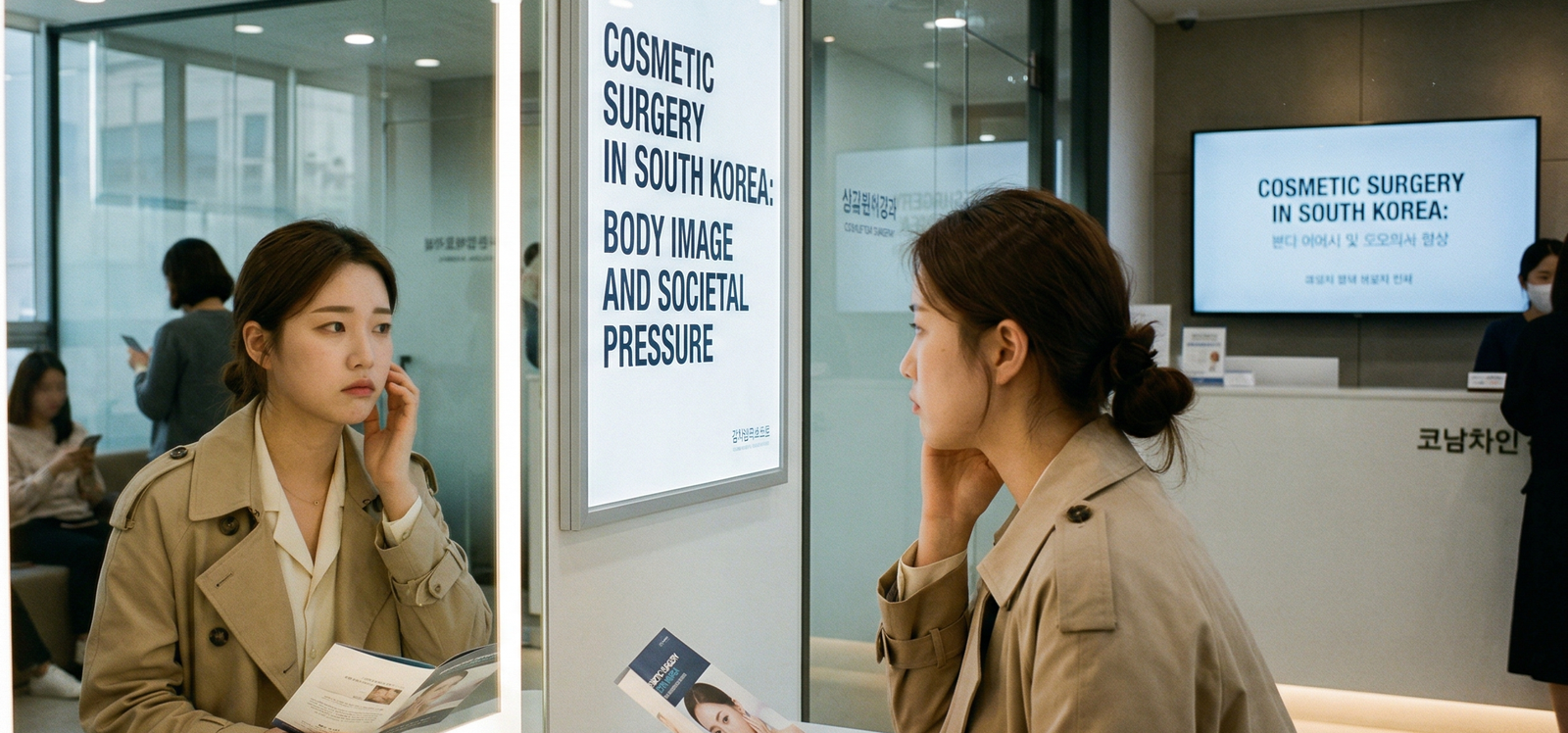
The phenomenon of cosmetic surgery in South Korea goes far beyond simple aesthetics; it is deeply rooted in complex psychological and societal pressures. While areas like Seoul’s affluent Gangnam district are lined with clinics and advertisements promoting physical transformation, dismissing this boom as mere vanity misses a crucial psychological reality.
For us at Formal Psychology, understanding this trend requires looking beyond the scalpel. It requires examining the profound intersection of societal pressure, competitive environments, and the heavy burden these factors place on individual body image and mental health.
The Cultural Phenomenon of “Lookism”
To truly understand cosmetic surgery in South Korea, one must first understand the concept of “lookism” (appearance-based discrimination). In many Western cultures, altering one’s appearance is often viewed through the lens of individual preference. In contrast, it is frequently perceived here as a highly practical tool for social and professional advancement.
For decades, the South Korean job market has been hyper-competitive. Until recent legislative changes, it was standard practice for job applicants to attach a photograph to their resume and provide their physical dimensions. This created a systemic environment where physical attractiveness was directly correlated with competence and employability. Psychologically, this shifts the motivation for surgery from narcissism to survivalism—a calculated investment in one’s future.
Media Influence and the Homogenization of Beauty
The global rise of the “Hallyu” wave (Korean pop culture) has heavily influenced beauty standards both domestically and internationally. K-pop idols and K-drama actors often share a highly specific, homogenized set of features:
From a psychological perspective, constant exposure to these idealized, heavily curated images creates a skewed baseline for what is considered “normal.” This triggers social comparison theory, where individuals determine their own social and personal worth based on how they stack up against others. When the “others” are mathematically perfected ideals, the resulting gap between the real self and the ideal self causes significant psychological distress.
Conformity vs. Individualism
Western psychology often links body modification to self-expression and individualism. In contrast, the psychological driver behind cosmetic surgery in South Korea is heavily tied to conformity. In a collectivist society, blending in and meeting societal expectations is highly valued.
Cosmetic procedures are often treated as a rite of passage. It is not uncommon for parents to gift their teenagers double-eyelid surgery upon graduating high school or entering university. The psychological message is clear: altering one’s body is not a rebellion, but a socially sanctioned method of fitting into the accepted mold and minimizing the risk of marginalization.
The Mental Health Toll: Beyond the Surface
While some studies indicate that physical alterations can offer a temporary boost in self-esteem, the relentless pursuit of perfection carries severe mental health risks:
- Body Dysmorphic Disorder (BDD): The hyper-focus on specific facial features and the normalization of surgical intervention can exacerbate or trigger BDD. Individuals may become obsessively preoccupied with perceived flaws that are unnoticeable to others.
- Anxiety and Depression: The pressure to maintain a certain look, coupled with the financial burden of these procedures, can lead to chronic anxiety. When self-worth is inextricably linked to a fleeting and narrow definition of beauty, emotional stability becomes incredibly fragile.
- The “Surgical Treadmill”: Psychologically, patients often experience a brief euphoria post-surgery, only to have their baseline of dissatisfaction reset, trapping the individual in a continuous loop of perceived inadequacy.
A Shifting Paradigm: “Escape the Corset”
It is crucial to note that this intense pressure is facing pushback. In recent years, South Korean women have spearheaded the “Escape the Corset” movement. This feminist and psychological awakening involves women destroying their makeup, cutting their hair short, and publicly rejecting the rigorous, time-consuming, and expensive beauty standards imposed upon them.
This movement represents a profound psychological shift—reclaiming cognitive bandwidth and financial resources previously drained by the pursuit of an impossible ideal. It signals a growing awareness of the mental health toll of lookism and a demand for a society that values individuals for their minds and character rather than just their appearance.
Conclusion
The high prevalence of cosmetic surgery in South Korea is a fascinating, if troubling, case study in cultural psychology. It highlights how societal structures, economic competition, and media saturation can fundamentally alter a population’s relationship with their own bodies. As the conversation around mental health continues to evolve globally, addressing the root causes of appearance-based pressure remains essential for fostering genuine, lasting psychological well-being.