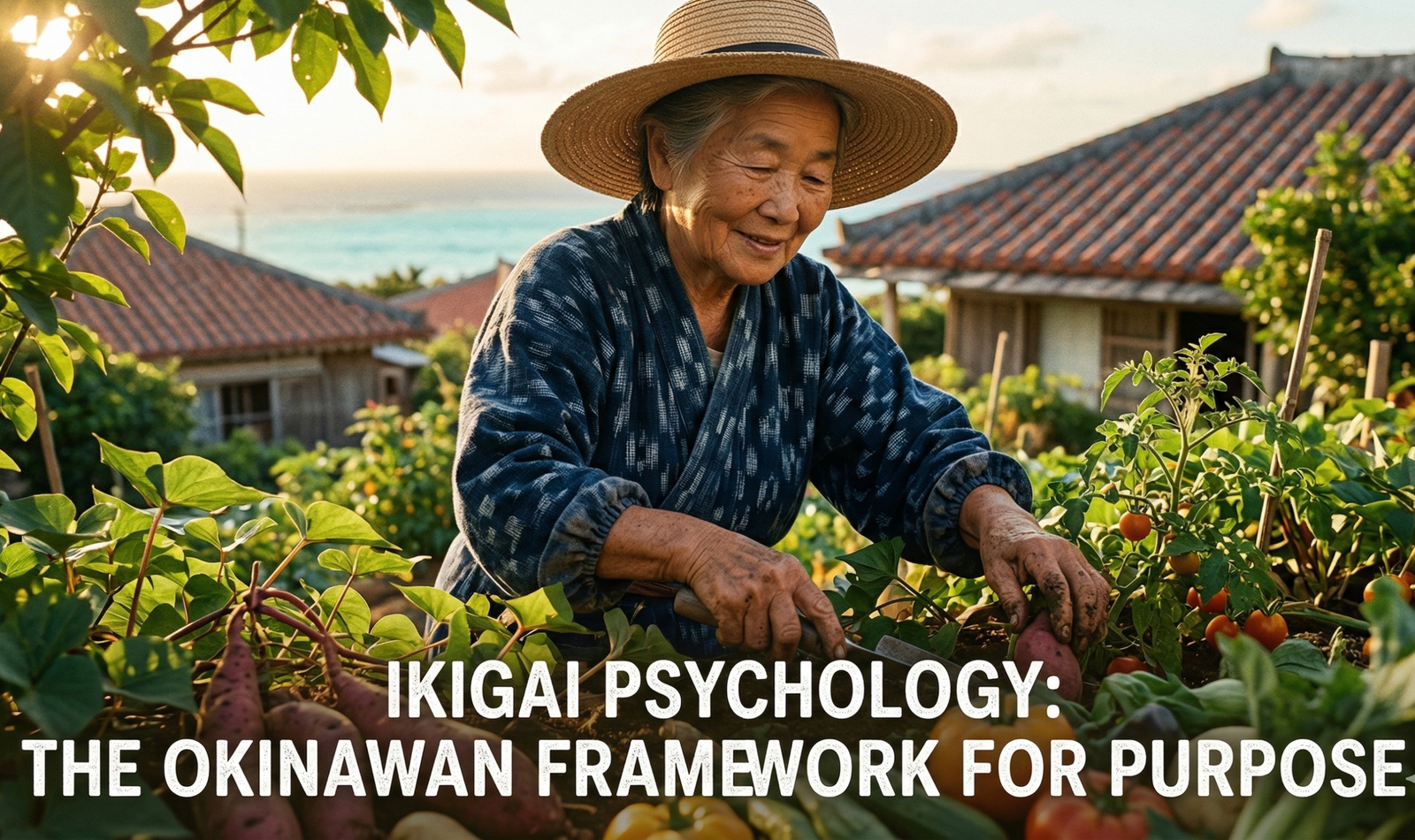

In the pursuit of mental well-being, clinical science has long grappled with the concept of “meaning.” From Viktor Frankl’s Logotherapy to modern Positive Psychology, the consensus is clear: humans require a sense of purpose to thrive. However, on the Japanese island of Okinawa—a designated “Blue Zone” renowned for its high concentration of centenarians—purpose is not an abstract clinical concept. It is a daily, lived experience. For readers of Formal Psychology, understanding Ikigai psychology offers a profound shift in how we conceptualize intrinsic motivation, resilience, and longevity.
It is not merely a philosophical buzzword; it is a robust psychological framework for a life well-lived.
Deconstructing Ikigai: More Than Just a Venn Diagram
The term Ikigai (生き甲斐) translates roughly to “a reason for being” or, more colloquially, “the reason to get up in the morning.” Iki means “life,” and gai describes “value” or “worth.”
In Western media, Ikigai is frequently misrepresented as a four-circle Venn diagram combining what you love, what you are good at, what the world needs, and what you can be paid for.
Psychological Insight: While this Venn diagram is a useful tool for career counseling, it is not traditional Ikigai. True Ikigai psychology is not inherently tied to economic value or grand global impact.
From a clinical standpoint, traditional Ikigai is micro-focused. It is about finding joy, flow, and mindfulness in the present moment. It can be found in sweeping the porch, tending to a garden, mastering a quiet hobby, or sharing a cup of tea with a friend.
The Core of Ikigai Psychology: Overlapping with Logotherapy
To fully grasp Ikigai psychology, we must look at its parallels with psychiatrist Viktor Frankl’s work. In his development of Logotherapy, Frankl argued that humanity’s primary motivational force is the search for meaning.
Ikigai mirrors Logotherapy in several profound ways, but it diverges in its application. While Logotherapy often helps individuals find meaning in spite of suffering, the Okinawan framework focuses on cultivating meaning through the proactive appreciation of daily life.
When an individual possesses a strong sense of Ikigai, they exhibit higher levels of:
- Intrinsic Motivation: Engaging in behaviors because they are naturally rewarding, rather than for external validation.
- Cognitive Resilience: The ability to withstand neurological decline and psychological stress.
- Eudaimonic Well-being: A type of happiness derived from personal growth and meaning, rather than transient pleasure (hedonic well-being).
Ikigai and Longevity: The Mind-Body Connection
Okinawa’s status as a Blue Zone provides empirical backing for the psychosomatic benefits of Ikigai psychology. The psychological state of having a purpose directly impacts physiological health.
1. Stress Reduction and Cortisol
Having a clear, manageable daily purpose lowers chronic anxiety. When individuals are absorbed in their Ikigai, they frequently enter a state of “flow.” Flow states naturally reduce the production of cortisol, lowering the risk of stress-related cardiovascular issues.
2. The Role of “Moai” (Community)
In Okinawa, purpose is heavily intertwined with Moai—social support groups that form in childhood and last a lifetime. Psychologically, this satisfies the fundamental human need for belongingness. The interplay between individual purpose and social connection creates a powerful buffer against depression and isolation.
How to Cultivate Your Ikigai
Finding your Ikigai does not require a dramatic life overhaul. From a psychological perspective, it is about shifting cognitive framing. Here are practical ways to begin:
- Conduct a “Flow” Audit: Track your week and note the moments where you lose track of time. What activities absorb you completely? These are clues to your Ikigai.
- Decouple Worth from Productivity: Practice engaging in an activity purely for the sake of the activity itself, completely divorced from financial gain or social media validation.
- Embrace Community: Nurture deep, low-stakes relationships. Your Ikigai might simply be your role as a supportive friend, a dedicated parent, or a community volunteer.
- Practice Micro-Gratitude: Upon waking, identify one incredibly small thing you are looking forward to that day—the smell of coffee or a morning walk.
Conclusion
Ikigai offers a refreshing, sustainable alternative to the exhausting modern pursuit of “finding your passion.” By viewing purpose through the lens of Ikigai psychology, we realize that meaning does not have to be a grand, lucrative, world-changing endeavor. It is quiet, deeply personal, and rooted in the present moment. Cultivating your Ikigai is not just a secret to a longer life; it is the blueprint for a profoundly richer one.