
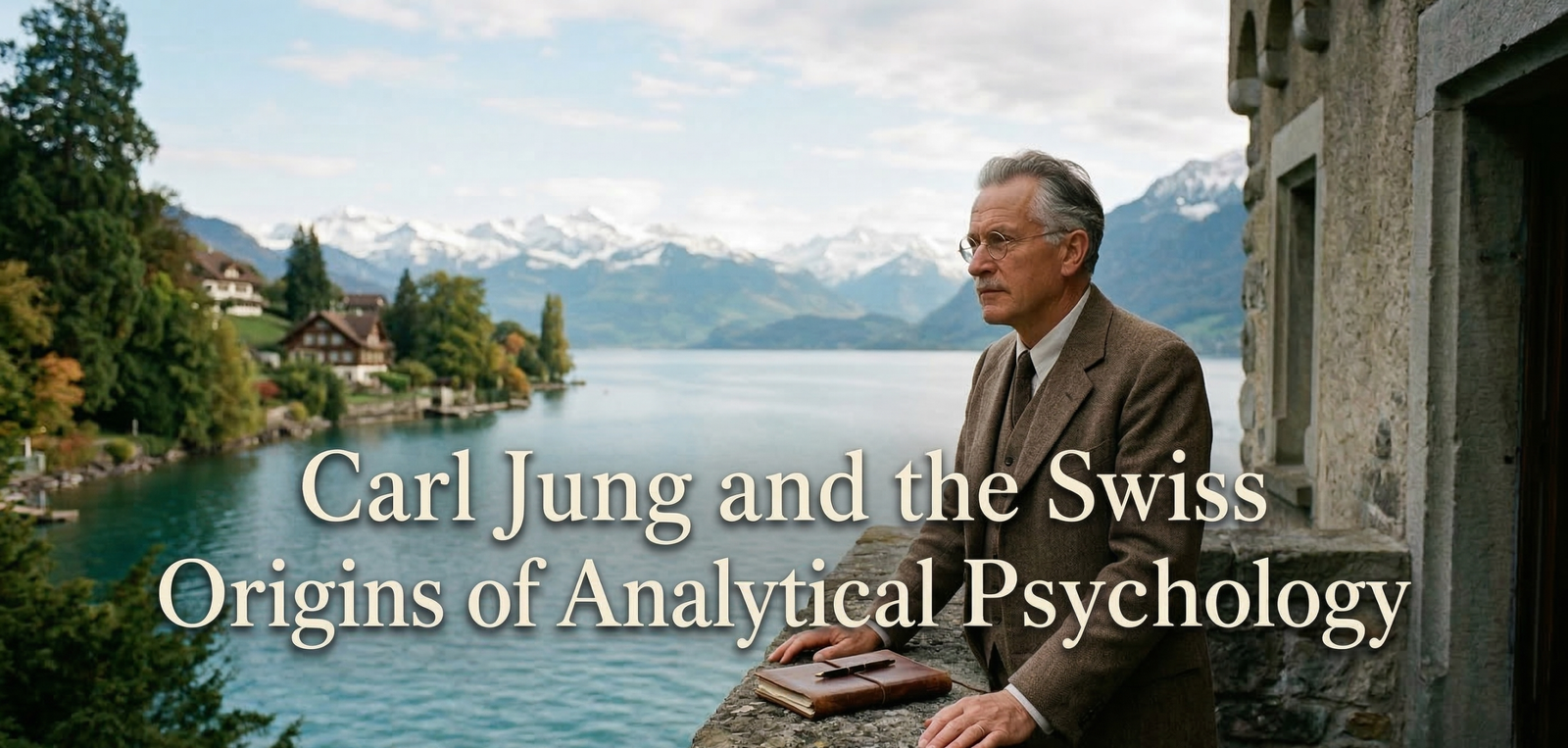

When exploring the depths of the human mind, the Swiss origins of Carl Jung Analytical Psychology offer a fascinating journey into how we understand the unconscious today. Born in Kesswil, Switzerland, in 1875, Carl Gustav Jung developed a psychological framework that diverged significantly from the traditional psychoanalysis of his time. His unique environment, rigorous psychiatric training in Zurich, and eventual break from Sigmund Freud culminated in a profoundly influential school of thought that continues to shape modern psychology.
The Swiss Foundation: The Burghölzli Hospital
To understand Carl Jung Analytical Psychology, one must look at his formative years at the Burghölzli Psychiatric Hospital in Zurich. Under the direction of the prominent psychiatrist Eugen Bleuler (who coined the term “schizophrenia”), Jung was immersed in a scientifically rigorous yet open-minded Swiss medical tradition.
Unlike the purely theoretical approaches of some contemporaries, Jung’s work at Burghölzli involved empirical research. He developed the Word Association Test, which provided measurable evidence for the existence of “complexes”—emotionally charged groups of ideas in the unconscious. This distinctly Swiss blend of empirical research and deep psychiatric care laid the essential groundwork for his later theories.
The Departure from Freudian Psychoanalysis
Initially, Jung and Sigmund Freud shared a close professional relationship, with Freud viewing the Swiss psychiatrist as his intellectual heir. However, Carl Jung Analytical Psychology was born out of a fundamental ideological split between the two thinkers, finalizing their separation around 1913.
While Freud argued that the unconscious was primarily a repository for repressed sexual desires and personal traumas, Jung viewed it as something far more expansive and creative. Jung broadened the concept of “libido” from strictly sexual energy to a generalized life force or psychic energy that motivates a wide range of human behaviors, including spiritual and creative pursuits.
Core Concepts of Carl Jung Analytical Psychology
After his break with Freud, Jung experienced a period of intense introspection, leading to the crystallization of his own psychological framework. The defining pillars of Carl Jung Analytical Psychology include:
1. The Personal and Collective Unconscious
Jung proposed a three-tiered model of the human psyche:
- The Ego: The conscious mind.
- The Personal Unconscious: Similar to Freud’s concept, this contains an individual’s repressed memories, forgotten experiences, and personal complexes.
- The Collective Unconscious: Jung’s most revolutionary contribution. He proposed a deep, underlying layer of the psyche shared by all human beings. It contains universal, inherited blueprints of experience, which are not shaped by personal history but by the evolutionary history of humanity.
2. Archetypes
Within the collective unconscious reside “archetypes”—universal, primal symbols and images that influence our thoughts, feelings, and behaviors. These patterns emerge across cultures in myths, dreams, and religions. Key archetypes include:
- The Persona: The “mask” or social face we present to the world to conform to societal expectations.
- The Shadow: The dark, hidden, and often repressed aspects of our personality that we refuse to acknowledge.
- The Anima/Animus: The unconscious feminine side in men (Anima) and the unconscious masculine side in women (Animus).
- The Self: The unifying center of the psyche, representing the harmony and balance of the conscious and unconscious.
3. Psychological Types
Jung also introduced the concepts of introversion and extraversion, proposing that psychic energy flows either inward toward subjective experience or outward toward the objective world. He combined these attitudes with four primary functions (thinking, feeling, sensation, and intuition) to create a comprehensive system of psychological types, which later inspired the Myers-Briggs Type Indicator (MBTI).
4. The Process of Individuation
The ultimate goal of Carl Jung Analytical Psychology is “individuation.” This is a lifelong psychological process of integrating the conscious and unconscious parts of the psyche. By confronting the Shadow, embracing the Anima/Animus, and striving toward the Self, an individual achieves profound psychological wholeness and self-realization.
The Lasting Legacy of Jung’s Work
The Swiss origins of Carl Jung Analytical Psychology remind us that the human psyche is not just a product of personal childhood experiences, but a rich tapestry woven from the history of human existence. From his early empirical work in Zurich to his deep explorations of mythology, alchemy, and eastern philosophies, Jung created a psychology that honors the spiritual and deeply symbolic nature of human life. Today, his theories remain a vital cornerstone for clinicians, researchers, and anyone on the path to self-discovery.