

When we study the history of psychology, our minds immediately jump to the year 1879, when Wilhelm Wundt established the first experimental psychology laboratory in Leipzig, Germany. While Wundt rightfully holds the title of the “Father of Modern Psychology,” the study of the human mind and behavior did not simply appear out of nowhere in the 19th century.
Long before laboratories and controlled experiments, the foundations of psychology were being laid in the Pre-Scientific Era. To truly understand how we got here, we must travel back thousands of years to Ancient Egypt and Ancient Greece, where early physicians and philosophers were already attempting to decode the mysteries of the brain and soul.
The Dawn of Neuroscience: Ancient Egypt and the Edwin Smith Papyrus
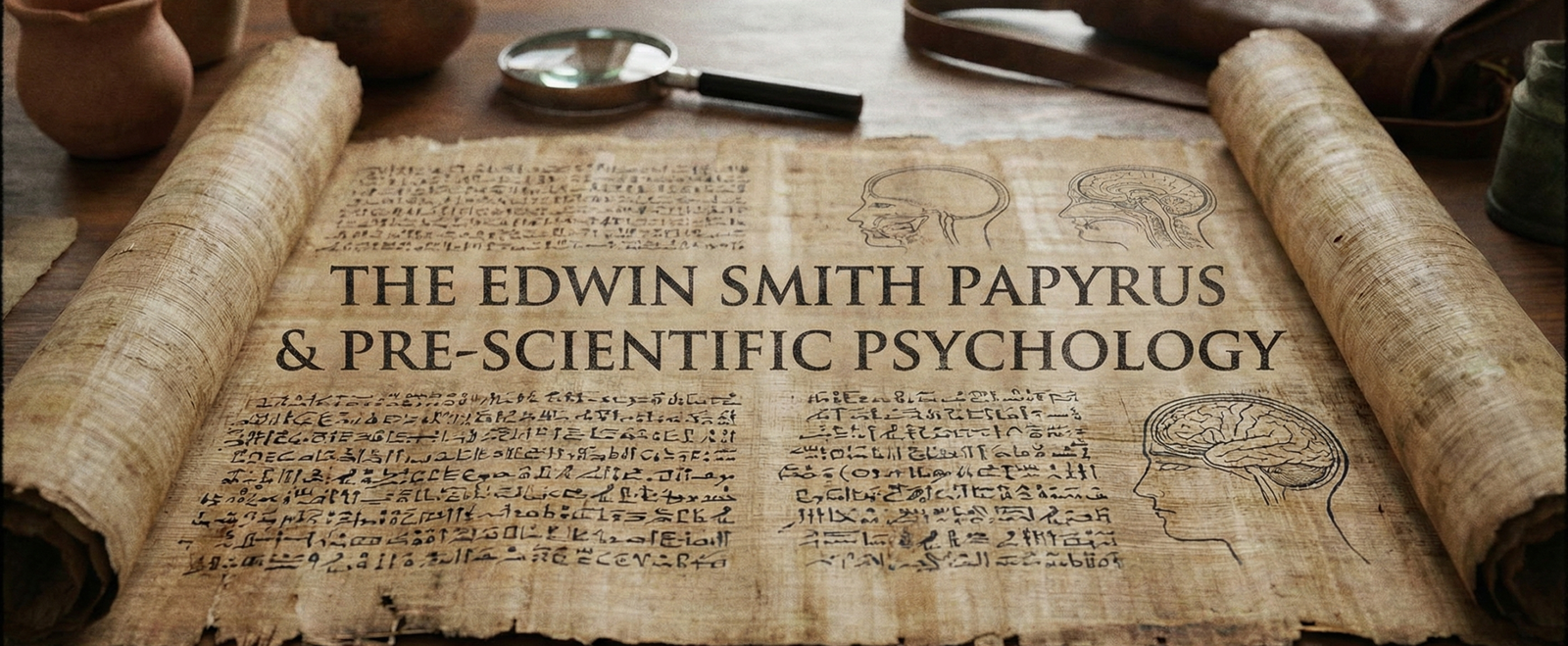
For centuries, humanity held a cardiocentric view—the belief that the heart was the seat of intelligence, emotion, and consciousness. Ancient Egyptians meticulously preserved the heart during mummification while famously discarding the brain. However, a revolutionary document changed our understanding of ancient medical knowledge: The Edwin Smith Papyrus.
Dating back to approximately 1600 BCE (with its original contents believed to stem from 3000 BCE during the Old Kingdom), this ancient text is widely attributed to the great Egyptian polymath and physician Imhotep.
Why is the Edwin Smith Papyrus Crucial for Psychology?
Unlike other medical texts of its time (such as the Ebers Papyrus), which relied heavily on magic, spells, and demonology to explain human ailments, the Edwin Smith Papyrus was purely rational, scientific, and observational. It was essentially a battlefield trauma manual, but its psychological implications were staggering:
- The First Written Record of the “Brain”: This papyrus holds the distinction of being the first document in human history to explicitly use the word “brain” (represented by a specific hieroglyph). It shifted the focus toward a cephalocentric view—the idea that the head controls the body.
- Contralateral Control: Through the observation of 48 distinct medical cases (27 of which were head traumas), the author noted that an injury to the right side of the brain caused paralysis on the left side of the body, and vice versa. This is the earliest recorded understanding of the brain’s crossed pathways.
- Early Localization of Function: The papyrus documented cases where head trauma led to aphasia (the loss of the ability to speak). This demonstrated an early understanding that specific areas of the brain govern specific behavioral functions.
- Neuroanatomy: The text remarkably describes the meninges (the membranes enveloping the brain), the cerebrospinal fluid (CSF), and the convolutions (the folded surface) of the brain.
The Philosophical Roots: Ancient Greece
While Egypt was laying the groundwork for clinical observation and neuroscience, Ancient Greece was cultivating the philosophical and theoretical roots of psychology. The Greeks approached the human mind through logic, reasoning, and the concept of the soul (psyche).
1. Socrates and Plato: Introspection and Dualism
Socrates famously urged his students to “know thyself,” championing the method of introspection—looking inward to examine one’s own thoughts and emotions. This remains a cornerstone of modern psychotherapy.
His student, Plato, introduced the concept of Dualism, arguing that the mind (soul) and the body are distinct entities. Plato also proposed a tripartite theory of the soul, dividing it into:
- Reason (Logic/Brain)
- Spirit (Courage/Emotions/Heart)
- Appetite (Basic Desires/Stomach) (A concept that eerily foreshadowed Sigmund Freud’s later division of the psyche into the Id, Ego, and Superego).
2. Aristotle: Empiricism and Monism
Plato’s student, Aristotle, took a different approach. In his seminal work, De Anima (On the Soul), he advocated for Monism—the belief that the mind and body are inseparable, like wax and the shape stamped onto it. Aristotle is often considered an early empiricist, arguing that knowledge is not innate but acquired through sensory experience and observation.
3. Hippocrates: The Biological Bridge
Hippocrates, known as the “Father of Medicine,” bridged the gap between Greek philosophy and biology. He vehemently rejected the idea that mental illnesses (like epilepsy) were punishments from the gods. Instead, he argued that all thoughts, emotions, and mental disorders originated in the brain.
Hippocrates introduced the Four Humors Theory, suggesting that physical and mental health relied on the balance of four bodily fluids:
- Blood: Cheerful and optimistic (Sanguine)
- Phlegm: Calm and sluggish (Phlegmatic)
- Black Bile: Depressed and melancholic (Melancholic)
- Yellow Bile: Aggressive and irritable (Choleric)
While factually incorrect by modern standards, this was a massive leap forward. It was the first time personality traits and mental health were systematically linked to internal biology and chemical imbalances.
Conclusion: The Convergence of Two Paths
The history of psychology is not a single, straight line starting in 1879. It is a rich tapestry woven from two distinct ancient threads. Ancient Egypt, via the Edwin Smith Papyrus, gave us the biological and observational foundations—the understanding that the physical brain governs behavior. Ancient Greece gave us the philosophical framework—the vocabulary to discuss consciousness, logic, and human nature.
Today, modern psychology thrives exactly at the intersection of these two ancient worlds: it is the empirical science of the brain and the profound study of the human mind.