

Psychology involves a wide array of factors regarding what humans do. It presents a number of major principles underlying human actions and behavior, giving us a rational basis to understand what we—and others—do on a daily basis.
But what exactly is it? At its core, psychology is the scientific study of the behaviors and mental processes of humans and animals. This fascinating field not only helps us understand the mechanics of the mind but also gives us a sense of our limitations—what we currently know and the massive distance we have yet to go to truly understand why individuals do what they do.
Here is a complete breakdown of the concept of psychology, its goals, and why it stands as a crucial scientific discipline today.
The Core Definition: Behavior and Mental Processes
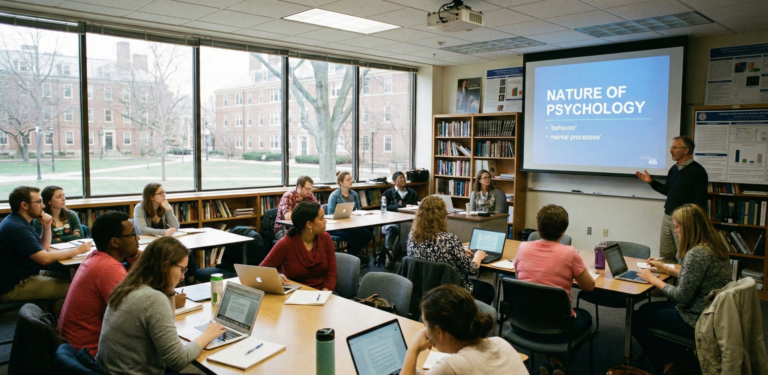
The standard, textbook definition states that psychology is the scientific study of behavior and mental processes. To fully grasp this, we must break down its two primary components:
- Behavior: This covers everything an organism does that can be directly observed and measured. Whether it is crying, hitting, smiling, sleeping, or running, if it is an outward action, it is classified as a behavior.
- Mental Processes: This covers our internal, subjective experiences that cannot be directly seen by others. Mental processes include thinking, feeling, remembering, dreaming, and perceiving.
Importantly, psychology does not limit itself solely to human beings; it also encompasses the study of animal behavior, which often provides vital insights into our own evolutionary habits and psychological foundations.
The Goals of Psychology
Psychology does not merely observe human nature for the sake of curiosity; it is driven by four foundational goals:
- To Describe: The first step in understanding behavior is to accurately describe it. By observing how individuals respond to different situations, psychologists can distinguish between normal and abnormal behaviors.
- To Explain: After describing a behavior, psychologists seek to understand why it happens. This involves identifying the underlying principles and finding patterns in human actions.
- To Predict: Once patterns are established, psychologists can anticipate how individuals might act in future situations.
- To Change (or Control): The ultimate goal is to apply this knowledge to improve lives. By understanding the roots of behavior, professionals can intervene to change negative patterns, treat mental health conditions, and enhance overall well-being.
Why Do We Need Psychology?
We don’t just study humans for fun; we study them to find patterns and principles that govern life. If we can figure out why someone acts aggressively, or why another person feels paralyzed by anxiety, we can create rational, logical solutions.
The need for psychology arises from our desire to improve the human condition. It provides the framework for therapy, informs educational practices, shapes public policy, and even helps us design safer, more efficient workplaces. Without psychology, we would lack the tools to address mental health crises, resolve interpersonal conflicts, or understand the deep-seated motivations behind human actions.
Why Psychology is a Science
A common misconception is that psychology consists of people sitting in armchairs guessing about human nature. In reality, it is a rigorous science grounded in empirical evidence.
The Scientific Method
How do we learn about human behavior? We do it by means of the scientific method. Psychologists observe a problem, make an educated guess (a hypothesis), run rigorous and controlled experiments (research), and invite other scientists to scrutinize their work to ensure it is accurate (peer review and self-criticism).
The Humility of Science
Perhaps the most important aspect of psychology as a science is its humility. The human brain is widely considered the most complex structure in the known universe. Good psychologists know that our current knowledge is limited. The science of psychology is constantly evolving; it acknowledges the boundaries of what is currently known while systematically pushing forward to discover more. It relies on careful observation rather than assumption, ensuring that every new discovery is rooted in hard data.