
Understanding human behavior and cognition requires a deep dive into the biological machinery that makes it all possible. In biopsychology and neuroscience, the cranial nerves serve as the crucial communication lines between the brain and the body. Among these twelve pairs of nerves, the trochlear nerve, also known as Cranial Nerve IV (CN IV), holds a uniquely specialized role.
While it may be the smallest cranial nerve in terms of the number of axons it contains, its precise control over eye movement makes it essential for how we visually interact with and perceive the world around us.
What is the Trochlear Nerve?
The trochlear nerve is a somatic efferent (motor) nerve. Unlike some cranial nerves that handle both sensory input and motor output, the trochlear nerve has one highly specific job: it provides motor supply to a single muscle in the eye called the superior oblique muscle.
Unique Anatomical Features
The trochlear nerve is famous among neuroanatomists for a few fascinating structural quirks:
- Smallest but Longest: It is the smallest cranial nerve by axon count, yet it has the longest intracranial length (the distance it travels within the skull).
- Dorsal Exit: It is the only cranial nerve that emerges from the dorsal (back) aspect of the brainstem.
- Contralateral Control: The fibers of the trochlear nerve cross over (decussate) before exiting the brainstem. This means that the trochlear nucleus in the right side of the brain controls the left eye, and vice versa.
Pathway of the Trochlear Nerve
To understand how the brain commands the eyes, we have to trace the nerve’s journey:
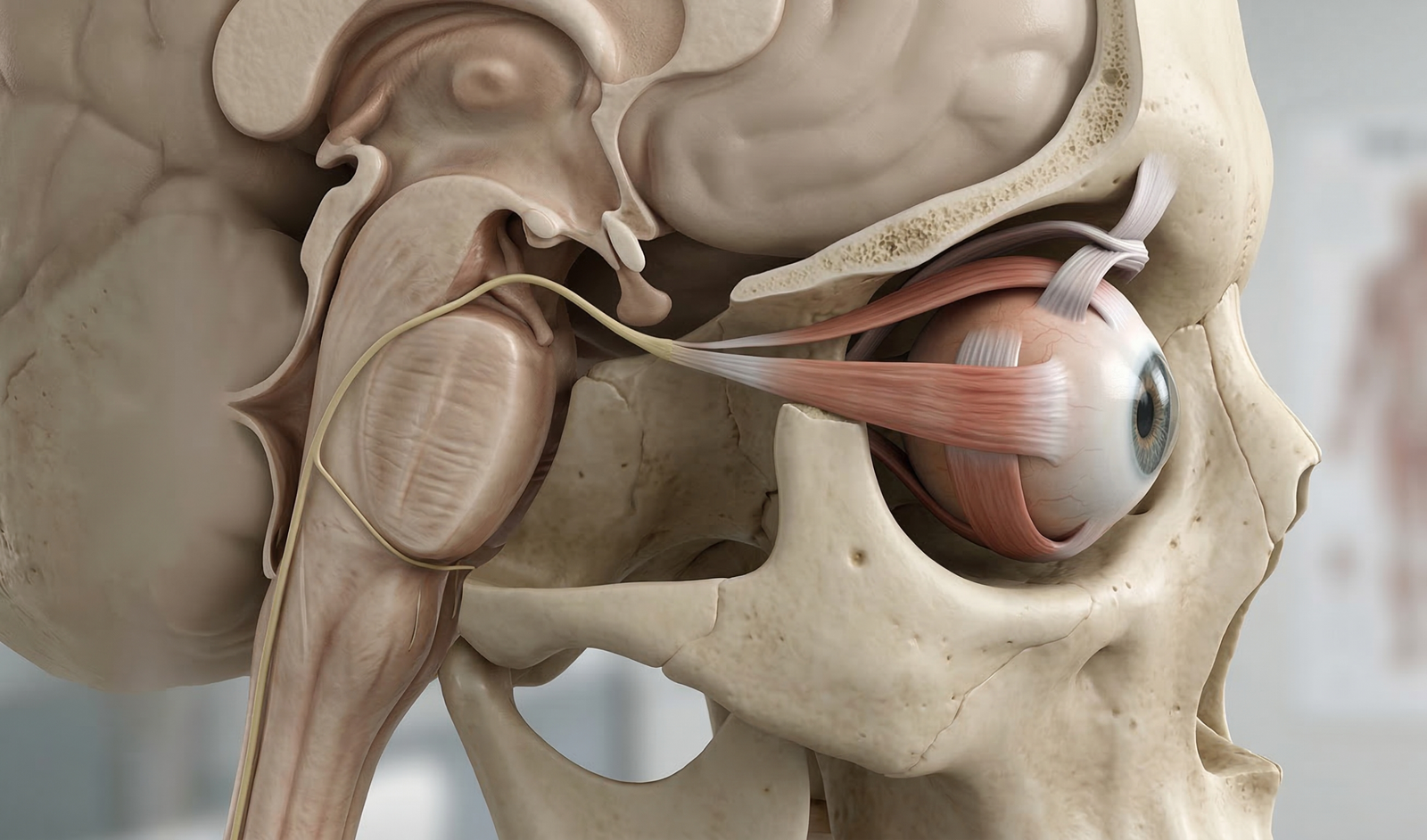
- Origin: It originates in the trochlear nucleus, located in the midbrain (part of the brainstem) just below the nucleus of the oculomotor nerve.
- Decussation: Immediately after leaving the nucleus, the nerve fibers cross to the opposite side of the brain.
- Exit and Travel: It exits the back of the brainstem, wraps around the midbrain, and travels forward through the subarachnoid space.
- Destination: It enters the eye socket (orbit) through the superior orbital fissure and finally connects to the superior oblique muscle.
The Superior Oblique Muscle: What Does It Do?
Because the trochlear nerve only controls the superior oblique muscle, understanding the nerve means understanding this muscle’s movements. The superior oblique muscle operates like a pulley system (the word trochlea actually means “pulley” in Latin).
It allows the eye to perform three distinct movements:
- Depression: Looking downward (especially when the eye is turned inward toward the nose).
- Intorsion: Rotating the top of the eye inward toward the nose.
- Abduction: Moving the eye slightly outward away from the nose.
Everyday Example: You rely heavily on your trochlear nerve when you look down and inward to read a book, walk down a flight of stairs, or check your phone.
Clinical and Psychological Relevance: Trochlear Nerve Palsy
When the trochlear nerve is damaged—whether by head trauma, microvascular issues (like diabetes), or congenital defects—it results in a condition known as Trochlear Nerve Palsy.
From a psychological and behavioral standpoint, the effects of this palsy are profound:
- Vertical Diplopia (Double Vision): Because the affected eye cannot properly look down and in, the brain receives misaligned visual inputs. This results in vertical double vision, which can be highly disorienting, causing dizziness, nausea, and significant anxiety or distress for the patient.
- Compensatory Head Tilt: To correct the double vision and bring the visual fields back into alignment, individuals with trochlear nerve palsy will unconsciously tilt their head away from the affected side, tuck their chin, and slightly turn their face. Over time, this chronic behavioral adaptation can lead to severe neck pain and muscle spasms.
- Cognitive Load: Constantly dealing with visual misalignment takes a toll on cognitive resources. The brain must work overtime to process conflicting sensory information, which can lead to fatigue, difficulty concentrating, and a decrease in reading comprehension.
Conclusion
The trochlear nerve perfectly illustrates the intricate connection between anatomy and our experience of reality. Though it controls just one muscle, Cranial Nerve IV is essential for seamless visual tracking and depth perception. For students and enthusiasts of psychology, studying structures like the trochlear nerve highlights how even the smallest neurological components profoundly shape our interaction with the environment.