
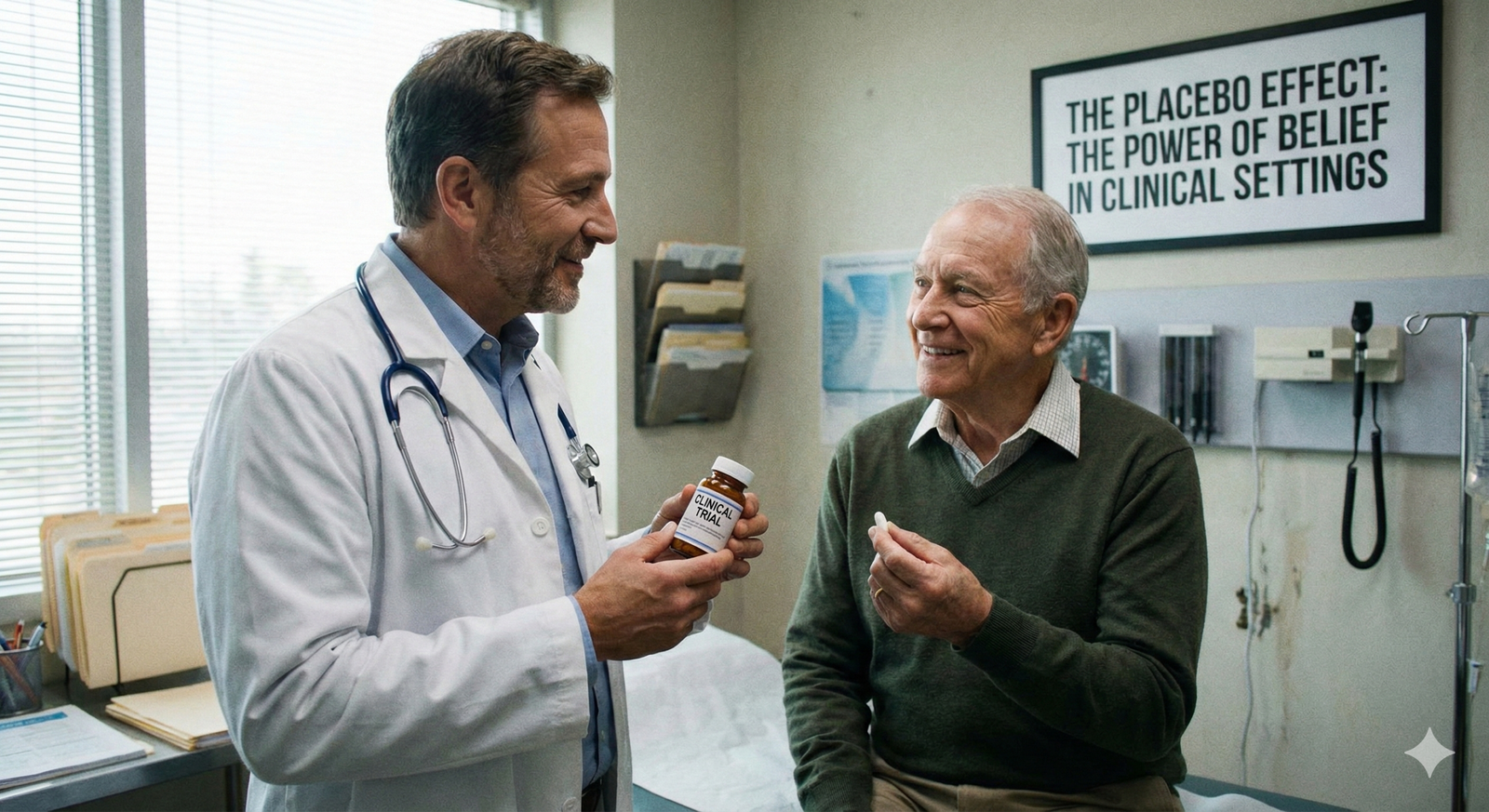

In the world of medical science and psychology, few phenomena are as fascinating—or as misunderstood—as the Placebo Effect. Often dismissed in casual conversation as “just in your head,” the placebo effect is actually a powerful, measurable psychobiological event. It demonstrates that the mind’s anticipation of healing can trigger genuine physiological changes in the body.
For clinicians and psychologists, understanding this mechanism is not just about experimental control; it is about harnessing the power of belief to optimize patient care.
What is the Placebo Effect?
At its core, the placebo effect occurs when a patient experiences a beneficial health outcome resulting from a substance or treatment that has no therapeutic effect (such as a sugar pill or saline injection).
Crucially, the improvement is not caused by the chemical composition of the pill, but by the patient’s belief that they are receiving treatment. This phenomenon challenges the traditional biomedical view that healing is solely mechanical, highlighting the profound mind-body connection.
The Mechanisms: Why Does It Work?
The placebo effect is not magic; it is biology. Research in formal psychology and neuroscience has identified several key mechanisms that drive this phenomenon:
1. Expectancy Theory
The most prominent psychological theory is expectancy. When a patient expects to get better, the brain initiates a cascade of cognitive and neural processes to match that expectation. If you believe a pill will reduce pain, your brain recruits the prefrontal cortex to modulate pain processing before the “medicine” even dissolves.
2. Classical Conditioning
Using Pavlovian principles, we are conditioned to associate medical rituals with relief.
- The Stimulus: A white coat, the smell of antiseptic, a syringe, or a pill bottle.
- The Response: The body prepares for healing. Over a lifetime, these cues automatically trigger physiological relaxation and symptom relief, independent of the drug itself.
3. Neurobiology and Neurotransmitters
This is where the psychology becomes physical. Brain imaging studies (fMRI) show that the placebo effect activates specific pathways in the brain.
- Endogenous Opioids: Belief can trigger the release of the brain’s natural painkillers (endorphins).
- Dopamine: Particularly in conditions like Parkinson’s disease, the expectation of therapeutic benefit releases dopamine in the striatum, improving motor function.
The “Evil Twin”: The Nocebo Effect
Just as positive expectations can heal, negative expectations can harm. This is known as the Nocebo Effect.
If a patient is warned about potential side effects (e.g., nausea, headaches) or distrusts the clinician, they are significantly more likely to experience those negative symptoms, even if given an inert substance. The nocebo effect highlights the critical importance of how doctors and therapists communicate risks to patients.
Factors Influencing the Power of Belief
Not all placebos are created equal. Psychology research suggests that the context of the treatment dramatically alters its effectiveness:
- Invasiveness: Injections generally produce a stronger placebo response than pills; surgery produces a stronger response than injections.
- Price: Expensive treatments are often perceived as more effective than cheap ones.
- Color: In studies, red pills are often associated with stimulation, while blue pills are associated with sedation/calming.
- The Practitioner: A warm, empathetic, and confident provider elicits a much stronger placebo response than a cold or uncertain one. This underscores the clinical value of the therapeutic alliance.
The New Frontier: Open-Label Placebos
For decades, it was believed that deception was necessary for the placebo effect to work (i.e., the patient must think it is a real drug). However, groundbreaking research has introduced the concept of Open-Label Placebos (OLPs).
In these scenarios, patients are told: “This is a sugar pill. It has no medicine. However, it helps many people because of the mind-body connection.” Surprisingly, studies show that OLPs still provide significant relief for conditions like Irritable Bowel Syndrome (IBS) and chronic back pain. This suggests that the ritual of taking a pill and the body’s subconscious conditioning are powerful enough to bypass the need for deception.
Clinical Implications
For the readers of Formal Psychology, the implications are clear:
- The Gold Standard: Placebo-controlled trials remain essential to distinguish the biochemical effects of a drug from the psychological effects of the ritual.
- Augmenting Therapy: Clinicians should not view the placebo effect as a nuisance variable to be eliminated, but as a therapeutic tool. By maximizing patient trust and fostering positive expectations, therapists and doctors can enhance the effectiveness of active treatments.
Conclusion
The placebo effect serves as a humbling reminder that medicine is not just about mechanics, and psychology is not just about abstract thoughts. It is the intersection where belief becomes biology. By understanding and respecting the power of belief, clinical psychology can offer more holistic and effective care.