
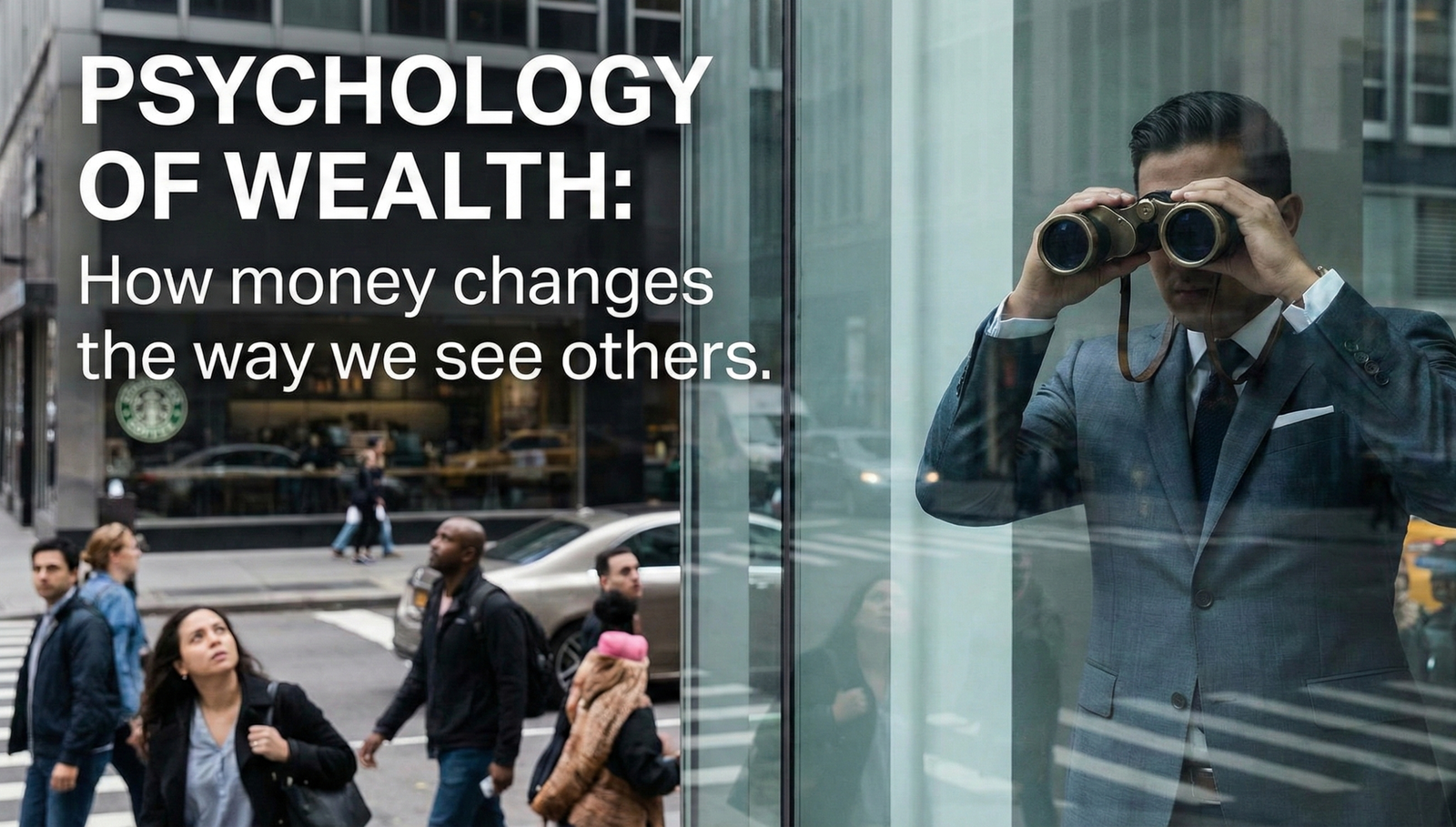

They say money changes people, but psychology suggests it doesn’t just change our lifestyle—it fundamentally rewires how we view humanity.
From the boardrooms of global corporations to the way we interact with strangers on the street, wealth (or the lack thereof) acts as a powerful lens through which we interpret the world. But does climbing the socioeconomic ladder make us more independent, or does it isolate us from the emotional experiences of others?
In this deep dive, we explore the Psychology of Wealth to understand how money impacts empathy, compassion, and social perception.
The “Monopoly” Effect: A Case Study in Entitlement
To understand how wealth shifts perspective, we have to look at one of social psychology’s most famous experiments: The Rigged Monopoly Study.
Conducted by psychologist Paul Piff at UC Berkeley, this study paired strangers in a game of Monopoly. However, the game was rigged. One player was randomly assigned to be the “rich” player—they started with twice the money, collected double the salary, and rolled both dice instead of one.
The Result: As the “rich” players began to win (an inevitable outcome of the rigged rules), their behavior changed. They became:
- Louder and more dominant: They slammed pieces on the board.
- Less polite: They ate more pretzels from a shared bowl, often with their mouths open.
- Self-attribution bias: Despite knowing the game was rigged in their favor, post-game interviews revealed that many “rich” players attributed their success to their own strategy and skill, rather than luck.
This suggests that as wealth accumulates, our brain may trick us into believing we are solely responsible for our success, causing us to view those with less as “less skilled” or “less deserving.”
The Empathy Gap: Why Wealth Can Blind Us
One of the most robust findings in the psychology of wealth is the negative correlation between high socioeconomic status (SES) and empathy.
1. The Science of “Reading” People
Psychologists Michael Kraus and Dacher Keltner found that individuals from lower socioeconomic backgrounds are generally better at reading facial expressions and emotional cues than their wealthier counterparts.
Why? This is often explained by the Contextualism vs. Solipsism theory:
- Lower SES individuals often rely more on social interdependence to survive. They must be hyper-aware of social threats and the moods of others to navigate their environment safely.
- Higher SES individuals, possessing more resources, are more independent. They do not need to rely on others for survival, which allows their social cognition muscles to atrophy. They can afford to be less observant.
2. The Neural Response to Suffering
Neuroscience backs this up. A study published in NeuroImage scanned the brains of participants while viewing images of people in pain.
- Participants from lower socioeconomic backgrounds showed significant activation in the neural networks associated with empathy and pain simulation.
- Participants from higher socioeconomic backgrounds showed significantly dampened responses in these regions.
Essentially, the wealthy brain may simply not “notice” suffering as intensely as the non-wealthy brain.
The Self-Sufficiency Hypothesis
Why does money make us less socially connected? Kathleen Vohs, a professor at the University of Minnesota, proposed the Self-Sufficiency Hypothesis.
Her research indicates that even the mere thought of money changes behavior. In her experiments, participants who were primed with money-related concepts (like seeing a screensaver of floating bills) became:
- More Independent: They worked longer on difficult tasks before asking for help.
- More Isolated: They preferred to work alone rather than in teams.
- Less Helpful: They were less likely to help a peer who dropped a stack of pencils.
Money shifts our mindset from “social connection” to “market exchange.” It signals that we can solve our own problems, leading to a decrease in prosocial behavior.
Wealth and Ethical Behavior: The “Greed is Good” Paradox
Does having more money make you more likely to break the rules? According to Piff’s research, the answer is often yes.
In a series of observational studies, researchers watched a busy intersection. They found that drivers of luxury cars were:
- Four times less likely to stop for pedestrians at a crosswalk than drivers of inexpensive cars.
- More likely to cut off other drivers in traffic.
This phenomenon is linked to psychological entitlement. When wealth buffers people from the consequences of their actions, the social contract feels less binding. The mindset shifts from “What is good for the community?” to “What is good for me?”
It’s Not All Bad: The Nuance of Wealth
It is critical to note that wealth does not automatically make someone “bad,” nor does poverty make someone “good.” These are statistical trends, not individual destinies.
The Buffer Effect
Wealth provides a psychological buffer against stress. Poverty taxes cognitive bandwidth—when you are worried about your next meal, your IQ effectively drops because your mental resources are depleted. Wealth frees up mental energy, which can be directed toward philanthropy and global change if the intention is set.
Breaking the Cycle
The empathy gap is not permanent. Research shows that simple “nudges” can restore compassion in wealthy individuals. When rich participants were asked to watch a short video about child poverty before an experiment, their empathy levels rose to match those of the non-wealthy participants.
Awareness is the antidote.
Conclusion: Bridging the Gap
The psychology of wealth teaches us that money is not just currency; it is a mindset. It encourages independence and agency, but often at the cost of connection and empathy.
For those of us striving for success, the challenge is to grow our net worth without shrinking our emotional world. As we climb the ladder, we must intentionally look down—not to judge, but to understand, connect, and lift others up.