
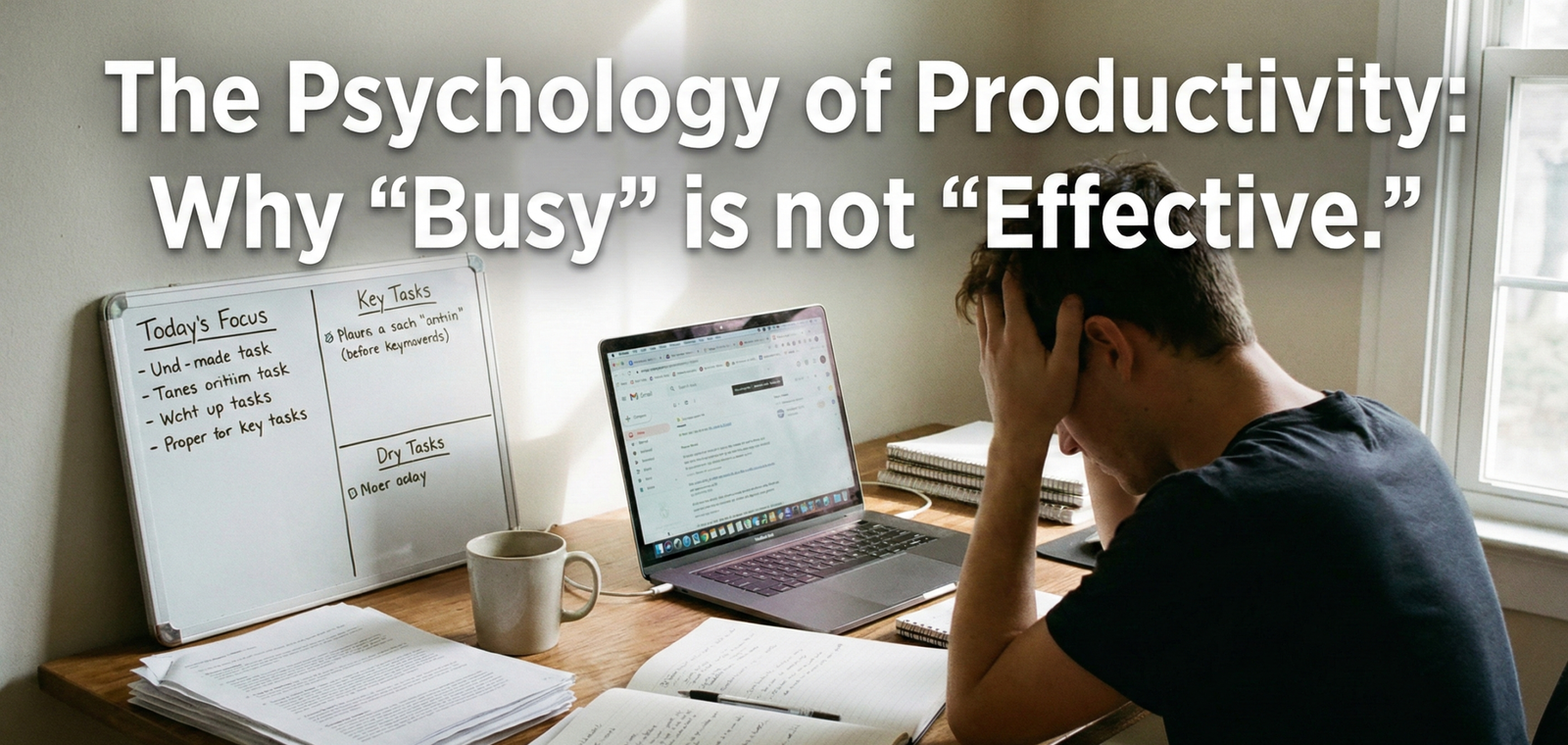

In modern society, “How are you?” is frequently answered with a breathless “So busy!” We wear our exhaustion like a badge of honor, equating a packed schedule with a meaningful life. However, from a psychological perspective, there is a profound difference between being busy (motion) and being effective (action).
At Formal Psychology, we believe that understanding the cognitive mechanisms behind how we work is the first step to reclaiming our time. Here is why your brain tricks you into staying busy, and how to retrain it for effectiveness.
The Busyness Paradox: Motion vs. Action
James Clear, author of Atomic Habits, draws a distinction that is crucial for understanding productivity:
- Motion (Busyness): Planning, strategizing, and learning. It feels like progress, but it produces no result.
- Action (Effectiveness): The behavior that delivers an outcome.
Psychologically, we often prefer motion because it allows us to feel like we are progressing without the risk of failure. This is the Illusion of Competence. When you are “busy” checking emails, organizing files, or color-coding your calendar, you are stimulating the brain’s reward centers without actually doing the difficult cognitive lifting required to create value.
The Neuroscience of the “Busy” Trap
Why is it so hard to stop being busy? The answer lies in neurochemistry and cognitive bias.
1. The Dopamine Feedback Loop
“Busyness” often involves completing small, low-value tasks—replying to a message, ticking off a grocery item, or clearing a notification. Each of these micro-tasks releases a small hit of dopamine, the neurotransmitter associated with pleasure and reward.
Deep, effective work—like writing a report or solving a complex problem—has a delayed reward. Our primitive brains prioritize the immediate dopamine hit of the trivial task over the long-term satisfaction of the significant task.
2. The Mere Urgency Effect
Research published in the Journal of Consumer Research identified a cognitive bias known as the “Mere Urgency Effect.” This explains our tendency to choose tasks that feel urgent (have a deadline) over tasks that are important (have high long-term value), even if the urgent task offers objectively lower rewards.
Your brain interprets “urgency” as a threat. To lower anxiety, we rush to clear the urgent tasks (the “busy” work), leaving us with no mental energy for the “effective” work.
3. Cognitive Switching Penalties
We often conflate busyness with multitasking. However, psychology tells us that multitasking is a myth. The brain cannot process two high-level cognitive tasks simultaneously; it rapid-switches between them.
This creates a “switching cost.” Every time you switch from a spreadsheet to your email and back, you lose focus. This state of constant fragmentation increases cognitive load, leading to decision fatigue and a lower IQ during the task. You feel exhausted (busy) but have accomplished very little (ineffective).
The Psychology of Avoidance: Productive Procrastination
Sometimes, busyness is a defense mechanism. In psychology, this is often referred to as Productive Procrastination.
We fill our time with “busy work” to avoid the anxiety associated with high-stakes work. If you have a difficult article to write, you might suddenly feel the urge to clean your entire office. You are technically working, but you are effectively hiding. By staying busy, you protect your ego from the potential judgment or failure associated with the “big task.”
Shifting from Busy to Effective
To move from a state of frantic busyness to calm effectiveness, we must leverage psychological principles to change our behavior.
1. Practice “Deep Work”
Coined by Cal Newport, Deep Work is the ability to focus without distraction on a cognitively demanding task. To achieve this, you must overcome the addiction to availability.
- Psychological Hack: Schedule “Deep Work” blocks on your calendar. Treat them as non-negotiable appointments. This utilizes implementation intentions—pre-deciding how you will act helps bypass the need for willpower in the moment.
2. Utilize the Pareto Principle (80/20 Rule)
The Pareto Principle states that 80% of results come from 20% of efforts.
- Apply it: Audit your to-do list. Identify the top 20% of tasks that will drive the most significant results. Ruthlessly eliminate, delegate, or delay the other 80%. Effectiveness is not about doing more things; it is about doing the right things.
3. Manage Energy, Not Just Time
The Circadian Rhythm dictates that our cognitive alertness fluctuates throughout the day.
- The Strategy: Do not waste your peak mental hours (usually the morning for most people) on low-value “busy” tasks like email. Align your most challenging work with your peak energy levels.
Conclusion
Being busy is often a sign of a lack of priority, not a sign of virtue. By understanding the psychology behind why we crave busyness—the dopamine hits, the urgency traps, and the fear of failure—we can start to make different choices.
True productivity requires the courage to be less busy so that you can be more effective. It requires silence, focus, and the willingness to say “no” to the trivial many, so you can say “yes” to the vital few.