
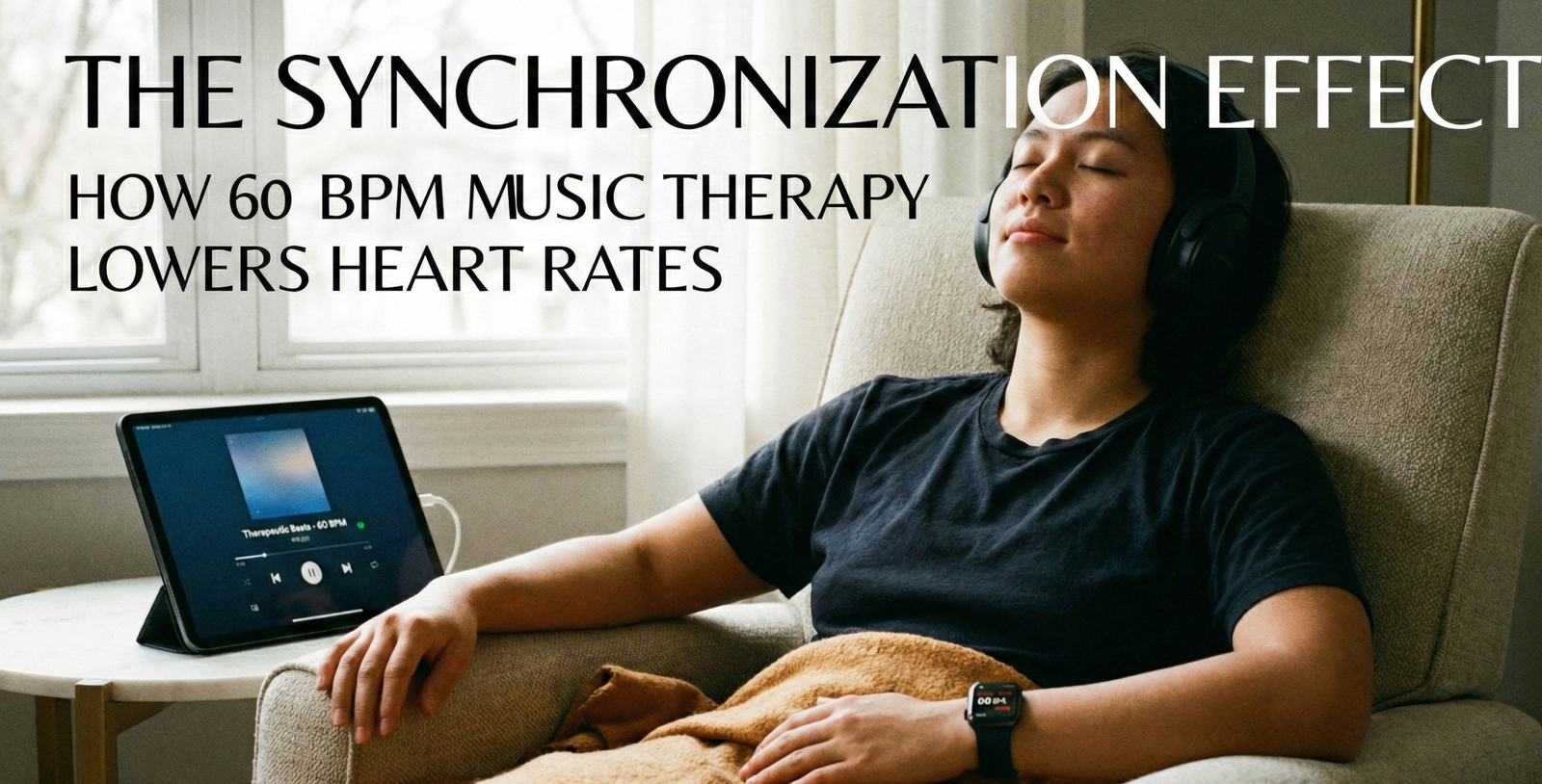

In the realm of physiological psychology, few interventions are as accessible and immediately effective as sound. While music has been used for millennia to soothe the soul, modern science has pinpointed a specific tempo that acts as a physiological “brake” for the human body: 60 beats per minute (BPM).
This article explores the mechanics of music therapy, specifically focusing on how tracks set to this tempo can forcibly—yet gently—lower heart rates, reduce cortisol levels, and induce a state of deep relaxation.
The Science of “Entrainment”
To understand why 60 BPM is the magic number, we must first understand a phenomenon known as Rhythmic Entrainment.
Entrainment is a principle of physics where two oscillating systems interact and eventually synchronize. In a biological context, the human body has its own internal rhythms: the heart rate, respiration rate, and brain wave activity. When exposed to a dominant external rhythm—like a drum beat or a metronome—the body has a natural tendency to synchronize with it.
Key Concept: When you listen to music, your heartbeat unconsciously attempts to match the tempo of the track. Fast music can elevate your heart rate (ideal for workouts), while slow music can drag it down to a resting state.
Why 60 BPM? The Biological Sweet Spot
A tempo of 60 BPM is significant because it aligns with the ideal resting heart rate for a healthy adult (typically between 60 and 100 beats per minute, with lower being associated with relaxation).
When an individual listens to a track consisting of a steady 60 BPM rhythm, the following cascade of physiological events occurs:
- Auditory Processing: The brain perceives the consistent, slow beat.
- Synchronization: Through entrainment, the heart rate begins to slow down to match the beat.
- Brain Wave Shift: Brain activity shifts from Beta waves (associated with an alert, waking state, 14–30 Hz) toward Alpha waves (relaxed alertness, 8–14 Hz) and eventually Theta waves (deep relaxation/meditation, 4–8 Hz).
- Parasympathetic Activation: The slower rhythm stimulates the vagus nerve, engaging the parasympathetic nervous system (the “rest and digest” mode) and suppressing the sympathetic nervous system (the “fight or flight” mode).
The Evidence: The “Weightless” Phenomenon
One of the most famous examples of this therapy in action is the study of the track “Weightless” by Marconi Union. Sound therapists and the band collaborated to create a song specifically designed to lower heart rates.
The track begins at 60 BPM and gradually slows to around 50 BPM over eight minutes. Studies conducted by Mindlab International found that:
- Participants experienced a 65% reduction in overall anxiety.
- Resting heart rates dropped by an average of 35%.
- The music was more effective at inducing relaxation than a massage or simply resting.
This highlights that the structure of the music—specifically the tempo and lack of repetitive melody—prevents the brain from predicting what comes next, forcing a shutdown of the “analyzing” mind and encouraging pure physiological synchronization.
Physiological and Psychological Benefits
Integrating 60 BPM tracks into a therapeutic regimen offers distinct advantages for both physical and mental health.
| Benefit Category | Specific Outcome |
| Cardiovascular | abrupt lowering of blood pressure; stabilization of heart rate variability (HRV). |
| Hormonal | Reduction in serum cortisol (stress hormone); increase in dopamine production. |
| Cognitive | Improved focus by reducing “background noise” in the brain; induction of a flow state. |
| Sleep | Faster onset of sleep latency; improvement in sleep quality by mimicking pre-sleep heart rates. |
Practical Application: How to Use 60 BPM Therapy
For readers of Formal Psychology looking to utilize this for clients or personal use, here is the recommended protocol:
1. The Environment
To maximize entrainment, the auditory stimulus must be clear. Headphones are recommended to create an immersive experience and block out competing external rhythms.
2. The Selection
Not all slow music works. The track should ideally:
- Have a consistent pulse near 60 BPM.
- Lack complex lyrics (which engage the language centers of the brain).
- Avoid sudden changes in volume (dynamics).
- Examples: Classical movements (Adagios), Ambient Drone, or specific “Binaural Beats” playlists.
3. The Duration
Entrainment is not instantaneous. It typically takes 5 to 7 minutes for the body to fully synchronize with the external rhythm. A listening session should last at least 15 minutes to achieve a sustainable drop in heart rate and blood pressure.
Limitations and Contraindications
While highly effective, music therapy via entrainment is not a panacea.
- Individual Variance: Musicians or people with high musical training may analyze the structure of the music rather than passively entraining to it, potentially reducing the relaxation effect.
- Driving/Machinery: Because 60 BPM tracks can induce Theta brain waves (drowsiness), they should strictly not be used while driving or operating heavy machinery.
Conclusion
The correlation between 60 BPM audio and heart rate reduction is a powerful example of the mind-body connection. By leveraging the physics of entrainment, we can hack the autonomic nervous system, providing a non-pharmacological method to treat acute stress and anxiety. For the psychology enthusiast or professional, understanding this mechanism provides a valuable tool for promoting homeostasis in a high-stress world.