
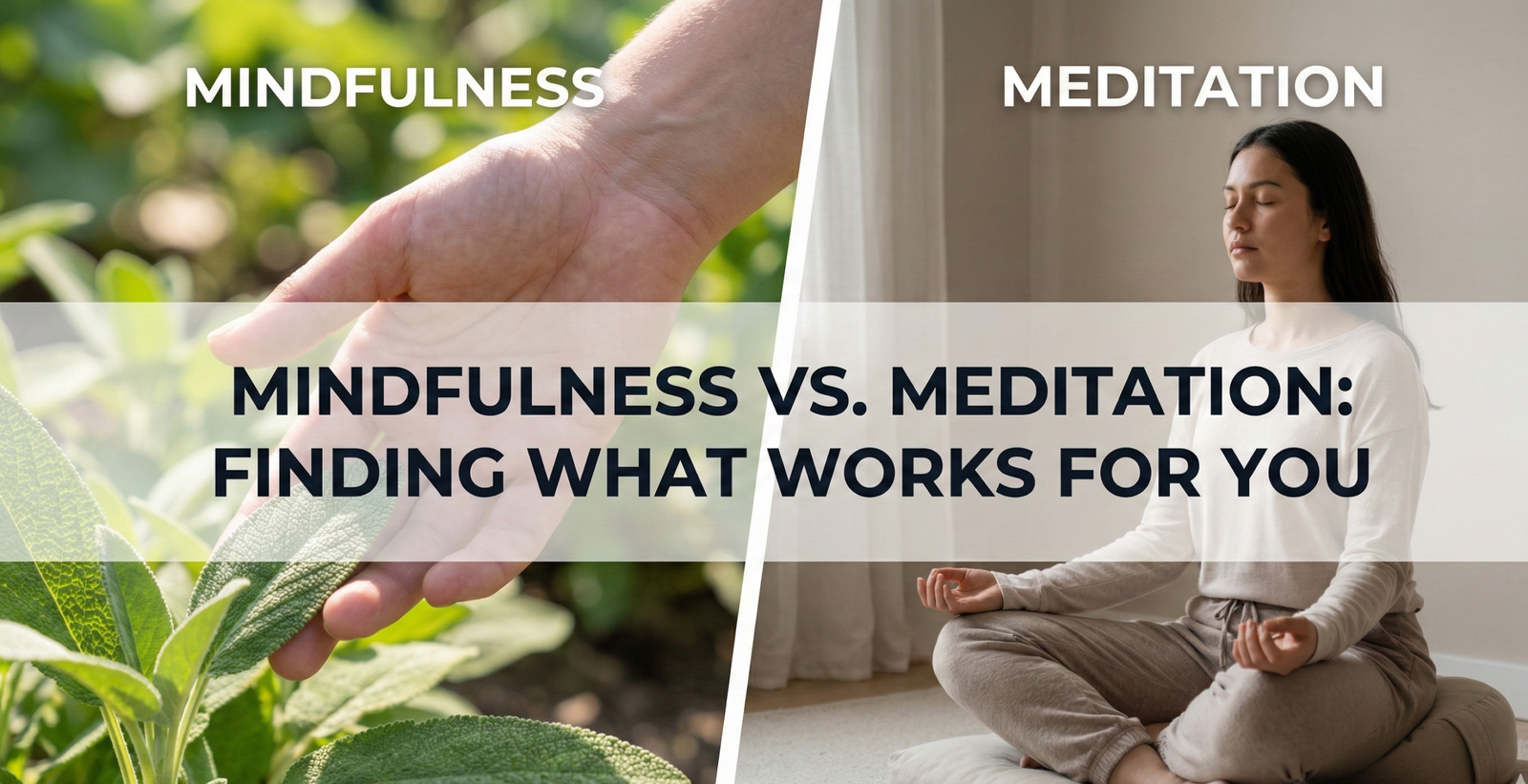

In the world of modern psychology and wellness, “mindfulness” and “meditation” are often used interchangeably. While they are closely related branches of the same tree, they are not identical. For psychology enthusiasts and those seeking mental clarity, understanding the nuance between the two is the first step toward building a sustainable practice.
At Formal Psychology, we believe in deconstructing these concepts to help you apply them effectively. Whether you are looking to reduce anxiety, improve cognitive focus, or simply understand the mechanics of your own mind, here is the definitive guide to the battle of the buzzwords: Mindfulness vs. Meditation.
Defining the Core Concepts
To understand the difference, we must first look at the definitions through a psychological lens.
What is Meditation?
Meditation is an intentional practice. It is a formal exercise that typically involves setting aside a specific time, finding a quiet space, and employing a specific technique to train attention and awareness.
Think of meditation as a “workout” for your brain. Just as you go to the gym to lift weights, you sit in meditation to lift the “weight” of your attention.
- Common Forms: Guided visualization, Transcendental Meditation (TM), Loving-Kindness (Metta), and Vipassana.
- The Goal: Often involves reaching a specific state of consciousness, deep relaxation, or spiritual growth.
What is Mindfulness?
Mindfulness is a quality of being. It is the psychological process of bringing one’s attention to experiences occurring in the present moment without judgment. While it can be practiced during meditation, it can also be applied to eating, walking, or even washing dishes.
Think of mindfulness as your “posture” throughout the day. You don’t need a gym (or a meditation cushion) to have good posture; you just need to be aware of how you are holding yourself.
- Common Forms: Mindful eating, active listening, sensory grounding techniques.
- The Goal: To be fully present and engaged with the “now,” reducing the cognitive load of ruminating on the past or worrying about the future.
The Key Differences: A Psychological Breakdown
While they overlap, the distinction lies in structure versus lifestyle.
| Feature | Meditation | Mindfulness |
| Structure | Formal, dedicated time (e.g., 20 mins/day). | Informal, can be continuous (24/7). |
| Environment | Usually requires a quiet, distraction-free zone. | Can be practiced anywhere (in traffic, at work). |
| Action | An act of “doing” (a specific exercise). | An act of “being” (a state of awareness). |
| Focus | Often focuses on the inner world (breath, mantra). | Focuses on both inner and outer worlds (environment, senses). |
The Intersection: Mindfulness Meditation
Confusion often arises because “Mindfulness Meditation” is a specific type of meditation. This is where you sit formally (meditation) to practice the skill of non-judgmental awareness (mindfulness).
In clinical psychology, this intersection is powerful. Therapies like MBSR (Mindfulness-Based Stress Reduction) and MBCT (Mindfulness-Based Cognitive Therapy) utilize formal meditation practices to cultivate the daily habit of mindfulness, proving highly effective for treating depression and anxiety.
Which Practice is Right for You?
Finding what works depends on your personality, your schedule, and your psychological needs.
Choose Meditation If:
- You crave structure: You are the type of person who benefits from a strict routine (e.g., “I will sit for 10 minutes at 7:00 AM”).
- You need deep restoration: You are experiencing high levels of burnout and need a specific time to “shut off” the world and reset your nervous system.
- You want to improve focus: Formal concentration meditation (like focusing on the breath) is excellent for training the brain to resist distractions, beneficial for those with ADHD-like symptoms.
Choose Mindfulness If:
- You are always “busy”: If finding 20 minutes to sit in silence feels impossible, mindfulness allows you to integrate mental health practices into your existing routine (e.g., being mindful while drinking coffee).
- You struggle with emotional reactivity: If you find yourself snapping at others or getting overwhelmed quickly, mindfulness teaches you to pause between a trigger and your reaction.
- You dislike sitting still: For those who find silence agitating, “active mindfulness” (like a mindful walk) is a much more accessible entry point.
How to Start: Practical Applications
1. The “2-Minute” Meditation (For Beginners)
- Sit comfortably.
- Close your eyes.
- Focus entirely on the sensation of air entering your nostrils and leaving your mouth.
- When your mind wanders (and it will), gently bring it back to the breath.
2. The “5-Senses” Mindfulness Drill (For Anxiety)
Use this when you feel overwhelmed during the day:
- See: Acknowledge 5 things you see around you.
- Feel: Acknowledge 4 things you can physically feel (feet on floor, fabric of shirt).
- Hear: Acknowledge 3 distinct sounds.
- Smell: Acknowledge 2 things you can smell.
- Taste: Acknowledge 1 thing you can taste.
Conclusion
Ultimately, the debate of “Mindfulness vs. Meditation” is not about choosing a winner; it is about choosing the right tool for the moment. Meditation is the training ground; mindfulness is the playing field.
For our readers at Formal Psychology, we recommend starting small. Try a formal meditation practice for just five minutes a day to build the muscle, and strive to carry that awareness—that mindfulness—into the rest of your hours.