
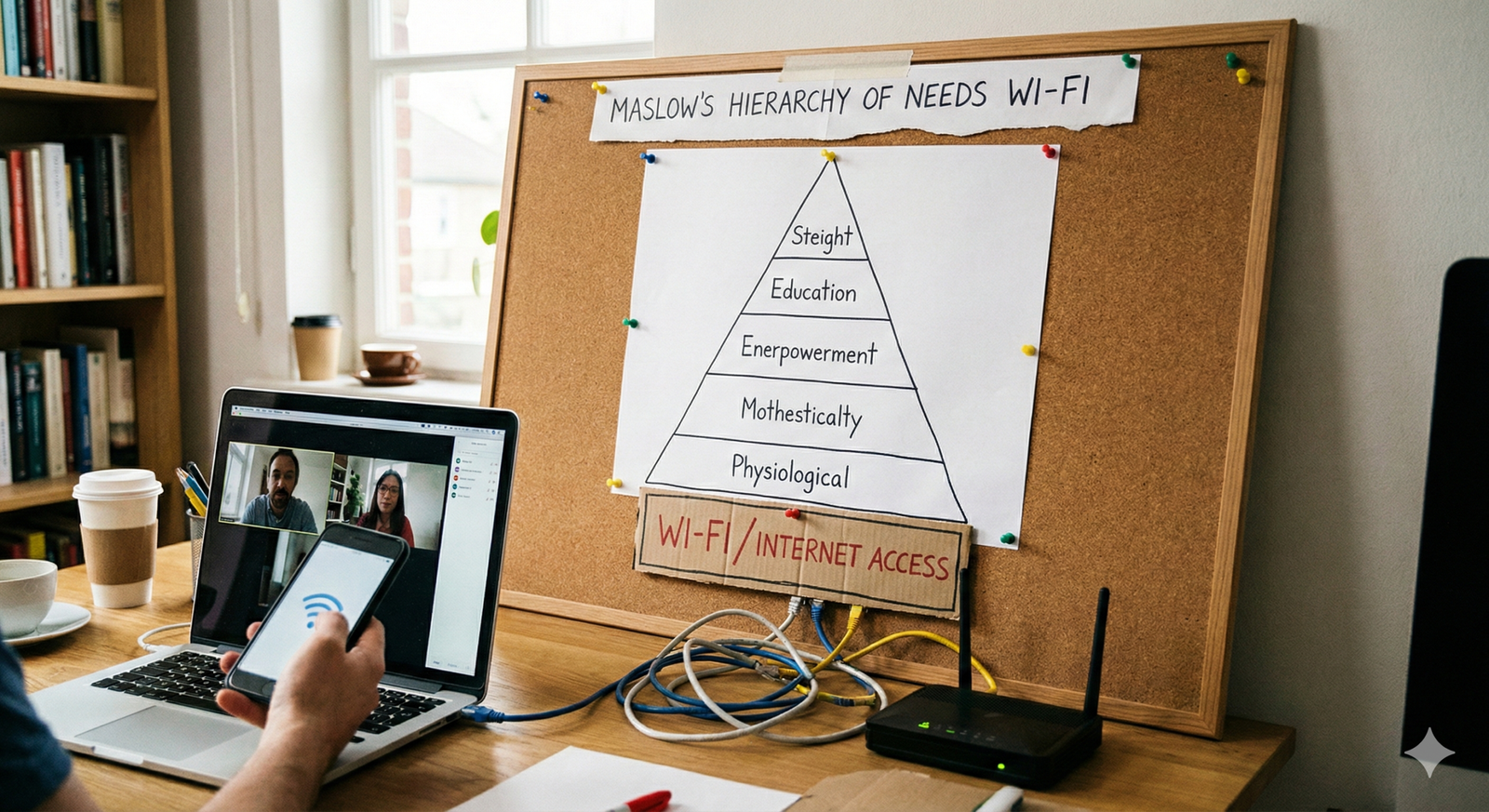

Introduction: The Joke That Became Reality
In the shifting landscape of modern psychology, the concept of Maslow’s Hierarchy of Needs Wi-Fi placement has moved from an internet meme to a serious academic debate. In the early 2010s, a joke began circulating featuring Abraham Maslow’s famous pyramid with a new layer scribbled at the base labeled “Wi-Fi.” But as we move through 2026, we must ask: Was the meme right?
At Formal Psychology, we believe that understanding the human condition requires analyzing the digital environment. The Maslow’s Hierarchy of Needs Wi-Fi discussion highlights a critical shift in how we view survival. In an era where “digital poverty” equates to social exclusion, is connectivity merely a tool for self-actualization, or has it become a physiological survival imperative?
The Traditional Hierarchy: A Quick Refresher
Before rewriting the pyramid, we must understand the original structure proposed by Abraham Maslow in 1943.
- Physiological Needs: Air, water, food, shelter, sleep, reproduction.
- Safety Needs: Personal security, employment, resources, health.
- Love and Belonging: Friendship, intimacy, family, connection.
- Esteem: Respect, self-esteem, status, recognition.
- Self-Actualization: Desire to become the most that one can be.
Maslow argued that lower needs must be satisfied before higher needs become motivated behavior. However, the Maslow’s Hierarchy of Needs Wi-Fi theory suggests a new foundational layer is required to access the others.
The Case for the “Digital Base”: Why Wi-Fi is the New Oxygen
In 2026, the argument for placing Wi-Fi at the bottom isn’t that the human body biologically metabolizes data. It is that digital access has become the “gatekeeper” need—the prerequisite to fulfilling all other tiers.
1. The Gateway to Physiological Survival
Strictly speaking, you can survive without the internet. But can you survive effectively in a modern urban environment?
- Food & Water: In many smart cities, food procurement is increasingly app-dependent. Supply chain logistics are digital.
- Shelter: Finding housing, paying rent, and managing utilities are almost exclusively online processes.
- Healthcare: Telemedicine is now a standard primary care model.
Psychological Verdict: This validates the Maslow’s Hierarchy of Needs Wi-Fi addition, as losing connection now triggers a survival-level anxiety response (nomophobia).
2. Safety in the Cloud
The second tier, Safety, is where the internet shines as a fundamental utility.
- Financial Security: Cash is vanishing. Accessing your money requires a secure connection.
- Physical Safety: GPS, emergency alerts, and home security systems rely on connectivity. Being “offline” in 2026 implies being “lost” or “vulnerable.”
3. Belonging in a Hybrid World
Maslow’s third tier is perhaps the most transformed. We no longer just “meet” people; we “network.”
- The “Phygital” Relationship: Long-distance relationships and niche communities exist almost entirely via Wi-Fi.
- Isolation: A lack of internet access today correlates strongly with social isolation, mimicking the psychological damage of solitary confinement.
The Counter-Argument: The “Digital Trap”
However, formal psychology warns against romanticizing the internet.
- The Fragility of Dependence: Basing our entire psychological pyramid on a paid commodity creates a society of high anxiety.
- Distortion of “Esteem”: When our esteem is algorithmic—based on likes and views—it becomes unstable.
- Barriers to Self-Actualization: The “attention economy” actively works to keep users stuck in lower-tier dopamine loops.
The 2026 Verdict: The “Invisible Foundation”
So, where does it belong? Leading cyberpsychologists in 2026 propose that in the Maslow’s Hierarchy of Needs Wi-Fi model, connectivity is not a layer, but the canvas upon which the pyramid is drawn.
It is the medium, not the motivation.
- It is the new environment: Just as early humans needed a savanna to hunt, modern humans need a digital network to function.
- The “Utility” Classification: Psychologically, we should treat internet access like electricity. It is an environmental prerequisite for mental health stability.
Conclusion: Updating the Model for a Connected Species
Does Wi-Fi belong at the bottom? Yes, but not as a replacement for food. It belongs at the bottom as the foundation of modern agency.
In 2026, depriving a human of connectivity is an act of psychological violence. It strips them of their ability to feel safe, to belong, and to esteem themselves. As we publish this on Formal Psychology, we acknowledge that the Maslow’s Hierarchy of Needs Wi-Fi evolution is real—and today, our drive to survive travels at the speed of light.
Key Takeaways for Psychology Students:
- Redefining “Basic”: A basic need is anything without which a person cannot function in their society. In 2026, the internet fits this definition.
- Nomophobia: The fear of being without a mobile phone is actually a fear of losing access to the hierarchy of needs.
- Digital Inequality: The “Digital Divide” is now a psychological divide.