
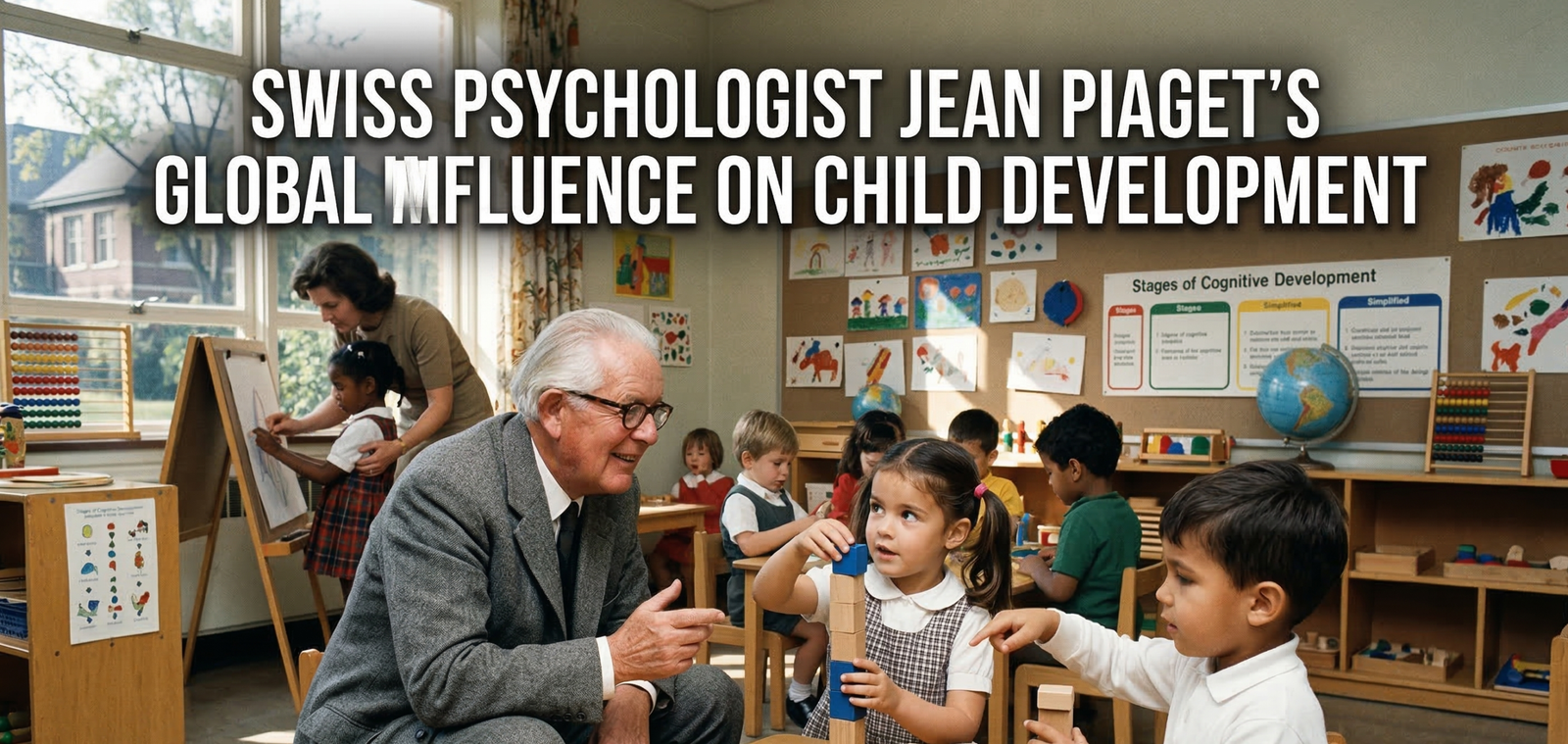

The study of Jean Piaget child development theories revolutionized the way we understand the human mind from birth to adulthood. Before the 20th century, the prevailing belief in both psychology and society was that children were simply “miniature adults.” Their minds were viewed as empty vessels waiting to be filled with knowledge. It was the pioneering work of Swiss psychologist Jean Piaget (1896–1980) that fundamentally dismantled this paradigm.
Piaget proposed a radical, transformative idea: children think differently than adults. By demonstrating that childhood is a unique and vital period of human growth, the impact of Jean Piaget child development research reshaped developmental psychology and left an indelible, global mark on how we educate and understand children today.
The Core of Piaget’s Theory: Constructivism
At the heart of his global influence is his theory of Constructivism. Piaget argued that children do not passively receive knowledge; rather, they actively construct their understanding of the world through experience and interaction.
To explain this process within the framework of Jean Piaget child development, he introduced three critical concepts:
- Schemas: The mental frameworks or building blocks of knowledge that help individuals organize and interpret information.
- Assimilation: The process of taking new information and fitting it into existing schemas.
- Accommodation: The process of altering existing schemas—or creating new ones—when new information contradicts what is already known.
“The principal goal of education in the schools should be creating men and women who are capable of doing new things, not simply repeating what other generations have done.” — Jean Piaget
The Four Stages of Cognitive Development
The most famous contribution of Jean Piaget child development studies is his stage theory of cognitive development. He mapped out a universal, sequential path that children follow as their intellect matures:
1. Sensorimotor Stage (Birth to 2 years)
In this initial stage, infants learn about the world entirely through their senses and motor actions. The key developmental milestone here is object permanence—the realization that objects continue to exist even when they cannot be seen, heard, or touched.
2. Preoperational Stage (2 to 7 years)
Children in this stage begin to think symbolically and use language to represent objects. However, their thinking is largely intuitive rather than logical, and it is characterized by egocentrism—the inability to take another person’s perspective.
3. Concrete Operational Stage (7 to 11 years)
This stage marks a major turning point as children begin to think logically about concrete events. They grasp the concept of conservation (understanding that quantity remains the same despite changes in shape or appearance) and can perform mental operations, though abstract thinking remains a challenge.
4. Formal Operational Stage (12 years and up)
In the final stage, adolescents develop the capacity for abstract reasoning and hypothetical thinking. They can analyze complex problems, use deductive logic, and plan systematically for the future.
Piaget’s Global Impact on Education
The principles of Jean Piaget child development transcended the borders of Switzerland and permeated educational systems worldwide. His influence caused a massive shift in pedagogical strategies:
- Discovery Learning: Traditional, rote-memorization classrooms were replaced by environments that encouraged active discovery. Teachers shifted from being “transmitters of knowledge” to “facilitators of learning.”
- Developmentally Appropriate Practice (DAP): Curricula around the world are now designed to match the cognitive stage of the students. Educators understand that teaching complex abstract concepts to a young child is ineffective because the child has not yet reached the Formal Operational stage.
- Play-Based Education: Piaget highlighted that play is the “work of childhood.” This insight became the foundation for early childhood education models globally, emphasizing hands-on, interactive learning spaces.
Global Legacy and Modern Critiques
While the global influence of Jean Piaget child development models is undeniable, modern psychology has refined his theories. Cross-cultural studies have shown that while the sequence of Piaget’s stages holds generally true globally, the rate at which children progress can be heavily influenced by cultural and environmental factors.
Furthermore, contemporaries like Russian psychologist Lev Vygotsky expanded upon Piaget’s foundation by emphasizing the profound role of social interaction and culture in cognitive development—an area Piaget largely overlooked in his early work. Despite these modern adaptations, Piaget’s core premise remains untouched.
Conclusion
Jean Piaget changed the way the world views the mind of a child. His empirical research and ground breaking theories provided a framework that continues to guide psychologists, parents, and educators worldwide. For readers exploring psychology, understanding the fundamentals of Jean Piaget child development is not just an exercise in historical reflection; it is a vital step in comprehending the very architecture of human thought.