
“The whole is other than the sum of the parts.” This famous maxim, often slightly misquoted, forms the foundational bedrock of Gestalt psychology. Emerging from the intellectual landscape of early 20th-century Germany, the Gestalt movement radically altered the trajectory of psychological science. Rather than breaking down human consciousness into its smallest possible components, Gestalt psychologists argued that the human mind inherently perceives objects as complete, unified wholes.
To truly grasp the impact of this school of thought on modern cognitive science, perception, and even design, we must return to its German roots and the brilliant minds that sparked the revolution.
The Intellectual Climate: A Rebellion Against Structuralism
In the late 19th and early 20th centuries, the dominant force in experimental psychology was Structuralism, championed by Wilhelm Wundt and Edward Titchener. Structuralism proposed that conscious experience could be understood by dismantling it into its most basic sensory elements—much like a chemist breaks down a compound into its constituent atoms.
The pioneers of Gestalt psychology found this reductionist approach fundamentally flawed. They argued that dissecting an experience destroyed the very essence of that experience. For instance, a melody is not simply a sequential list of isolated notes; it is perceived as a cohesive tune. If you transpose the melody to a different key, the individual notes change entirely, yet the listener still recognizes the same melody. The relationship between the parts, the Germans argued, is what creates the Gestalt (a German word roughly translating to “form,” “shape,” or “unified whole”).
The Founding Fathers of the Gestalt Movement
The birth of Gestalt psychology is generally traced back to 1912 in Frankfurt, Germany, spearheaded by a triad of visionary psychologists.
1. Max Wertheimer (1880–1943)
The movement was officially ignited by Max Wertheimer’s publication on the phi phenomenon. While traveling on a train, Wertheimer observed that flashing lights at a railroad crossing created the illusion of movement, even though the lights were merely turning on and off in rapid succession.
He purchased a toy stroboscope and conducted formal experiments with his colleagues. Wertheimer proved that human perception goes beyond mere sensory input; the mind actively organizes stimuli to create a sense of motion where none exists.
2. Wolfgang Köhler (1887–1967)
Köhler extended Gestalt principles beyond human perception and into the realm of animal learning and problem-solving. Stationed at a primate research facility on the island of Tenerife during World War I, Köhler observed chimpanzees attempting to reach bananas suspended out of grasp.
Instead of relying on random trial-and-error (as behaviorists of the time suggested), the chimpanzees demonstrated sudden moments of insight learning. They would pause, observe their environment, and suddenly stack boxes or connect sticks to reach the food. Köhler demonstrated that learning involves organizing the environment into a meaningful “whole” to solve a problem.
3. Kurt Koffka (1886–1941)
If Wertheimer was the spark and Köhler the primary researcher, Koffka was the great communicator of the movement. He published extensively, introducing Gestalt principles to the broader psychological community and specifically applying them to developmental psychology. His 1922 article, Perception: An Introduction to the Gestalt-Theorie, was instrumental in introducing these German concepts to American psychologists.
Core Principles: The Laws of Perceptual Organization
The Gestalt psychologists formalized their observations into specific “laws” that explain how our minds automatically organize visual data.
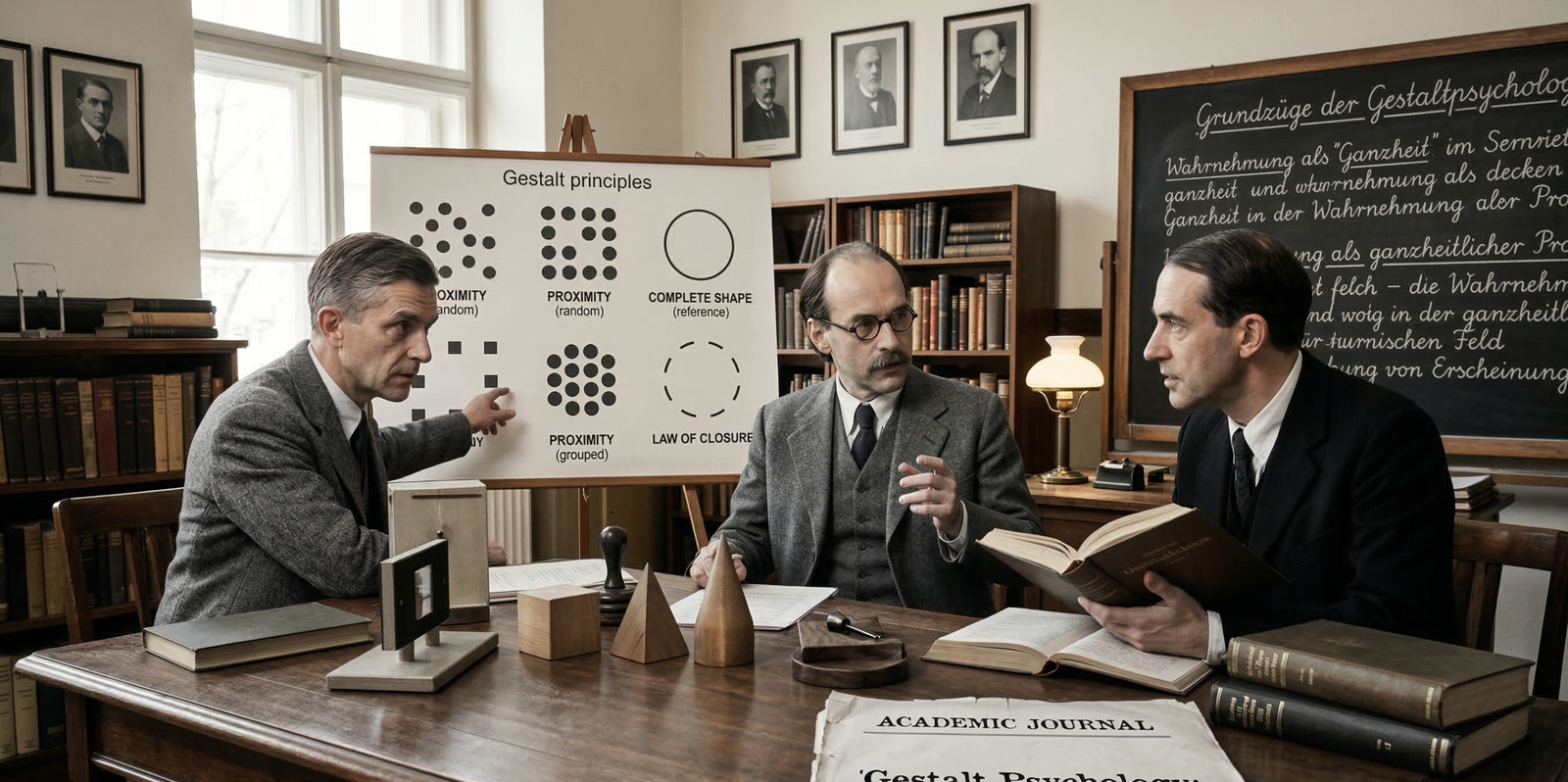
1. The Law of Proximity Objects that are close to one another are perceived as a group. If you see an array of dots with some clustered closely together, your mind will automatically group those clustered dots into a distinct unit, separate from the others.
2. The Law of Similarity Elements that share visual characteristics—such as shape, size, color, or texture—are perceived as belonging together.
3. The Law of Closure The human mind dislikes incomplete shapes. When faced with a complex or fragmented visual image, our brains will literally “fill in the gaps” to perceive a complete, enclosed figure.
4. Figure-Ground Organization This principle dictates that we instinctively organize our visual field into a focal object (the figure) and the background against which it stands (the ground). The famous Rubin vase illusion perfectly illustrates how the mind can shift between perceiving two faces in profile (figure) or a vase (the new figure, previously the ground).
The Exodus and Global Impact
The thriving intellectual hub of Gestalt psychology in Germany was brutally cut short by the rise of the Nazi regime in the 1930s. Wertheimer, Köhler, and Koffka, facing persecution and the dismantling of academic freedom, fled to the United States.
While their arrival in America—a landscape dominated by Behaviorism—was initially met with resistance, their ideas slowly permeated the scientific community. The Gestalt emphasis on internal cognitive processes laid the crucial groundwork for the Cognitive Revolution of the 1950s.
Furthermore, fellow German psychologist Kurt Lewin, closely associated with the Gestalt school, applied these holistic principles to social behavior, essentially founding modern social psychology by emphasizing that an individual’s behavior must be understood within the totality of their environment (Field Theory).
The Enduring Legacy
Today, the German roots of Gestalt psychology stretch far beyond the confines of historical textbooks. Its principles are actively utilized in:
- Cognitive Science: Understanding how the brain processes complex visual and auditory information.
- Psychotherapy: Influencing humanistic approaches (Note: Gestalt therapy, founded by Fritz Perls, shares the name and some holistic concepts, but is a distinct offshoot from the original experimental German school).
- UX/UI Design: Modern graphic designers and software engineers rely heavily on Gestalt laws of proximity and similarity to create intuitive, user-friendly digital interfaces.
By insisting that we look at the whole picture rather than just the pixels, Wertheimer, Köhler, and Koffka fundamentally reshaped our understanding of the human mind.