
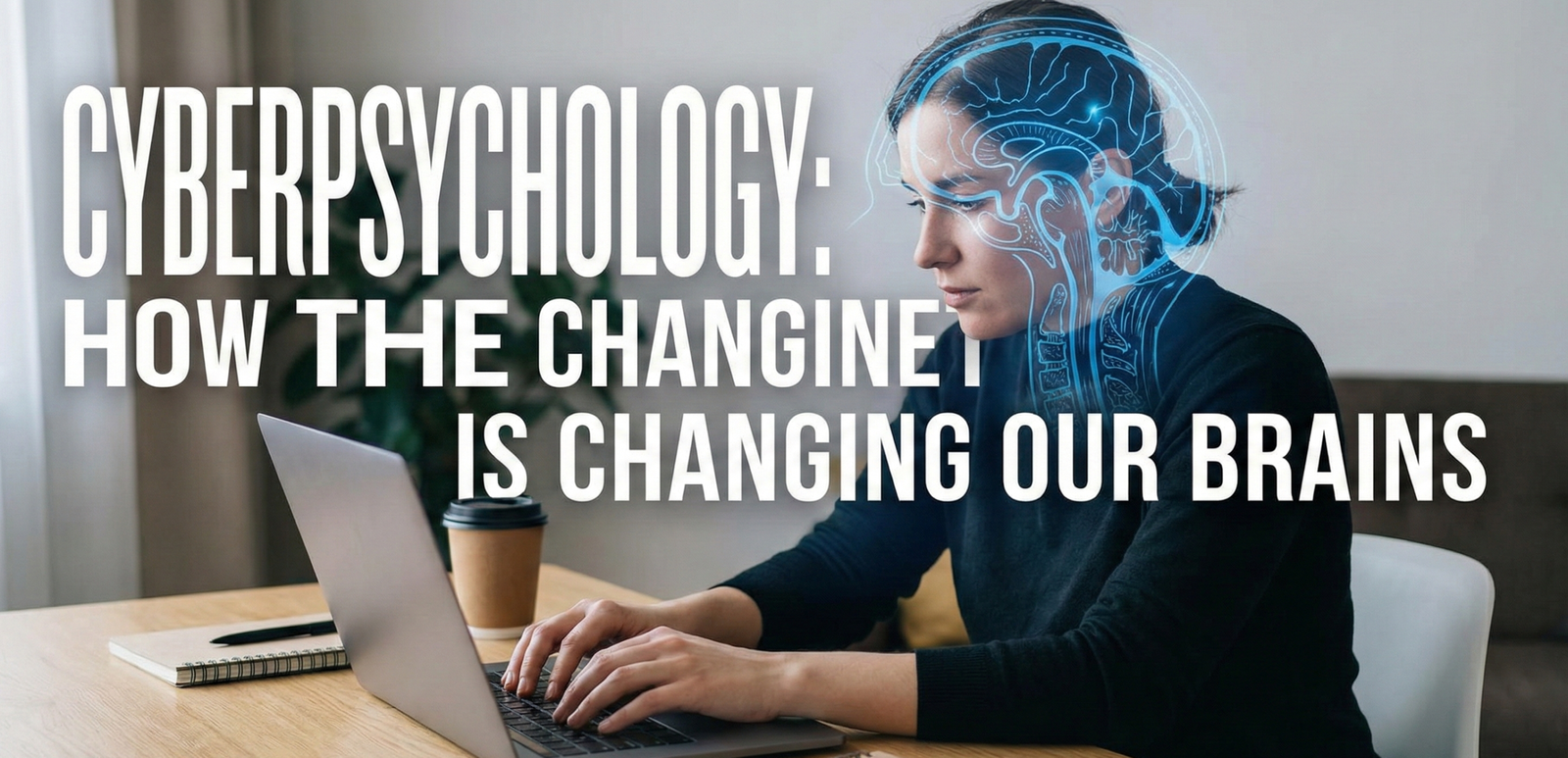

In the span of a single generation, the internet has transitioned from a luxury utility to an extension of the human nervous system. We do not just “use” the internet anymore; we live alongside it. This shift has given rise to Cyberpsychology, a growing field dedicated to understanding the psychological processes related to technology use.
But beyond just changing our habits, is the digital world actually changing our biology? The short answer is yes. Through a process called neuroplasticity, our brains are actively rewiring themselves to adapt to the high-speed, information-rich environment of the web.
What is Cyberpsychology?
Cyberpsychology is the study of the human mind and behavior in the context of human-technology interaction. It examines how we behave online, how digital environments impact our mental health, and crucially, how constant connectivity alters our cognitive functions.
As we outsource more of our mental tasks to devices—from navigation to memory—our brains are optimizing for efficiency, often at the cost of depth. Here is how the internet is fundamentally reshaping our cognitive landscape.
1. The “Google Effect” and Digital Amnesia
One of the most significant findings in cyberpsychology is the phenomenon known as “The Google Effect” or Digital Amnesia.
In the past, retaining information was essential for survival and success. Today, we know that answers are just a click away. Psychological studies suggest that when people believe they can access information later (e.g., saving a file or knowing it’s on Google), they are less likely to commit that specific information to memory.
- Transactive Memory: We are shifting from “internal memory” to “transactive memory.” We don’t remember the fact itself; we remember where to find it.
- The Trade-off: While this frees up cognitive space for processing, it may weaken our ability to recall details without digital assistance.
2. The Attention Economy and Fragmented Focus
The internet is built on the Attention Economy. Websites, apps, and platforms are designed to capture and hold our attention for as long as possible. This constant barrage of notifications, hyperlinks, and breaking news has fragmented our attention spans.
- Continuous Partial Attention: We rarely focus fully on one thing anymore. Instead, we exist in a state of “continuous partial attention,” constantly scanning for the next update.
- The Cost of Multitasking: Psychology tells us that true multitasking is a myth. Rapidly switching between tabs and apps forces the brain to constantly re-orient itself, leading to “switch costs”—a drain on mental energy that lowers overall productivity and IQ.
3. Social Media and the Dopamine Loop
Why is scrolling so addictive? The answer lies in dopamine, a neurotransmitter associated with pleasure and reward.
Social media platforms utilize a mechanic similar to slot machines, known as Variable Ratio Reinforcement. When you pull down to refresh your feed, you don’t know if you’ll see a boring update or an exciting notification. This uncertainty spikes dopamine, compelling you to check again and again.
The Psychological Impact:
- Phantom Vibration Syndrome: The anxiety-induced sensation that your phone is vibrating when it isn’t.
- Social Comparison Theory: Curated online personas lead us to compare our “behind-the-scenes” lives with everyone else’s “highlight reels,” often leading to feelings of inadequacy and depression.
4. The Online Disinhibition Effect
Have you noticed that people are often ruder, more aggressive, or conversely, more open online than they are in person? This is called the Online Disinhibition Effect.
Two main factors drive this:
- Anonymity: You feel safe from repercussions.
- Invisibility: You cannot see the other person’s facial expressions or body language, which reduces empathy.
This disconnect allows the brain’s “social brake” to loosen, leading to behaviors ranging from cyberbullying to intense over-sharing in anonymous forums.
5. Neuroplasticity: The Brain That Changes Itself
The brain is not static; it is plastic. It physically changes based on what we do repeatedly.
- Deep Reading vs. Skimming: Before the internet, our brains were trained for “deep reading”—linear, sustained focus on long texts. Now, we are training our brains to “skim”—scanning for keywords in an F-shaped pattern.
- The Result: While we are becoming faster at processing large volumes of data, we may be losing the neural pathways required for deep, contemplative thinking and sustained concentration.
Conclusion: Adapting to a Digital Future
The internet is not inherently “bad” for the brain; it is simply a new environment to which we are adapting. Cyberpsychology helps us understand these changes so we can remain in control.
To protect your cognitive health, experts recommend practicing digital hygiene:
- Single-tasking: Focus on one digital task at a time.
- Digital Detox: Scheduled time offline to allow the brain’s “default mode network” to reset.
- Deep Work: Intentionally engaging in activities that require sustained focus without internet aid.
By understanding how the web shapes us, we can use technology as a tool for empowerment rather than a crutch for cognition.