
They say that if you want someone to like you, you should do something nice for them. It sounds intuitive: kindness begets kindness. However, psychology—and history—tells us the opposite is often true.
If you really want to win someone over, you shouldn’t just do a favor for them; you should ask them to do a favor for you.
This counter-intuitive psychological phenomenon is known as the Ben Franklin Effect. It suggests that we like people not because we help them, but rather, we help people because we like them—and if we help someone we don’t like, our brains will trick us into liking them to resolve the conflict.
The History: An Old Rivalry Turned Friendship
The effect is named after Benjamin Franklin, one of the Founding Fathers of the United States, who was not just a politician but a master of human nature.
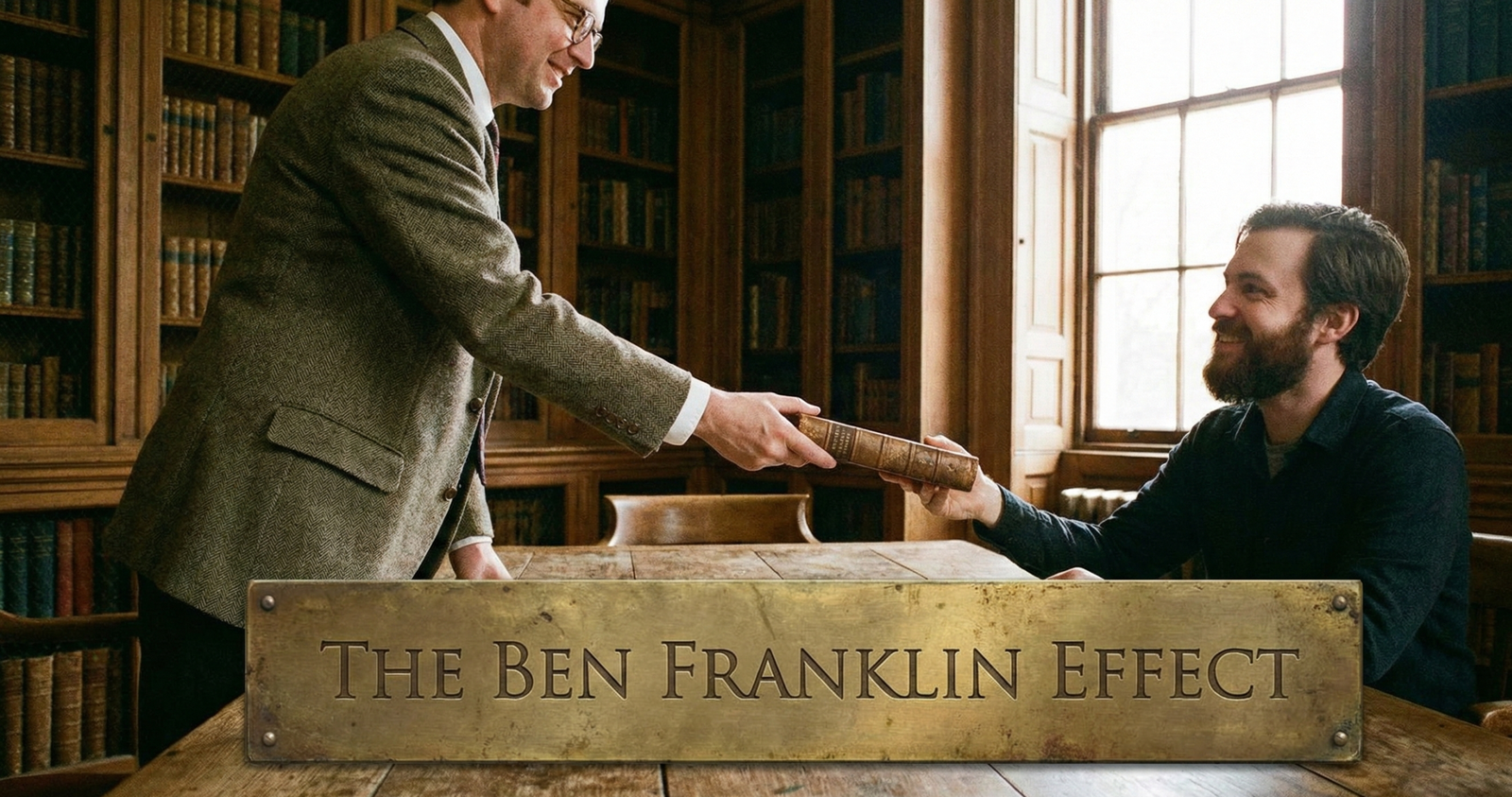
In his autobiography, Franklin describes how he handled a rival legislator who frequently criticized him in speeches. Franklin didn’t try to debate him or do him a favor to win his favor. Instead, Franklin knew this rival possessed a rare and valuable book in his library.
Franklin sent a polite note asking if he could borrow the book for a few days. Flattered, the rival sent it immediately. Franklin returned it a week later with a note of strong gratitude.
The next time they met in the legislature, the rival spoke to Franklin for the first time—and with great civility. They eventually became lifelong friends. Franklin summarized the lesson with this famous quote:
“He that has once done you a kindness will be more ready to do you another, than he whom you yourself have obliged.”
The Science: Cognitive Dissonance
Why does this work? The answer lies in a core concept of social psychology: Cognitive Dissonance.
Proposed by psychologist Leon Festinger in 1957, cognitive dissonance is the mental discomfort we experience when we hold two conflicting beliefs, or when our behavior contradicts our beliefs. The human brain craves consistency. When there is a conflict, we must change either our behavior or our attitude to restore balance.
Here is how it applies to the Ben Franklin Effect:
- The Conflict: You do a favor for someone you don’t particularly know or like.
- The Dissonance: Your brain asks, “Why did I just spend my time and energy helping this person if I don’t care about them?”
- The Resolution: To eliminate the discomfort, your brain rationalizes the action: “I must have helped them because I actually like them/they are a worthy person.”
In essence, you rewrite your own internal narrative to justify your actions.
The Research Evidence
In 1969, researchers Jecker and Landy tested this theory. Students participated in an intellectual contest where they could win money. afterward:
- Group A was asked by the researcher personally to return the money because he was using his own funds and was running low.
- Group B was asked by a secretary to return the money to the department’s general fund.
- Group C was allowed to keep the money.
The results? Group A liked the researcher the most. The personal nature of the favor triggered the dissonance and the subsequent increase in likability.
How to Apply the Ben Franklin Effect
You can ethically use this psychological tool to improve relationships in various areas of life.
1. In Professional Networking
Instead of just offering help, ask a mentor or a peer for a small, specific piece of advice.
- Don’t say: “Can I pick your brain?” (This feels like a burden).
- Do say: “I really admire how you handled that project. Could you recommend one book that helped you shape your strategy?”
2. In Romantic Relationships
Partners often want to feel needed. Asking your partner for help with something they are skilled at—fixing a gadget, choosing an outfit, or proofreading an email—validates their competence and strengthens their bond to you.
3. Resolving Conflict
If you have “friction” with a colleague, ask them for a small, low-stakes favor. Ask to borrow a pen, or ask for their opinion on a minor work matter. This forces their brain to break the pattern of hostility.
The Caveat: The “Foot-in-the-Door” Technique
It is important to note the difference between the Ben Franklin Effect and being a burden. The favor must be:
- Small: It shouldn’t require major effort or cost.
- Personal: It works best when the request connects to the person’s unique skills or possessions (like Franklin’s rare book).
If the favor is too large, the person will not rationalize it as “I like you”; they will rationalize it as “This person is annoying/manipulative,” which backfires.
Conclusion
The Ben Franklin Effect teaches us a profound lesson about human connection: Relationships are built on mutual investment. By allowing others to invest in you—even in small ways—you signal that you value them, and you give them the psychological space to value you in return.
Next time you want to build a bridge, don’t just offer a hand; ask for one.