
The human experience is profoundly shaped by our ability to perceive our environment. We navigate the world through sensory input, relying heavily on our capacity to hear sounds and maintain physical equilibrium. At the neurological core of these abilities lies the vestibulocochlear nerve, also known as Cranial Nerve VIII (CN VIII).
In the realm of psychology and neuropsychology, understanding Cranial Nerve VIII is vital. Disruptions to this nerve do not merely cause physical symptoms like dizziness or deafness; they fundamentally alter an individual’s spatial awareness, cognitive load, and psychological well-being.
What is the Vestibulocochlear Nerve?
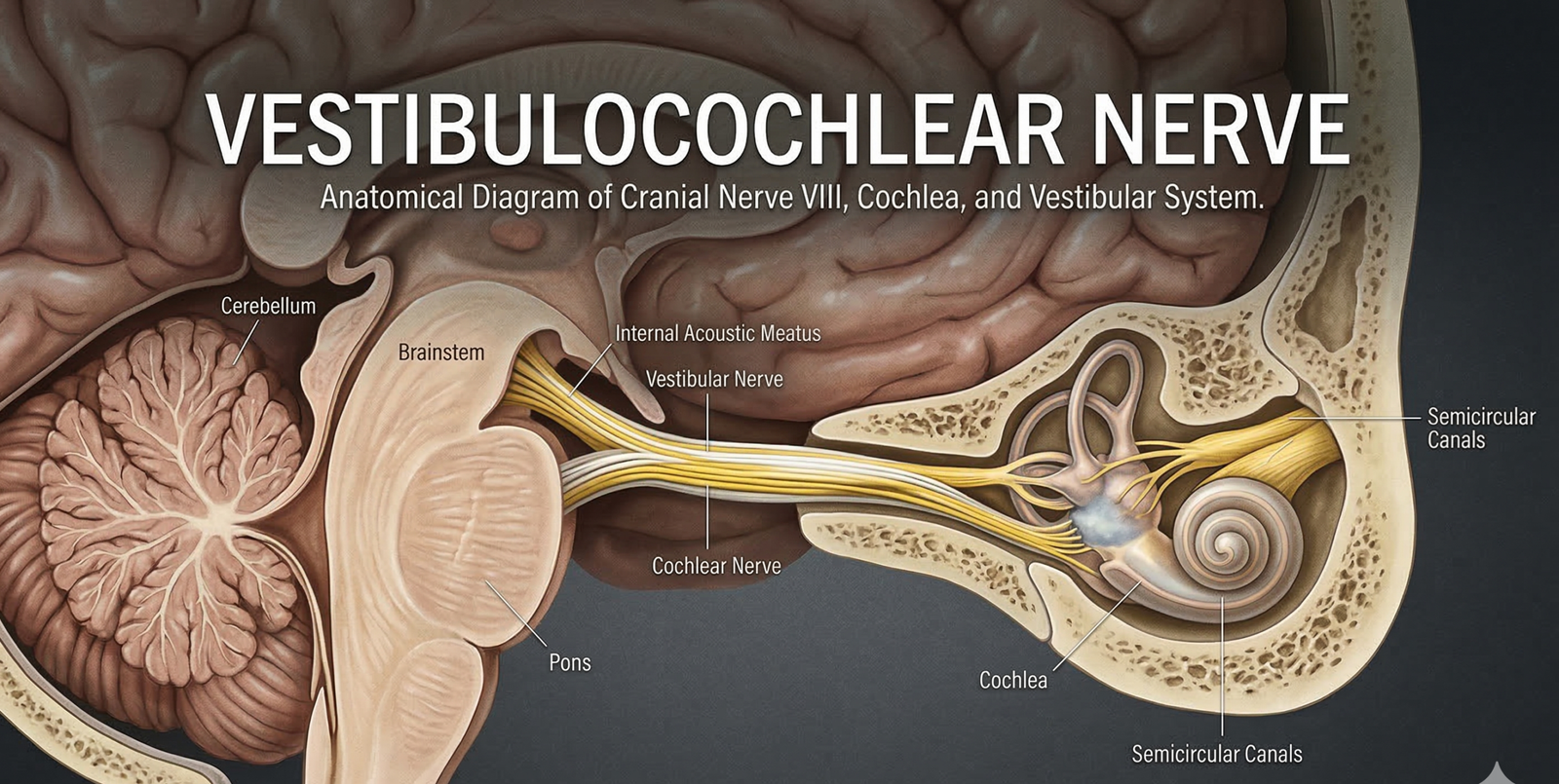
The vestibulocochlear nerve is a purely sensory intracranial nerve responsible for transmitting auditory (sound) and vestibular (balance) information from the inner ear to the brain (Benoudiba et al., 2013).
Anatomically and functionally, it is divided into two distinct components:
- The Cochlear Nerve: Responsible for hearing.
- The Vestibular Nerve: Responsible for balance, spatial orientation, and movement coordination.
Histological evaluations of the nerve reveal that these two components are distinct, with the cochlear fibers appearing anatomically denser and darker than the vestibular fibers as they travel through the posterior cranial fossa (Schefter & Harner, 1986).
Anatomy and Pathway
The journey of the vestibulocochlear nerve begins in the intricate structures of the inner ear and ends in the complex processing centers of the brain.
1. The Peripheral Receptors
- Cochlear Component: Impulses originate in the spiral ganglion of the cochlea. Specialized hair cells translate sound vibrations into electrical action potentials.
- Vestibular Component: This portion originates in the vestibular apparatus, which includes the semicircular canals (detecting angular rotation) and the otolith organs, known as the utricle and saccule (detecting linear acceleration and gravity) (Highstein & Holstein, 2006).
2. The Cranial Pathway
Once the sensory information is converted into electrical signals, the peripheral processes merge. The vestibular and cochlear nerves join together to form CN VIII within the internal acoustic meatus (a canal in the temporal bone). The nerve then travels through the cerebellopontine angle to enter the brainstem at the pontomedullary junction.
3. Brainstem and Cortical Processing
Upon reaching the brainstem, the nerve splits again to deliver information to specific nuclei:
- Auditory Pathway: Cochlear fibers synapse in the cochlear nuclei. Signals then ascend through the brainstem to the auditory cortex located in the temporal lobe, where sound is consciously perceived and interpreted.
- Vestibular Pathway: Vestibular fibers terminate in the vestibular nuclei of the brainstem, a complex network that informs the brain about the position of the head with respect to gravity and movement (Highstein & Holstein, 2006).
Clinical Significance and Disorders
Damage to the vestibulocochlear nerve can have devastating consequences, necessitating precise neurophysiologic monitoring during surgical procedures near the skull base to prevent permanent structural injury (Simon, 2011). In clinical practice, several disorders are linked to CN VIII pathology:
Vestibular Schwannoma (Acoustic Neuroma)
Vestibular schwannomas are benign tumors arising from the Schwann cells that myelinate the nerve. They are the most common lesions responsible for damage to CN VIII (Benoudiba et al., 2013). As the tumor slowly grows, it compresses the nerve, leading to progressive unilateral hearing loss, persistent ringing in the ears (tinnitus), and severe imbalance.
Vestibular Neuritis (Acute Unilateral Vestibulopathy)
Vestibular neuritis involves the inflammation of the vestibular portion of the nerve, often following a viral infection. It leads to a sudden vestibular tone imbalance between the two ears (Strupp & Magnusson, 2015).
The diagnosis is primarily based on patient history and bedside examinations (Strupp et al., 2022). Patients typically experience a dramatic and acute onset of:
- Spinning or non-spinning vertigo
- Postural imbalance and a tendency to fall
- Severe nausea and vomiting
- Oscillopsia (the illusion of a vibrating environment)
Ménière’s Disease
Ménière’s disease is characterized by episodic attacks of vertigo, fluctuating hearing loss, and aural fullness. Advanced neuroimaging, specifically diffusion tensor imaging (DTI), has demonstrated that patients with Ménière’s disease actually exhibit microstructural damage within the vestibulocochlear nerve, indicating that the condition affects nerve integrity beyond just the inner ear environment (Yuan et al., 2022).
The Neuropsychological Impact of CN VIII Dysfunction
From a psychological perspective, disorders of the vestibulocochlear nerve frequently result in significant psychiatric comorbidities.
The Psychological Burden of Hearing Loss: When the cochlear nerve is impaired, the resulting sensorineural hearing loss forces the brain to allocate excessive cognitive resources simply to process speech. This increased cognitive load frequently leads to chronic fatigue, social withdrawal, and a heightened risk of depressive disorders.
The Anxiety of Spatial Disorientation: The vestibular system operates largely in the subconscious. However, when the vestibular nerve fails, the world suddenly feels unpredictable. Conditions like vestibular neuritis or Ménière’s disease induce vertigo attacks that strip patients of their physical autonomy. This lack of control often triggers severe anxiety disorders, panic attacks, and agoraphobia (fear of open or crowded spaces), as patients live in constant dread of their next dizzy spell.
Conclusion
The vestibulocochlear nerve is an extraordinary sensory highway that keeps us tethered to reality—allowing us to communicate through sound and move confidently through space. For psychological professionals, recognizing the profound mental health implications of CN VIII disorders allows for a more holistic, empathetic approach to treating patients suffering from hearing and balance impairments.