
The trigeminal nerve, also known as cranial nerve V, is one of the most important nerves in the human nervous system. It is the largest cranial nerve and plays a crucial role in transmitting sensory information from the face to the brain while also controlling the muscles responsible for chewing.
Understanding the trigeminal nerve is essential not only in neuroscience and medicine but also in psychology, as it plays a significant role in pain perception, facial sensation, emotional expression, and neurological disorders that affect mental well-being.
This article explores the anatomy, branches, functions, disorders, and psychological relevance of the trigeminal nerve in a comprehensive and SEO-friendly manner.
What is the Trigeminal Nerve?
The trigeminal nerve (cranial nerve V) is a mixed nerve, meaning it contains both sensory and motor fibers.
It is primarily responsible for:
- Facial sensation (touch, pain, temperature)
- Motor control of chewing muscles
- Reflex actions such as blinking and jaw movement
The name “trigeminal” comes from the Latin word trigeminus, meaning “threefold”, referring to its three major branches that spread across the face.
These branches allow the brain to receive sensory signals from almost the entire face, mouth, teeth, and nasal cavity.
Anatomy of the Trigeminal Nerve
The trigeminal nerve originates from the brainstem, specifically from the pons, which is a part of the hindbrain.
It consists of two roots:
1. Sensory Root
This is the larger root and carries sensory information such as:
- Pain
- Touch
- Temperature
- Pressure
from the face to the brain.
2. Motor Root
The motor root controls muscles involved in mastication (chewing).
These muscles include:
These muscles help in biting, chewing, and jaw movement.
Three Major Branches of the Trigeminal Nerve
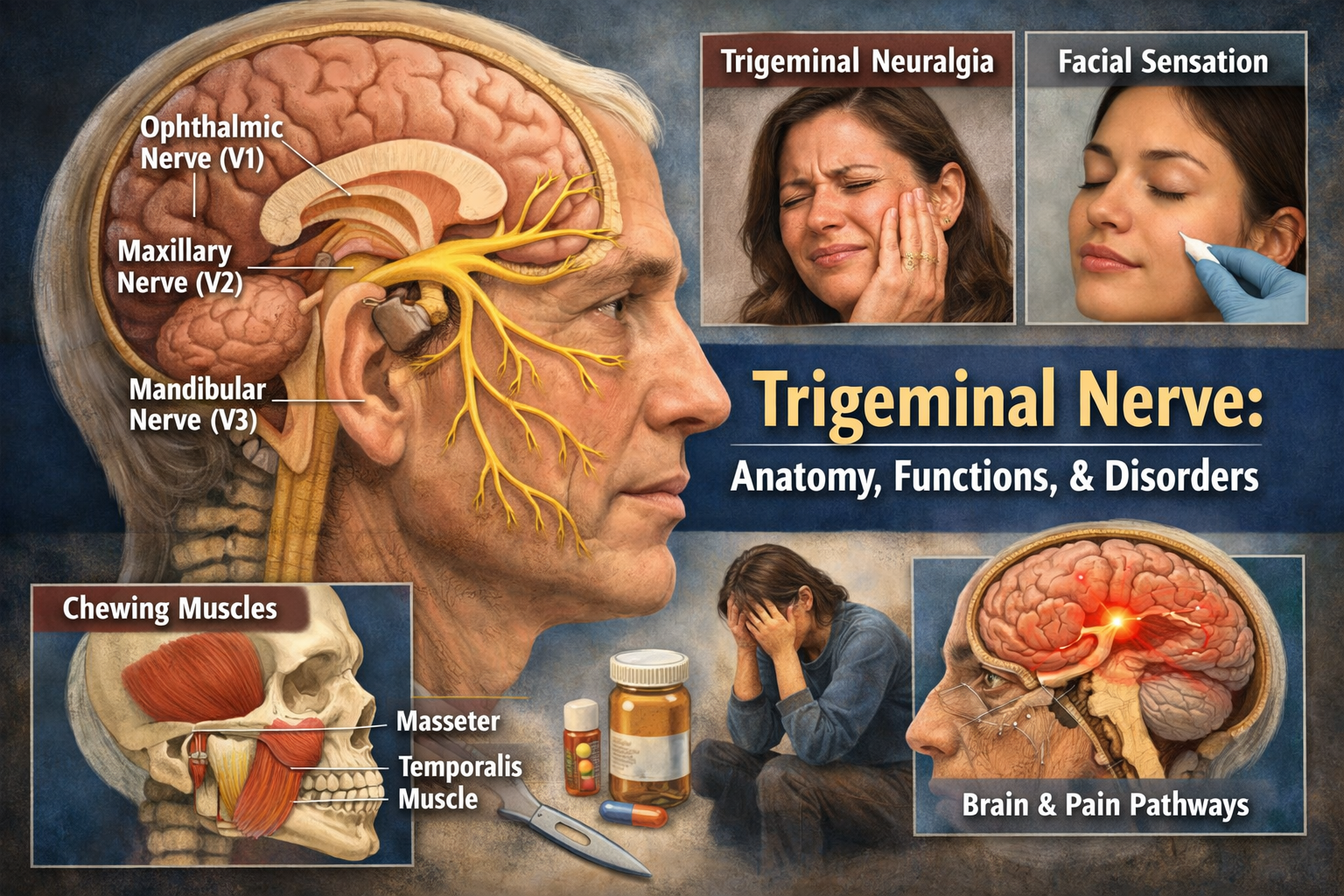
The trigeminal nerve divides into three primary branches, each responsible for sensation in different parts of the face.
1. Ophthalmic Nerve (V1)
The ophthalmic nerve is purely sensory and supplies the upper part of the face.
Functions include sensation from:
It also plays an essential role in the corneal reflex, which protects the eyes.
2. Maxillary Nerve (V2)
The maxillary nerve is also purely sensory and supplies the middle region of the face.
It transmits sensory signals from:
- Lower eyelid
- Cheeks
- Upper lip
- Upper teeth and gums
- Nasal cavity
- Palate
This branch is particularly important in dental sensation and facial pain perception.
3. Mandibular Nerve (V3)
The mandibular nerve is the only branch with both sensory and motor functions.
It controls:
Sensory functions
- Lower lip
- Lower teeth
- Chin
- Jaw
- Parts of the tongue
Motor functions
- Muscles responsible for chewing
This branch is essential for eating, speaking, and jaw movement.
Functions of the Trigeminal Nerve
The trigeminal nerve performs several critical functions in the body.
1. Facial Sensation
It carries sensory information such as:
- Touch
- Pain
- Temperature
- Pressure
from the face to the brain.
This allows humans to feel stimuli on the face, which is essential for survival and protection.
2. Chewing and Jaw Movement
The motor fibers of the trigeminal nerve control muscles that help in:
- Biting
- Chewing food
- Jaw opening and closing
Without proper functioning of this nerve, mastication becomes difficult.
3. Protective Reflexes
The trigeminal nerve is involved in several reflex actions, including:
These reflexes protect sensitive structures like the eyes and oral cavity.
Trigeminal Nerve Disorders
Damage or dysfunction of the trigeminal nerve can lead to several neurological conditions.
1. Trigeminal Neuralgia
Trigeminal neuralgia is one of the most painful neurological disorders.
It is characterized by:
- Sudden intense facial pain
- Electric shock-like sensations
- Pain triggered by everyday activities such as talking or brushing teeth
This condition often affects one side of the face and can significantly impact quality of life and mental health.
2. Trigeminal Neuropathy
Trigeminal neuropathy occurs when the nerve is damaged due to injury, infection, or tumors.
Symptoms may include:
- Facial numbness
- Weak chewing muscles
- Loss of sensation
3. Multiple Sclerosis and Trigeminal Pain
People with multiple sclerosis (MS) sometimes develop trigeminal neuralgia because the disease damages the protective myelin sheath around nerves.
Psychological Impact of Trigeminal Nerve Disorders
Chronic facial pain caused by trigeminal nerve disorders can have significant psychological consequences.
1. Anxiety and Depression
Severe and unpredictable pain can lead to:
- Anxiety disorders
- Depression
- Emotional distress
Patients may fear daily activities that trigger pain, leading to reduced quality of life.
2. Social Withdrawal
People suffering from trigeminal neuralgia may avoid:
- Eating in public
- Speaking for long periods
- Social interactions
This can lead to isolation and loneliness.
3. Chronic Pain and Mental Health
From a psychological perspective, chronic pain can affect:
- Cognitive functioning
- Emotional regulation
- Sleep quality
Psychologists often work alongside neurologists to provide coping strategies, cognitive behavioral therapy (CBT), and stress management techniques.
Diagnosis of Trigeminal Nerve Disorders
Doctors diagnose trigeminal nerve disorders through:
- Neurological examination
- MRI scans to detect nerve compression
- Sensory tests to evaluate facial sensation
Accurate diagnosis is essential to determine the cause of facial pain.
Treatment and Management
Treatment depends on the severity and cause of the condition.
1. Medications
Common medications include:
- Anticonvulsants
- Muscle relaxants
- Pain relief drugs
These medications help reduce nerve pain signals.
2. Surgical Treatments
In severe cases, procedures may include:
- Microvascular decompression
- Gamma knife radiosurgery
- Rhizotomy
These treatments aim to reduce pressure on the nerve.
3. Psychological Therapy
Since chronic pain affects mental health, psychological interventions such as:
- Cognitive Behavioral Therapy (CBT)
- Mindfulness-based stress reduction
- Pain coping therapy
can significantly improve patient well-being.
Importance of the Trigeminal Nerve in Psychology and Neuroscience
The trigeminal nerve is highly relevant in psychological and neuroscientific research because it connects sensory perception, pain processing, and emotional response.
Researchers study this nerve to understand:
- Pain perception mechanisms
- Brain-body interaction
- Emotional responses to chronic pain
- Neurological disorders affecting mental health
Understanding this nerve helps psychologists develop better treatments for pain-related psychological disorders.
Conclusion
The trigeminal nerve (cranial nerve V) is a vital component of the human nervous system responsible for facial sensation and chewing movements. With its three major branches—ophthalmic, maxillary, and mandibular—it plays a key role in transmitting sensory information and controlling important motor functions.
Disorders affecting this nerve, particularly trigeminal neuralgia, can cause severe facial pain and significantly impact psychological health and quality of life. Therefore, a multidisciplinary approach involving neurology, psychology, and pain management is essential for effective treatment.
Understanding the trigeminal nerve not only enhances our knowledge of human anatomy and neuroscience but also highlights the deep connection between physical pain and mental well-being.