
The human visual system is a marvel of biological engineering, and at the heart of this system lies the optic nerve. Also known as Cranial Nerve II, the optic nerve serves as the vital communication bridge between the eyes and the brain. In the realm of biopsychology and cognitive science, understanding the optic nerve is fundamental to grasping how raw sensory data is transformed into the rich, complex visual world we perceive.
This article explores the anatomical structure, physiological functions, and psychological implications of the optic nerve.
Anatomy of the Optic Nerve
The optic nerve is not a single nerve fiber, but rather a bundled cable containing approximately 1.2 million retinal ganglion cell axons. Remarkably, because it is derived from an outpouching of the diencephalon during embryonic development, the optic nerve is considered part of the central nervous system (CNS) rather than the peripheral nervous system.
The physical trajectory of the optic nerve can be broken down into four distinct anatomical segments:
- Intraocular (Optic Nerve Head): This is where the nerve fibers gather at the back of the eye, forming the optic disc. Because there are no photoreceptors (rods and cones) at this specific location, it creates the natural physiological “blind spot” in human vision.
- Intraorbital: The segment that travels through the orbit (eye socket) within a sheath of protective fat and connective tissue.
- Intracanalicular: The narrow portion where the nerve passes through the optic canal in the sphenoid bone to enter the cranial cavity.
- Intracranial: The final segment before the nerves from both eyes converge at a critical junction known as the optic chiasm.
Function: Navigating the Visual Pathway
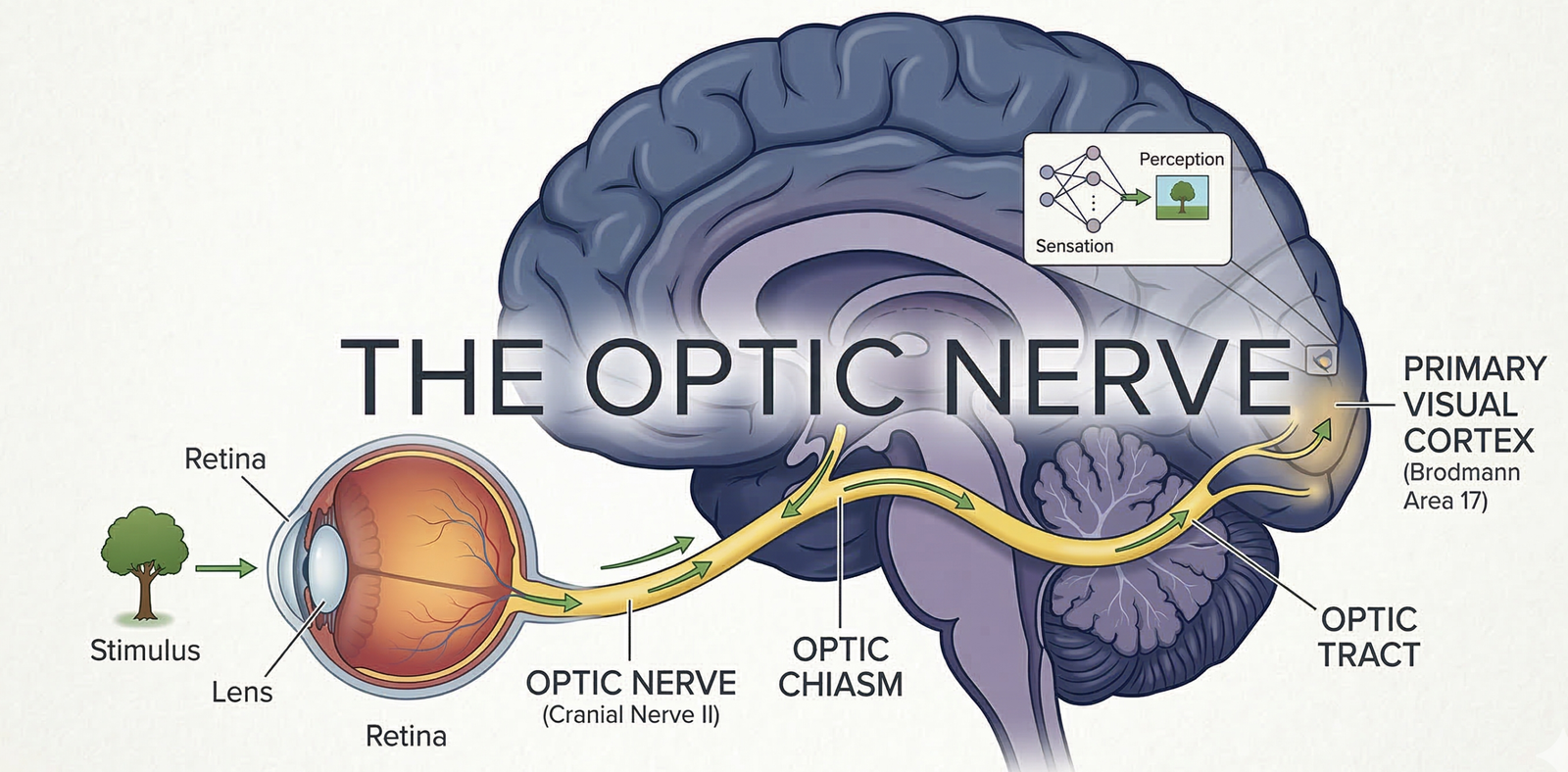
The primary function of the optic nerve is to transmit visual information—encoded as electrical impulses—from the retina to the visual centers of the brain. This journey is known as the visual pathway.
- Transduction: Light entering the eye is converted into electrical signals by the photoreceptors in the retina.
- Transmission: These signals are passed to bipolar cells and then to retinal ganglion cells, whose long axons make up the optic nerve.
- The Optic Chiasm: A crucial crossing point in the brain. Here, nerve fibers from the nasal (inner) half of each retina cross over to the opposite side of the brain, while fibers from the temporal (outer) half stay on the same side. This ensures that visual information from the right field of vision is processed by the left hemisphere of the brain, and vice versa.
- Processing: The signals travel via the optic tract to the Lateral Geniculate Nucleus (LGN) in the thalamus, which acts as a relay station, before finally reaching the primary visual cortex in the occipital lobe for advanced processing.
The Optic Nerve in Biopsychology and Perception
For psychologists, the optic nerve represents the first step in the complex psychological process of perception. Sensation (the physical detection of light) occurs in the eye, but perception (the psychological interpretation of that light) occurs in the brain.
The Blind Spot and Neural Filling
The optic disc’s lack of photoreceptors creates a blind spot in each eye’s visual field. However, from a psychological standpoint, we rarely notice this gap. The brain utilizes top-down processing and contextual clues from the surrounding environment to “fill in” the missing information. This phenomenon highlights how human perception is not merely a passive recording of reality, but an active, constructive cognitive process.
Visual Agnosia and Cognitive Processing
Damage along the visual pathway, subsequent to the optic nerve, can lead to fascinating neuropsychological conditions such as visual agnosia. While the optic nerve may perfectly transmit the visual data, the brain loses the ability to interpret it. Patients may be able to see an object clearly but fail to recognize or name it, demonstrating the distinct boundary between biological sensation and cognitive perception.
Clinical Significance and Disorders
Damage or disease affecting the optic nerve can profoundly impact a person’s vision and, consequently, their psychological well-being, often leading to anxiety, depression, or adjustment disorders. Common conditions include:
| Condition | Description |
| Glaucoma | A group of eye conditions that damage the optic nerve, often associated with abnormally high pressure inside the eye. It is a leading cause of blindness. |
| Optic Neuritis | Inflammation of the optic nerve, frequently linked to autoimmune diseases like Multiple Sclerosis (MS). It can cause pain and temporary vision loss. |
| Optic Neuropathy | General damage to the optic nerve caused by blocked blood flow (ischemic), toxicity, or nutritional deficiencies. |
Conclusion
The optic nerve is much more than a simple biological cable; it is the fundamental conduit for human visual perception. By translating physical light into neural language, Cranial Nerve II provides the raw data that our brains use to construct our reality. For students and professionals in psychology, a thorough understanding of the optic nerve bridges the gap between biological neuroscience and cognitive psychology, illustrating exactly how we interact with the world around us.