
Category: Cognitive Psychology / Personality Assessment
Reading Time: 8 Minutes
Have you ever looked at a friend’s messy scrawl and joked that they must be a genius? Or looked at perfectly looped cursive and assumed the writer is organized and calm?
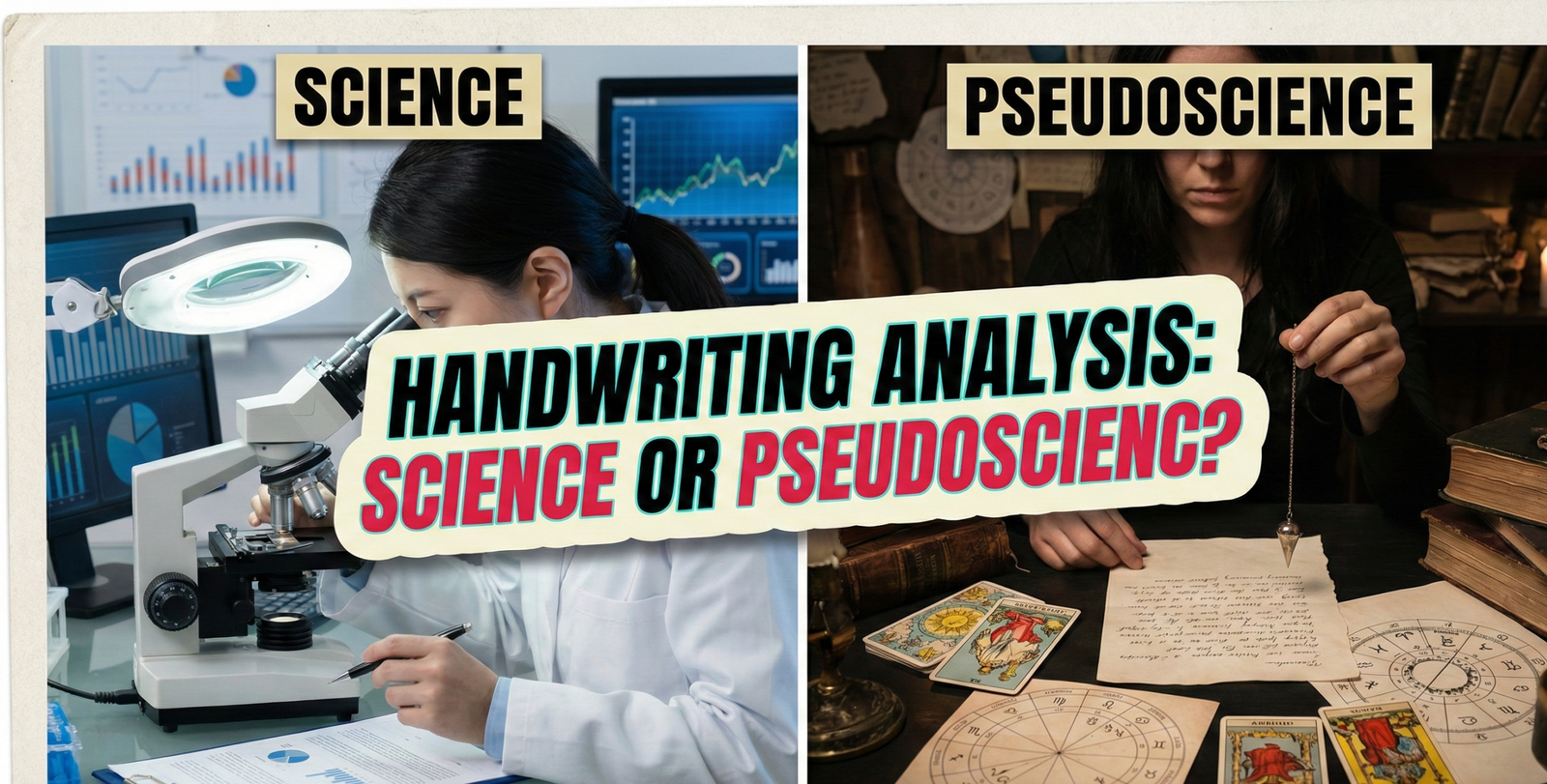
This practice is known as Graphology—the study of handwriting to determine a person’s character, personality traits, and mental state. It is a fascinating concept that has captured human imagination for centuries. But for students and professionals in psychology, the critical question remains: Is graphology a legitimate scientific tool, or is it merely a pseudoscience?
In this deep dive for Formal Psychology, we examine the evidence, the methods, and the verdict of the scientific community.
1. What is Graphology?
Graphology is based on the hypothesis that handwriting is “brain writing”—an expressive movement modulated by the central nervous system that reveals subconscious personality traits.
Graphologists analyze physical characteristics of handwriting, including:
- Slant: (Left, right, or vertical) believed to indicate emotional responsiveness.
- Pressure: Believed to indicate vitality or stress levels.
- Size: Believed to indicate self-esteem or introversion/extroversion.
- Zone Balance: Analysis of upper loops (intellect), middle zone (ego/daily life), and lower loops (instincts/drives).
The “Logic” Behind the Claims
Proponents argue that just as body language reveals internal states, the micro-movements of writing reveal the writer’s psychological makeup. For example, a graphologist might claim that “t” bars crossed very high suggest high goals and ambition, while open “o”s suggest talkativeness.
2. The Scientific Verdict: Evidence vs. Belief
When subjected to the rigorous standards of psychological science—reliability and validity—graphology struggles to hold up.
The Problem of Reliability
Reliability refers to consistency. If two different graphologists analyze the same script, will they give the same personality profile?
- Studies show: Inter-rater reliability in graphology is often low. Two analysts often produce contradictory profiles for the same person.
The Problem of Validity
Validity refers to accuracy. Does the analysis actually measure what it claims to measure?
- Meta-Analysis Results: Extensive meta-analyses (such as those by Dean & Kelly) comparing graphology predictions against standardized personality tests (like the Big Five or Eysenck Personality Questionnaire) show zero to near-zero correlation.
- In controlled studies where graphologists are given handwriting samples and asked to predict job performance or personality traits, they perform no better than chance.
The Consensus
The majority of the academic psychological community classifies graphology as pseudoscience. It is grouped similarly to astrology—a system that relies on subjective interpretation and anecdotal evidence rather than empirical data.
3. The Vital Distinction: Graphology vs. Forensic Document Examination
It is crucial for Formal Psychology readers to distinguish between Graphology and Forensic Handwriting Analysis. They are often confused but are fundamentally different.
| Feature | Graphology | Forensic Document Examination |
| Goal | Determine personality or character. | Determine authorship or authenticity. |
| Method | Interprets loops and slants as psychological traits. | Compares spacing, letter formation, and variations to match a suspect. |
| Legal Status | Generally inadmissible in court. | Widely accepted as forensic evidence. |
| Scientific Basis | Considered Pseudoscience. | Considered Applied Science. |
Forensic experts do not claim to know if a suspect is “shy” or “aggressive” based on their writing; they only claim to know if the suspect wrote the note.
4. Why Does It Feel Real? The Psychology of Belief
If graphology is scientifically invalid, why do millions of people (and even some corporations) still use it? The answer lies in cognitive psychology.
The Barnum Effect (Forer Effect)
This is the same psychological phenomenon that makes horoscopes feel accurate. Graphological readings often consist of vague, universally applicable statements.
- Example: “You have a great deal of unused capacity which you have not turned to your advantage.”
- Almost everyone identifies with this statement, making the analysis feel “uncannily accurate.”
Confirmation Bias
If you know someone is an artist, and you see they have “creative” looking handwriting, you count that as a “hit” for graphology. You ignore the accountant who has messy writing or the artist who writes with rigid precision.
Semantic Association
We naturally associate “upward” movements with optimism and “downward” movements with pessimism. These are metaphorical associations, not neurological connections, but they feel intuitively correct to our brains.
5. Conclusion: A Projective Art, Not a Science
For the readers of Formal Psychology, the takeaway is clear:
While handwriting analysis can be an entertaining party trick or a “projective technique” (similar to the Rorschach inkblot test) to start a conversation, it should not be used for serious diagnostics, hiring decisions, or character judgment.
Handwriting is determined by biomechanics, fine motor skills, training, and culture—not by your subconscious secrets. As psychologists, we must rely on evidence-based tools. Graphology, unfortunately, does not make the cut.