
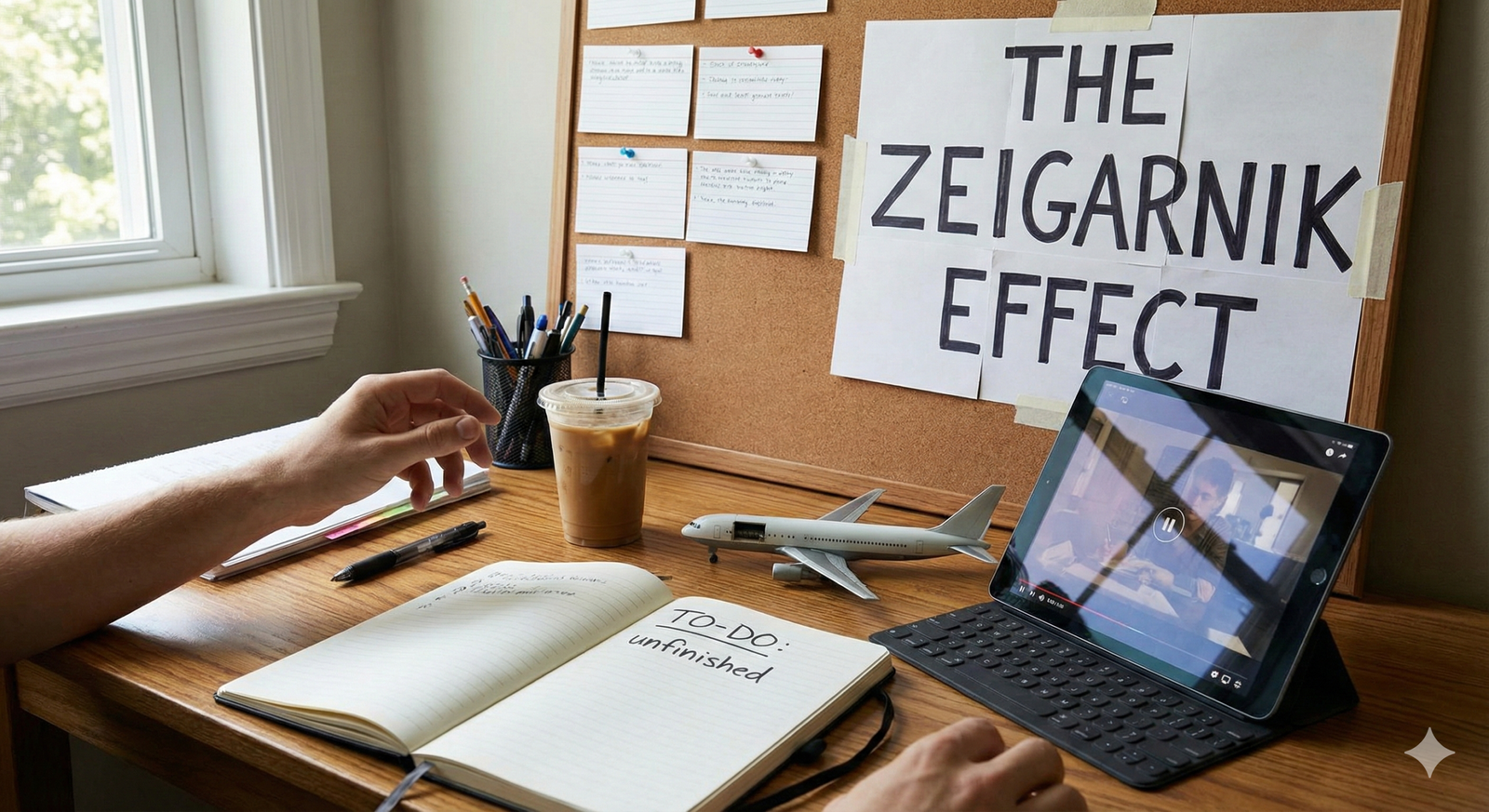
Have you ever had a song stuck in your head, playing on an endless loop just because you couldn’t remember the final lyric? Or perhaps you’ve found yourself lying awake at night, unable to sleep because you left an email draft open at work?
This mental “itch” isn’t just anxiety; it is a well-documented psychological phenomenon known as the Zeigarnik Effect.
At Formal Psychology, we believe in understanding the mechanisms behind our daily behaviors. Today, we are decoding why your brain prioritizes unfinished business—and how you can hack this mechanism to master your productivity.
What is the Zeigarnik Effect?
The Zeigarnik Effect states that people remember uncompleted or interrupted tasks better than completed ones. Essentially, when a task is left unfinished, the brain maintains a state of “cognitive tension,” keeping the information accessible in your short-term memory. Once the task is finished, that tension is released, and the brain “archives” or discards the information.
The Origin Story: A Waiter in Vienna
The discovery of this effect dates back to the 1920s and is attributed to a Soviet psychologist named Bluma Zeigarnik.
While sitting in a busy Viennese restaurant, Zeigarnik noticed something peculiar about the waiters. They could remember complex orders for large tables with perfect accuracy—as long as the bill was unpaid. However, the moment the transaction was closed and the customers left, the waiters instantly forgot the details of the order.
Intrigued, Zeigarnik conducted a series of experiments. She asked participants to complete simple puzzles and tasks, but she interrupted them halfway through some of the activities. The results were clear: Participants were twice as likely to recall the tasks they had been interrupted during than the ones they had completed.
The Psychology Behind the Effect
Why does our brain do this? It comes down to a need for cognitive closure.
When you start a task, your mind opens a “task-specific tension.” This is essentially a mental open loop. Your brain keeps this loop active in your working memory to ensure you return to it. It is a biological reminder system designed to prevent us from abandoning important goals.
- Task Initiation: The brain engages and creates a mental file.
- Interruption: The file remains open; cognitive tension persists.
- Completion: The tension is resolved, and the brain files the memory away (often forgetting the specifics).
This is why you might study furiously for an exam and remember every detail, only to forget most of it the day after the test is over.
The Zeigarnik Effect in Everyday Life
You are likely manipulated by the Zeigarnik Effect every day without realizing it.
- TV Cliffhangers: Screenwriters are masters of this. By ending an episode in the middle of a high-stakes moment (an unfinished task), they create psychological tension that compels you to binge-watch the next episode immediately to get “closure.”
- Video Games: Quests and progress bars utilize this effect. A progress bar stuck at 95% creates a mental itch that is much harder to ignore than one at 0%.
- Clickbait: Headlines like “You won’t believe what happened next…” open a curiosity loop that your brain demands you close by clicking the link.
The Dark Side: Anxiety and “Open Loops”
While the Zeigarnik Effect is a natural memory aid, it can backfire. In the modern world, we often have dozens of “open loops” at once—unread texts, half-finished projects, and vague to-do lists.
When your brain is holding onto too many unfinished tasks, it leads to:
- Decision Fatigue: Your working memory is clogged with “pending” files.
- Intrusive Thoughts: The brain interrupts your relaxation time to remind you of incomplete work.
- Sleep Disturbance: The cognitive tension prevents the mental wind-down necessary for sleep.
How to Use the Zeigarnik Effect to Your Advantage
You can turn this psychological quirk into a superpower. Here is how to apply the Zeigarnik Effect for better productivity and mental peace.
1. The “Just Five Minutes” Rule (Beating Procrastination)
Procrastination often stems from the fear of a large, looming task. To trigger the Zeigarnik Effect, simply commit to doing the task for five minutes.
- Why it works: Once you start, you open that “cognitive loop.” Even if you stop after five minutes, the psychological tension will nag you to return and finish the job. The hardest part is starting; the Zeigarnik Effect helps you continue.
2. Strategic Interruptions (Boosting Creativity)
If you are stuck on a difficult problem or writer’s block, intentionally stop while you still know what happens next.
- Why it works: By walking away mid-task, you keep the problem active in your subconscious. This incubation period allows your brain to work on the solution in the background, often leading to “Aha!” moments when you are in the shower or taking a walk.
3. The Brain Dump (Reducing Anxiety)
If you are overwhelmed by open loops, you need to “trick” your brain into thinking the tasks are handled.
- Why it works: Writing down your unfinished tasks in a trusted system (like a planner or app) signals to your brain that the information is safe. This reduces the cognitive tension, allowing you to relax without forgetting the tasks entirely.
Conclusion
The Zeigarnik Effect is a powerful reminder that our brains are wired for completion. While it can be a source of stress when left unchecked, understanding this mechanism allows us to hack our motivation.
Whether you are a student trying to retain information or a professional looking to beat procrastination, the key is simple: Just start. Your brain will take care of the rest.