
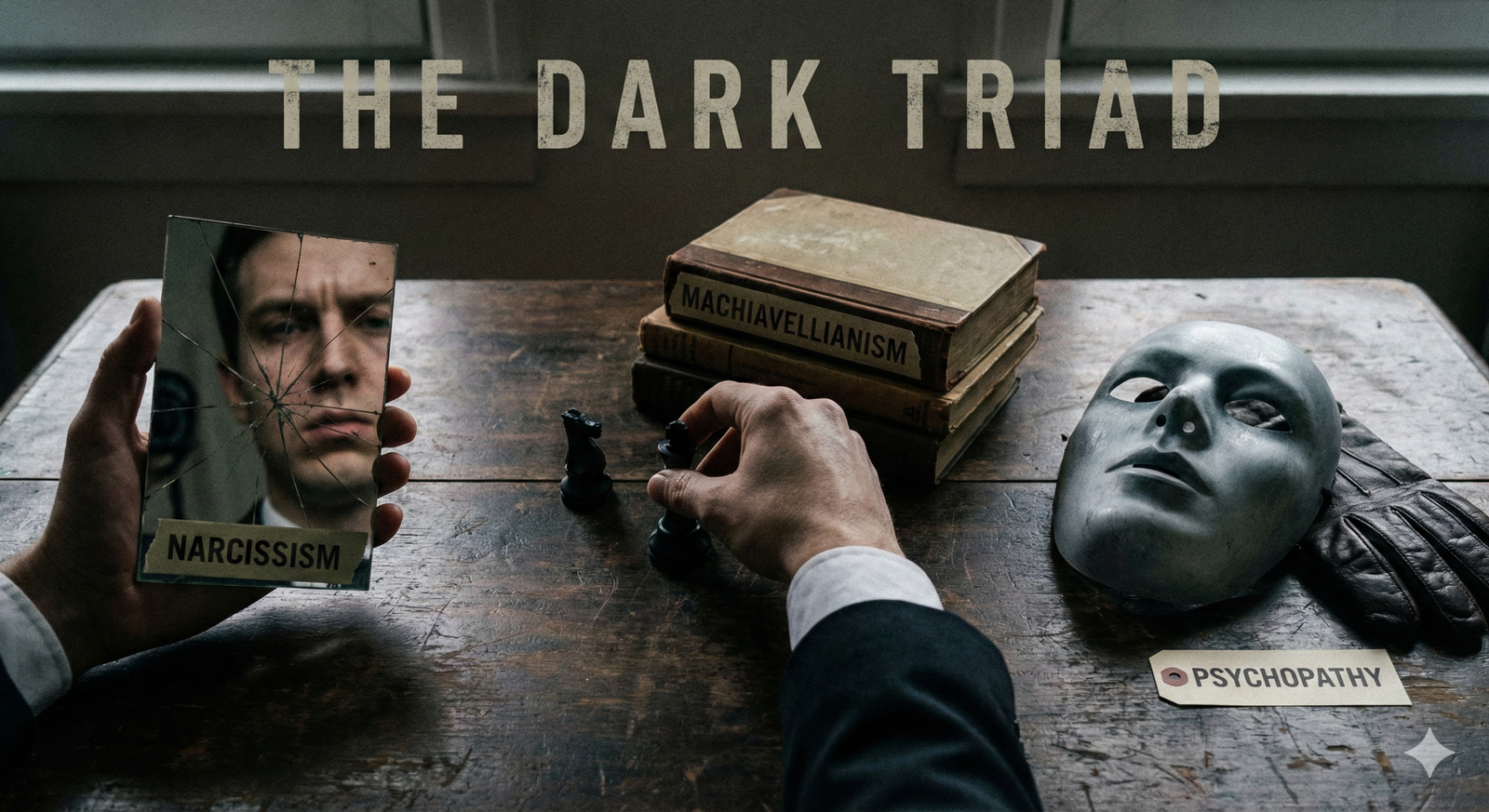
In the vast landscape of personality psychology, few concepts are as captivating—and unsettling—as the Dark Triad. This term, coined by researchers Delroy Paulhus and Kevin Williams in 2002, refers to a constellation of three distinct but theoretically related offensive personality traits: Narcissism, Machiavellianism, and Psychopathy.
While these traits are distinct, they often overlap, creating a profile of individuals who are callous, manipulative, and willing to exploit others for personal gain. For students of psychology and laypeople alike, understanding the Dark Triad is essential for recognizing toxic behaviors in relationships, the workplace, and society at large.
What is the Dark Triad?
The Dark Triad represents the “malevolent” side of human personality. Unlike clinical disorders diagnosed in a medical setting, the Dark Triad traits are generally viewed as subclinical. This means that while an individual may score high on these traits, they may not necessarily meet the threshold for a clinical personality disorder diagnosis (like Narcissistic Personality Disorder or Antisocial Personality Disorder). Instead, they function within society, often rising to positions of power despite—or because of—their darker tendencies.
1. Narcissism: The Mask of Superiority
Named after the Greek myth of Narcissus, who fell in love with his own reflection, Narcissism within the Dark Triad is characterized by grandiosity, pride, egotism, and a lack of empathy.
- Key Characteristics:
Unlike the other two traits, narcissists are often driven by a fragile ego. Their grandiosity is a defense mechanism to protect deep-seated insecurity. They don’t just want to win; they want to be seen winning.
2. Machiavellianism: The Art of Manipulation
Named after the Renaissance political philosopher Niccolò Machiavelli, Machiavellianism refers to a personality type that is cynical, unprincipled, and manipulative. High-Mach individuals view people as stepping stones rather than human beings.
- Key Characteristics:
- Strategic and calculating behavior.
- Cynical worldview (believing that “the ends justify the means”).
- Emotional detachment and lack of affect.
- Focus on self-interest and deception.
- High impulse control (unlike psychopaths, they can wait for the perfect moment to strike).
A Machiavellian individual is the ultimate chess player in the social world. They do not seek attention like the narcissist; they seek power and control, often operating from the shadows to orchestrate events in their favor.
3. Psychopathy: The Coldest Cut
Considered the darkest of the three, Psychopathy in the context of the Dark Triad is characterized by enduring antisocial behavior, impulsivity, selfishness, callousness, and remorselessness.
- Key Characteristics:
- Lack of empathy, guilt, or remorse.
- Shallow affect (incapable of deep emotional bonding).
- Impulsivity and thrill-seeking behavior.
- Persistent violation of social norms.
- Low anxiety and fearlessness.
High-psychopathy individuals are often charming on the surface (the “glib charm”), but this facade hides a distinct lack of conscience. Unlike the Machiavellian who calculates, the psychopath often acts on impulse, unconcerned with the consequences for themselves or others.
The Overlap: The “Dark Core”
While distinct, these three traits share a common core often referred to as the D-Factor (Dark Factor). The unifying themes are:
- Callousness: A distinct lack of empathy for others.
- Manipulativeness: A willingness to use others for personal gain.
An individual high in the Dark Triad possesses a “short-term mating strategy” evolutionary profile—preferring immediate gratification and exploitation over long-term cooperation and stability.
Identifying the Dark Triad in Real Life
Recognizing these traits in the wild is the first step toward protection.
- In the Workplace: They are often the co-worker who steals credit for your ideas (Narcissism), the manager who pits employees against each other to maintain control (Machiavellianism), or the executive who makes ruthless firing decisions without a hint of remorse (Psychopathy).
- In Relationships: They may “love bomb” you initially to gain control, gaslight you to make you doubt your reality, and discard you once you no longer serve a purpose.
Conclusion: Why It Matters
Understanding the Dark Triad is not just an academic exercise for psychologists; it is a survival skill. By recognizing the red flags—grandiosity, manipulation, and a lack of empathy—we can better navigate our social environments and protect our mental well-being.
At Formal Psychology, we believe that shedding light on the darker aspects of human nature is the best way to disarm them. Knowledge is the ultimate defense against manipulation.