
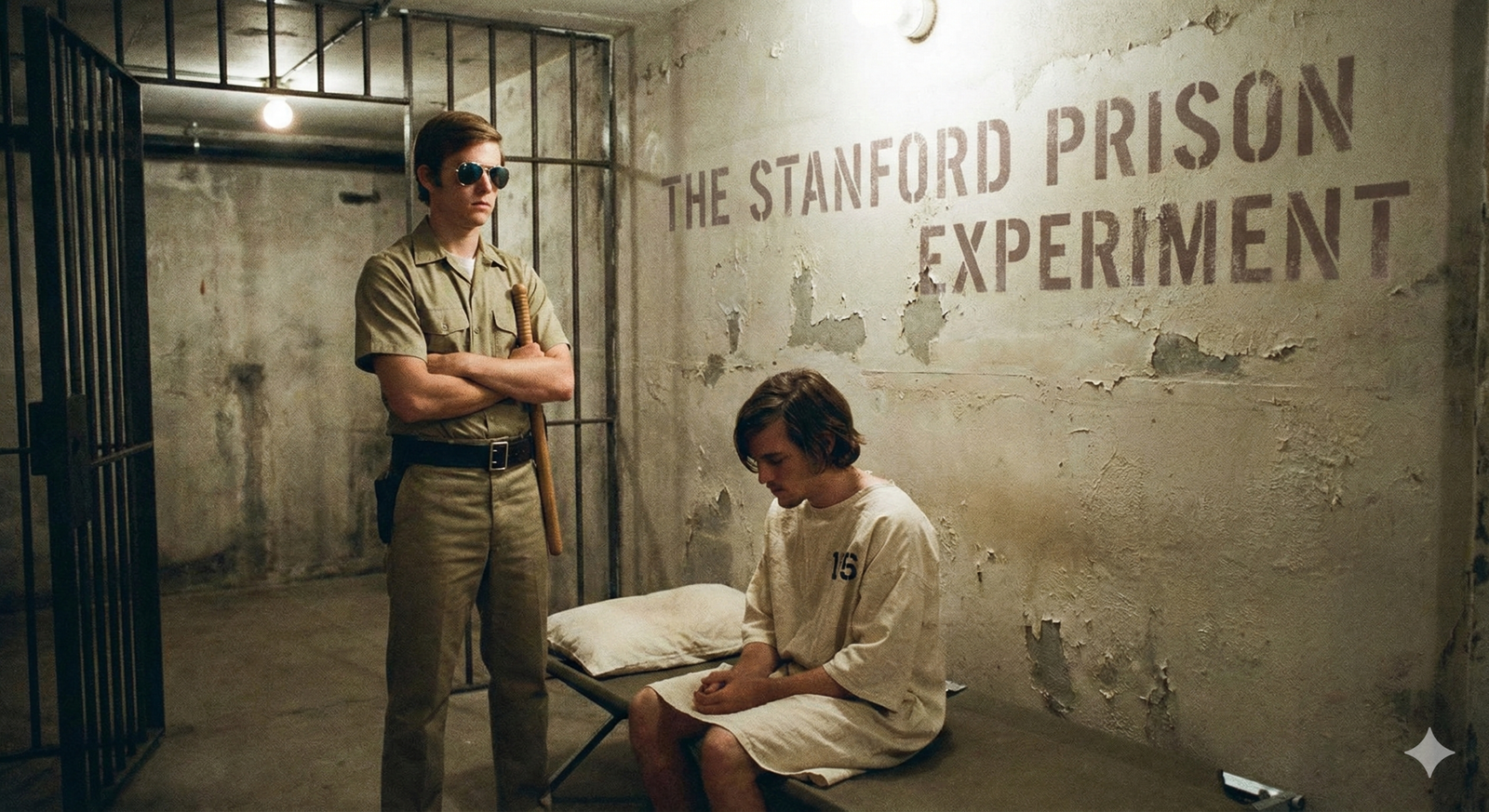
In the annals of social psychology, few studies have captured the public imagination—or incited as much academic debate—as the Stanford Prison Experiment (SPE). Conducted in August 1971 by Professor Philip Zimbardo, the study was intended to examine the psychological effects of perceived power.
More than half a century later, the narrative surrounding the experiment has shifted from a cautionary tale about the inherent darkness of human nature to a complex lesson on research ethics, demand characteristics, and the importance of scientific replicability.
The Premise: The Power of the Situation
The core hypothesis of the SPE was rooted in situational attribution. Zimbardo sought to demonstrate that social roles and institutional environments (the situation) could override individual personality traits (disposition).
The Methodology
- Participants: 24 male college students, screened for psychological stability, were paid $15 a day.
- The Setting: A mock prison built in the basement of the Stanford Psychology Department.
- The Roles: Participants were randomly assigned to be “prisoners” or “guards.”
To heighten realism, prisoners were arrested at their actual homes by real Palo Alto police officers. They were stripped, deloused, and given smocks with numbers. Guards were given military-style uniforms, mirrored sunglasses to prevent eye contact, and wooden batons.
The Descent into Chaos
The experiment was scheduled to run for two weeks but was abruptly terminated after only six days.
What transpired in that short time became the defining narrative of the study:
- Rapid Deindividuation: Guards quickly adopted authoritarian behaviors, subjecting prisoners to psychological torture, sleep deprivation, and humiliation.
- Learned Helplessness: Prisoners initially rebelled but soon became passive, depressed, and anxious.
- Role Internalization: Even Zimbardo admitted to losing his objectivity, acting more like a “Prison Superintendent” concerned with maintaining order than a lead researcher concerned with safety.
The conclusion drawn at the time was the Lucifer Effect: good people can turn evil when placed in a “bad barrel” (a corrupting system).
50 Years Later: Re-evaluating the Findings
While the SPE remains a staple in introductory psychology textbooks, modern analysis suggests the “lessons” are different than what was originally taught.
1. The Role of “Demand Characteristics”
Recent archival investigations suggest the guards did not act spontaneously. Recordings and documents released decades later reveal that Zimbardo and his warden, David Jaffe, gave guards specific instructions to be “tough” and to create feelings of helplessness.
This introduces demand characteristics—where participants act in a way they believe the researcher wants them to. The guards may have been “role-playing” based on the script provided by the authority figure (Zimbardo), rather than succumbing to the natural corruption of power.
2. Selection Bias
A 2007 study on the “recruitment” phase of the SPE found that the wording of the ad matters. When an ad mentions “prison life,” it tends to attract volunteers who score higher on traits like aggression and narcissism and lower on empathy compared to a generic ad for a “psychological study.” This suggests the sample might not have been as “average” as claimed.
3. The Failure to Replicate
The BBC Prison Study (2002), a televised replication attempt, produced vastly different results. In that scenario, guards failed to establish authority, and prisoners organized a coup. This demonstrated that tyranny is not a natural outcome of groups; rather, group dynamics are fluid and depend on shared identity and leadership.
The Ethical Revolution
Perhaps the most enduring legacy of the SPE is the overhaul of research ethics.
Under today’s Institutional Review Board (IRB) standards, the SPE would be impossible to conduct. The study violated current core ethical principles:
- Protection from Harm: Participants suffered genuine psychological trauma.
- Right to Withdraw: When a prisoner asked to leave, he was initially treated as if he were “paroled” and denied, leading him to believe he could not quit.
The SPE, along with the Milgram Experiment, was the catalyst for the strict ethical codes (like the Belmont Report) that govern human subject research today.
What We Truly Learned
Fifty years later, we can distill the true lessons of the Stanford Prison Experiment:
- Systems Matter, But So Does Leadership: People do not automatically abuse power. They abuse power when authorities (like Zimbardo) legitimize oppression and encourage cruelty.
- Critical Thinking in Science: The SPE teaches us to question “textbook” science. It reminds us that dramatic results require rigorous scrutiny regarding methodology and experimenter bias.
- The Fragility of Identity: While the “natural evil” narrative is flawed, the study still highlights how easily human beings can be manipulated by social pressures, labels, and dehumanization.
Conclusion
The Stanford Prison Experiment is no longer viewed simply as proof that “we are all potential monsters.” Instead, it stands as a complex monument to the early, often reckless days of social psychology. It serves as a reminder that science is a self-correcting process, and that the story of human behavior is far more nuanced than a simple division between guards and prisoners.