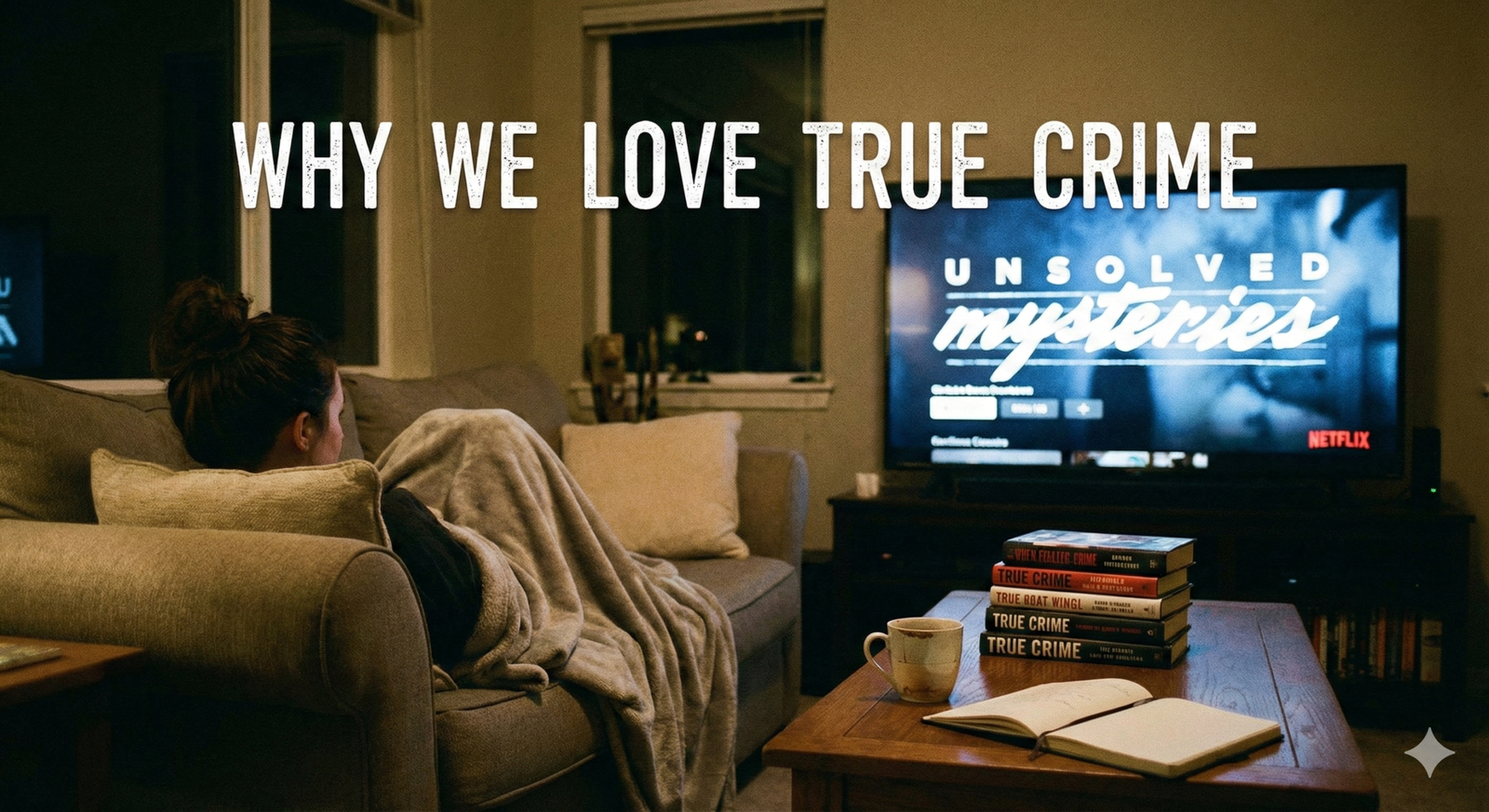

Whether it is binge-watching Dahmer on Netflix or listening to the Serial podcast on a morning commute, true crime has evolved from a niche genre into a global cultural phenomenon. But for many, this obsession comes with a pang of guilt: Is it normal to be entertained by tragedy?
At Formal Psychology, we believe the answer lies not in moral deficiency, but in the complex wiring of the human mind. Our fascination with the macabre is a deeply rooted psychological trait that serves specific evolutionary and emotional functions.
Here is the fully explained psychology behind why we love true crime.
1. Evolutionary Psychology: The Survival Instinct
One of the leading theories behind true crime obsession is the evolutionary survival instinct. Psychologists suggest that our interest in murder and mayhem is not just “morbid curiosity,” but a biological drive to avoid becoming a victim.+1
Learning by Vicarious Experience
By studying the circumstances of a crime—how a killer gained entry, what red flags the victim missed, or how a survivor escaped—we are essentially running a mental simulation.
- Threat Detection: We watch to identify warning signs in our own lives.
- Preparedness: We unconsciously ask ourselves, “What would I do in that situation?”
Note: This theory explains why statistics show that women are the primary consumers of true crime. As the demographic most frequently targeted by violent crime, women may use these narratives as “survival guidebooks” to navigate a dangerous world.
2. The Physiology of Fear: Controlled Adrenaline
Why do we enjoy being scared? The answer lies in the amygdala, the part of the brain responsible for processing fear.
When we watch a horror movie or a true crime documentary, our brain releases stress hormones like adrenaline and cortisol. However, because we are watching from the safety of our couch, our frontal lobes (the reasoning center) confirm that we are not in actual danger.
The “benign masochism” effect
This mixture of high arousal and verified safety creates a sensation known as benign masochism. It allows us to experience the “rush” of danger without the actual threat, followed by a flood of dopamine and endorphins when the tension resolves.
3. The Need for Cognitive Closure
Humans have an innate desire for cognitive closure—we hate ambiguity. Unsolved mysteries bother us; solved cases comfort us.
True crime stories often follow a structured narrative arc:
- Disruption: A crime occurs, shattering the peace.
- Investigation: The chaotic gathering of clues (The Puzzle).
- Resolution: The perpetrator is caught, and order is restored.
This structure appeals to our psychological need to see justice served and order restored to a chaotic world. It reaffirms the “Just World Hypothesis”—the psychological bias that good things happen to good people and bad people get punished.
4. Shadow Work and the “Deviant Mind”
Carl Jung, the Swiss psychiatrist, spoke of the “Shadow Self”—the unconscious part of our personality that contains our repressed darker impulses.
Civilized society requires us to suppress aggression and violence. True crime allows us to safely explore these suppressed aspects of humanity. We are fascinated by the “Deviant Mind” because it is alien to us. We look at a serial killer and wonder:
- How can a human being lack empathy?
- What happened in their childhood to create this?
- Could I ever be capable of this?
This exploration allows us to confront the reality of evil from a safe distance, helping us process the frightening fact that monsters look just like us.
5. Empathy and The “Helper” Instinct
Contrary to the idea that true crime fans are desensitized, many are driven by hyper-empathy.
Dr. Scott Bonn, a criminologist and author, argues that many fans develop a parasocial relationship with the victim. We watch not to glorify the killer, but to bear witness to the victim’s story. We want to ensure they are not forgotten. This aligns with the human drive for altruism—the desire to help the pack and ensure the safety of the community.
Summary: Is Your Obsession Healthy?
For the vast majority of people, an interest in true crime is a normal, healthy expression of human curiosity. It helps us:
- Prepare for danger.
- Process fear in a controlled environment.
- Understand the extremes of human psychology.
- Seek justice and order.
However, if you find that consuming this content leads to genuine paranoia, anxiety, or an inability to sleep, it may be time to take a break.
Key Takeaways for Psychology Students & Enthusiasts
| Psychological Driver | Explanation |
| Evolutionary Preparedness | Using stories to learn survival tactics and spot danger. |
| Benign Masochism | Enjoying negative emotions (fear) in a safe context. |
| Cognitive Closure | The need to solve puzzles and see order restored. |
| The Shadow Self | Exploring the suppressed, darker capacity of human nature. |