

Introduction
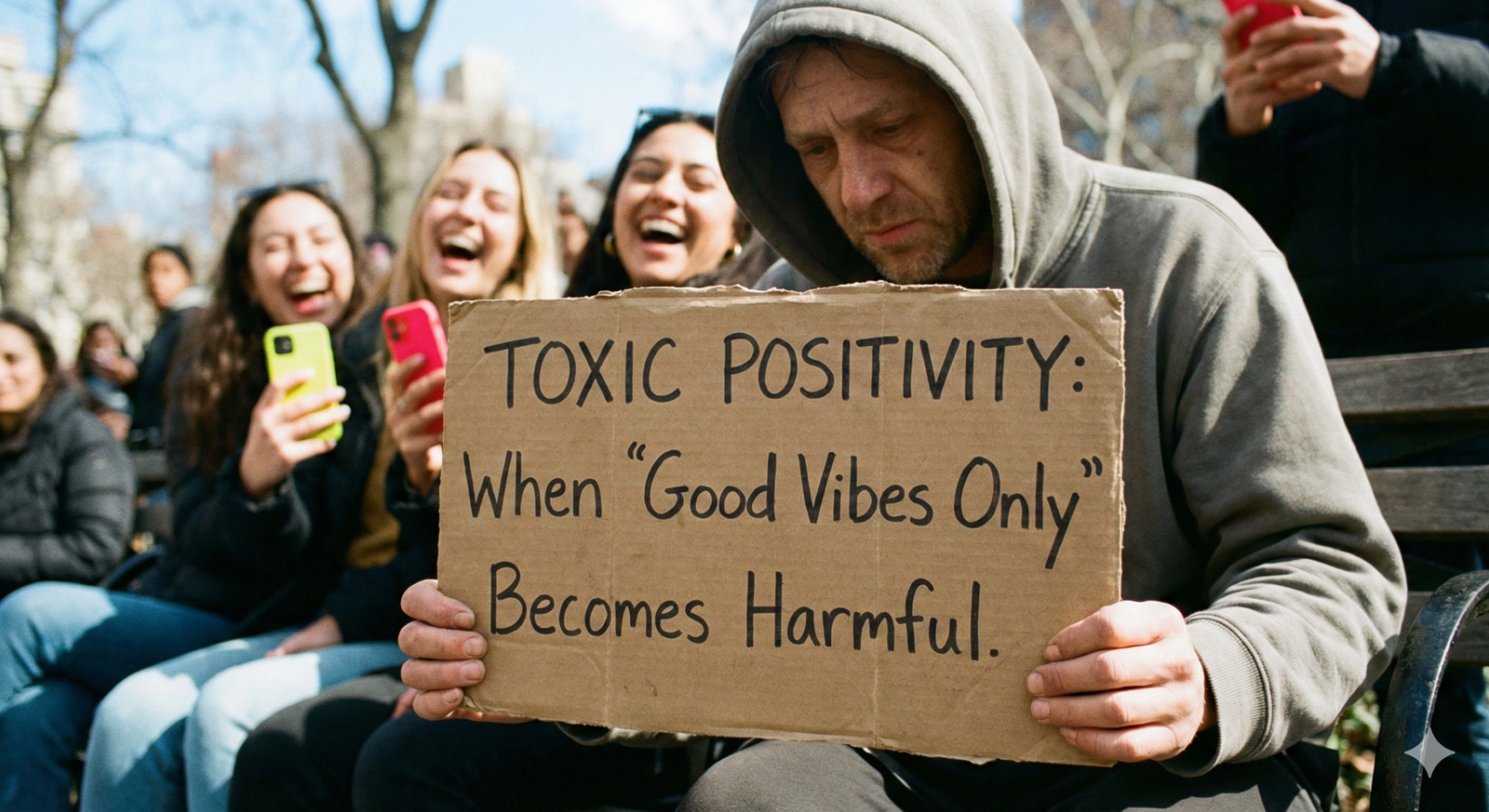
In the age of social media, we are constantly inundated with mantras like “Good vibes only,” “Look on the bright side,” and “Happiness is a choice.” While intended to be uplifting, this relentless pursuit of positivity can sometimes mutate into a maladaptive psychological mechanism known as toxic positivity.+1
At formalpsychology.com, we believe in the integration of the full spectrum of human emotion. This article explores the nuances of toxic positivity, distinguishing it from healthy optimism, and provides evidence-based strategies to navigate difficult emotions authentically.
What is Toxic Positivity?
Toxic positivity is the excessive and ineffective overgeneralization of a happy, optimistic state across all situations. It results in the denial, minimization, and invalidation of the authentic human emotional experience.+1
Unlike healthy optimism, which acknowledges a difficult situation while hoping for a better outcome, toxic positivity demands that we ignore the difficulty entirely. It stems from the belief that negative thoughts are a failure of character and that distress should be immediately replaced with forced cheerfulness.
Key Distinction:
- Healthy Optimism: “This is a really hard situation, but I believe I have the skills to get through it.”
- Toxic Positivity: “Don’t think about the bad stuff! Just stay positive and everything will be fine.”
The Psychology: Why Do We Do It?
Psychologically, toxic positivity functions as an avoidance mechanism. Negative emotions—grief, anger, frustration, and fear—are uncomfortable. To avoid this discomfort, individuals may unconsciously project positivity to create distance from their own pain or the pain of others.+2
- Discomfort with Vulnerability: Many people lack the emotional literacy to sit with sadness. “Fixing” the problem with a positive platitude relieves the listener’s anxiety, even if it harms the speaker.
- Social Conditioning: Society often praises those who “keep a stiff upper lip,” reinforcing the idea that suppressing negative emotion is a sign of strength, rather than a potential health risk.
The Dangers of Suppressed Emotion
When we force positivity, we engage in emotional suppression. Research in formal psychology consistently shows that suppressing emotions does not make them disappear; it merely drives them underground where they can cause more significant psychological and physiological damage.+1
- The Rebound Effect: Attempting to push away a thought or feeling often makes it return with greater intensity.
- Shame and Isolation: When a person is suffering and is told to “just be happy,” they internalize a secondary emotion: shame. They begin to feel that their natural reaction to trauma or stress is “wrong,” leading to isolation.+1
- Gaslighting: Toxic positivity can act as a form of unintentional gaslighting, making individuals question their own reality and emotional validity.
Identifying the Signs
Toxic positivity can be self-inflicted or imposed by others. Here is how to spot it:
In Yourself:
- Hiding your true feelings to avoid “bringing down the mood.”
- Feeling guilty for being sad, angry, or tired.
- Minimizing your problems with phrases like “It could be worse.”
- Dismissing your own trauma because others have it harder.
In Others:
- They shut down your concerns with “Everything happens for a reason.”
- They seem uncomfortable when you express anything other than happiness.
- They offer simple solutions to complex emotional problems (“Just go for a run, you’ll feel better!”).
Toxic Positivity vs. Healthy Validation
To shift away from toxic patterns, we must move toward validation. Validation does not mean agreeing with the negative thought; it means acknowledging the existence of the emotion.
| Instead of saying (Toxic Positivity) | Try saying (Healthy Validation) |
| “Good vibes only!” | “All vibes are welcome here. How are you really feeling?” |
| “Don’t worry, be happy.” | “I can see you are stressed. That makes sense given the situation.” |
| “Failure is not an option.” | “Failure is part of growth. It’s okay to be disappointed.” |
| “It could be so much worse.” | “Your pain is valid, regardless of how ‘bad’ the situation is.” |
| “Everything happens for a reason.” | “I’m so sorry you’re going through this. I’m here for you.” |
How to Break the Cycle
1. Practice “Both/And” Thinking
Dialectical Behavior Therapy (DBT) teaches us that two opposing truths can exist simultaneously. You can be grateful for your life and devastated by a loss. You can be optimistic about the future and anxious about the present. Embracing the “and” eliminates the binary pressure to be only happy.
2. Label Your Emotions
Neuroscience suggests that the simple act of labeling an emotion (“I am feeling frustrated”) dampens the activity in the amygdala, the brain’s alarm center. Instead of suppressing the feeling, name it.
3. Set Boundaries
If someone in your life constantly invalidates your feelings with toxic positivity, it is healthy to set a boundary.
- Script: “I know you’re trying to help, but right now I don’t need a solution or a silver lining. I just need to be heard.”
Conclusion
True psychological resilience is not the absence of distress, but the ability to navigate through it. By rejecting the “good vibes only” narrative, we create space for authentic connection, emotional processing, and genuine healing. At Formal Psychology, we encourage you to embrace the full complexity of your human experience—shadows and all.