
“Looking without seeing is a fundamental flaw in the architecture of the human brain.”
Have you ever searched frantically for your keys, only to realize they were in your hand the whole time? Or perhaps you were so engrossed in a text message that you walked right into a lamppost? These aren’t just moments of clumsiness; they are examples of a fundamental cognitive mechanism known as selective attention.
Nothing illustrates this phenomenon better than one of the most famous studies in the history of psychology: The “Invisible Gorilla” experiment.
The Experiment: Can You Count the Passes?
In 1999, psychologists Daniel Simons and Christopher Chabris at Harvard University conducted a study that would forever change how we understand human perception.
The Setup
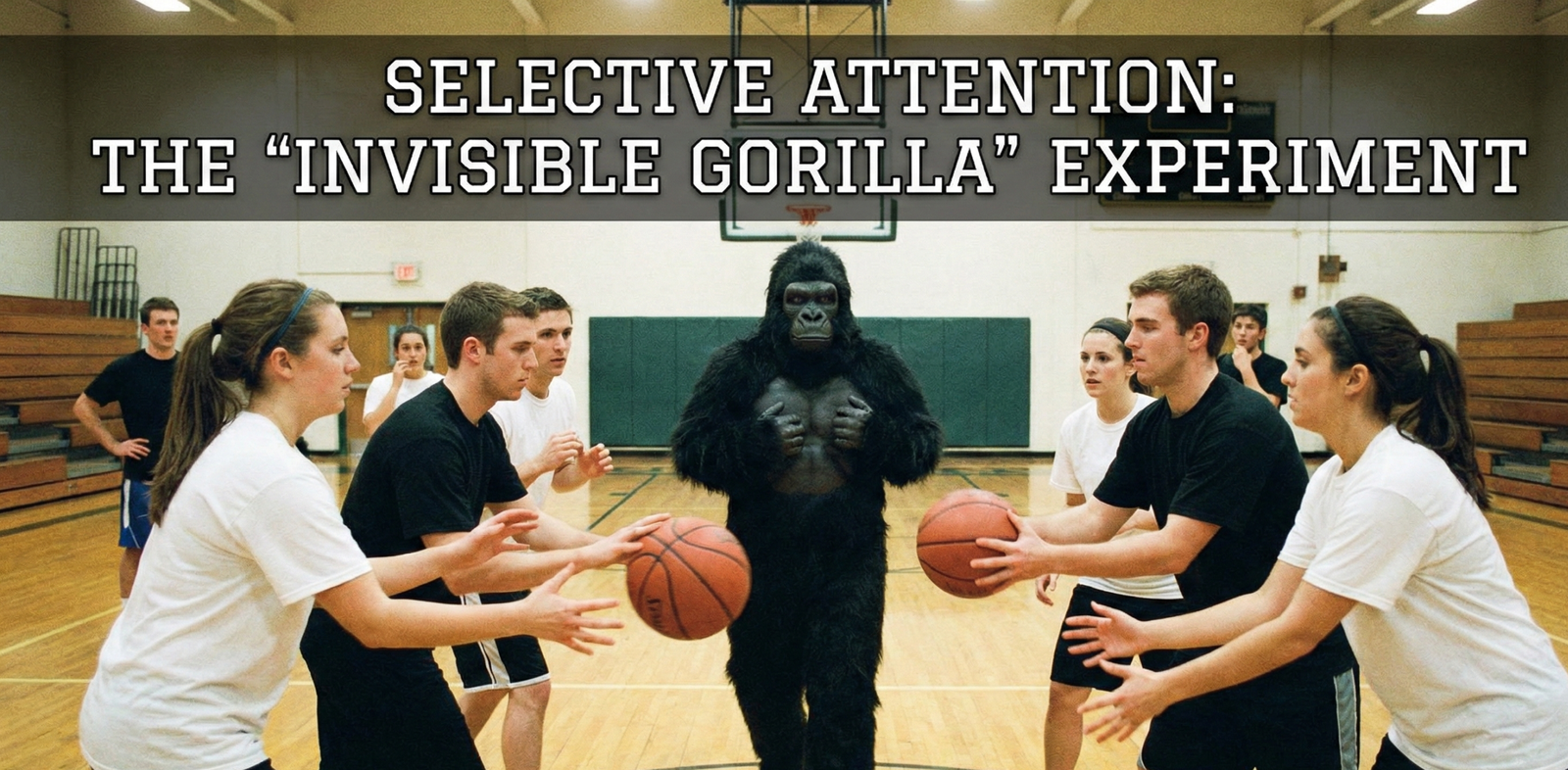
Participants were asked to watch a short video of two teams of people passing basketballs. One team was wearing white shirts, and the other was wearing black shirts. The participants were given a simple, attention-demanding task:
- Count the number of passes made by the team in white.
The Twist
Midway through the video, a person wearing a full-body gorilla suit walks into the center of the frame, faces the camera, thumps their chest, and walks off-screen. The gorilla is visible for a total of 9 seconds.
The Result
After the video ended, the researchers asked the participants: “Did you see anything unusual?”
Shockingly, 50% of the participants did not see the gorilla.
Half of the people—intelligent, focused observers—were so busy counting passes that their brains completely filtered out a giant ape standing right in front of them. When shown the video a second time without the counting task, they were incredulous, often exclaiming, “I must have missed it!” or “The video was changed!”
The Science: What is Inattentional Blindness?
The Invisible Gorilla experiment is the textbook definition of Inattentional Blindness.
This is the psychological phenomenon where an individual fails to perceive an unexpected stimulus that is in plain sight. This happens not because of visual defects, but because the brain is overloaded with other tasks.
How It Works
Our brains are not video cameras. We do not record everything we see. Instead, our cognitive resources are limited. To function efficiently, the brain must prioritize information:
- Top-Down Processing: Your brain focuses on your goal (counting the white passes).
- Filtering: To maintain focus, your brain actively suppresses “irrelevant” information (the black team, the background, and… the gorilla).
- The Bottleneck: Because the gorilla was unexpected and didn’t match the target stimulus (white shirts), it didn’t make it past the attention bottleneck into conscious awareness.
Factors That Influence Selective Attention
Why did half the people see it and half didn’t? Several factors influence the intensity of inattentional blindness:
1. Cognitive Load
The harder the task, the “blinder” you become. If the participants had just been watching the video passively, 100% would have seen the gorilla. The requirement to count passes (a high cognitive load) forced the brain to tunnel vision.
2. Similarity
We are more likely to notice unexpected objects that share features with the object we are tracking.
- In variations of the study, if participants tracked the black team, they were much more likely to spot the black gorilla.
- Because they were tracking the white team, they were primed to ignore dark objects.
3. Expectation
We see what we expect to see. In the real world, gorillas don’t usually interrupt basketball games. Because the stimulus was highly incongruent with the context, the brain dismissed it as noise.
Real-World Implications: Why It Matters
While missing a gorilla in a video is harmless, the implications of selective attention in the real world are profound and sometimes dangerous.
- Driving Safety: This is the primary cause of “Looked but Failed to See” accidents. A driver looking for other cars (large objects) might completely fail to “see” a cyclist or motorcycle, even if they are looking directly at them.
- Eyewitness Testimony: The experiment casts doubt on the reliability of eyewitnesses. Just because someone was present at a crime scene doesn’t mean they processed the details, especially if they were focused on a weapon or their own safety.
- Professional Expertise: Even experts aren’t immune. In a study involving radiologists, 83% of them missed an image of a gorilla inserted into a lung CT scan because they were hunting for cancer nodules.
The Illusion of Attention
The most disturbing part of the Invisible Gorilla experiment isn’t that we miss things; it’s that we believe we see everything.
Simons and Chabris coined the term “The Illusion of Attention.” We operate with a false confidence that if something important happens in our field of view, we will automatically notice it. Psychology tells us this is simply not true.
Conclusion
The Invisible Gorilla teaches us a humbling lesson about the human mind: We perceive very little of the world around us.
Our reality is a construction, heavily edited by our attention. While this allows us to focus and complete complex tasks, it leaves us vulnerable to missing the unexpected. The next time you are sure you saw everything, remember the gorilla. You might be missing more than you think.