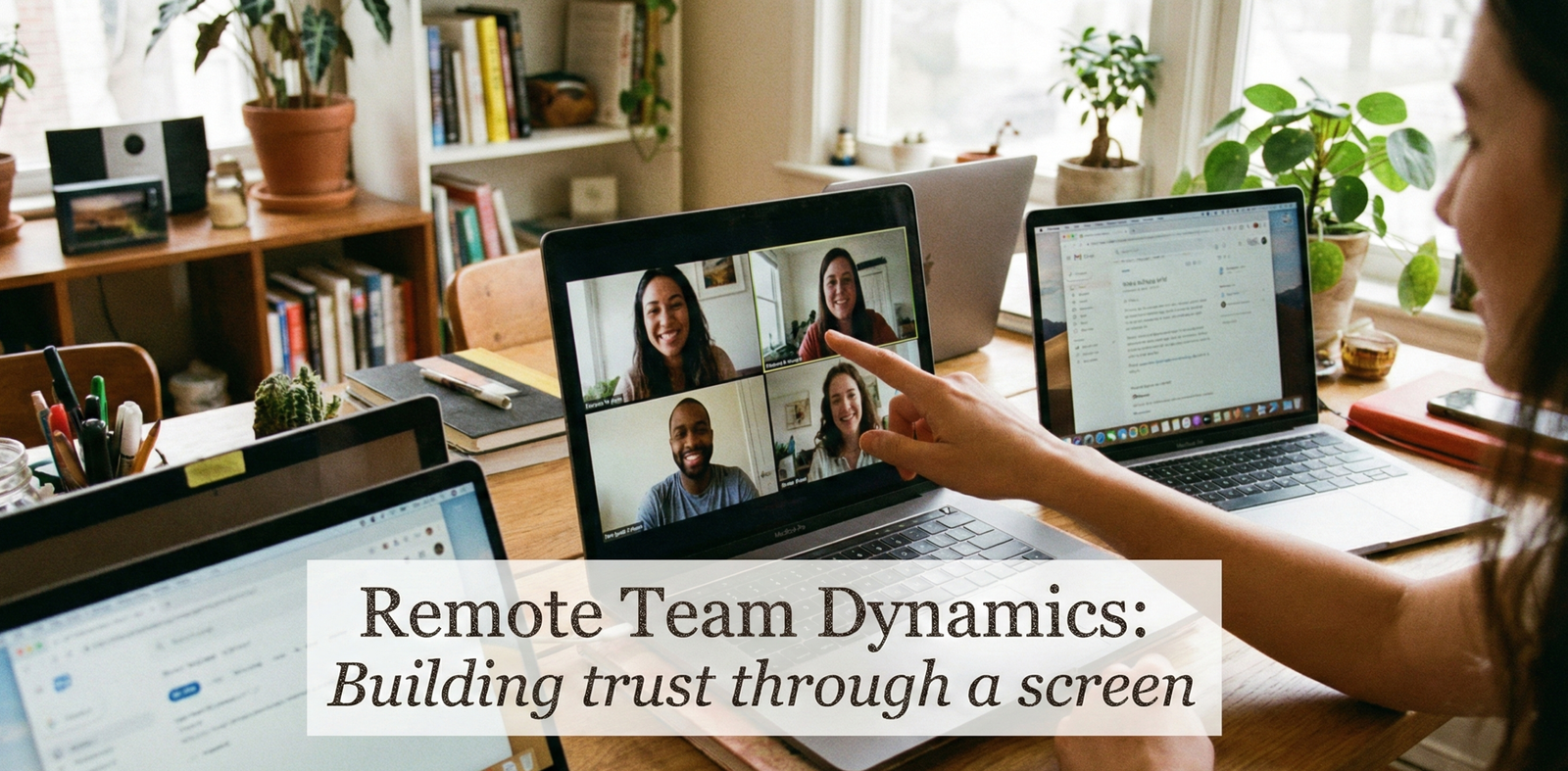

The shift to remote work has fundamentally altered the landscape of organizational psychology. While technology has solved the logistical problem of how we work from anywhere, it has introduced a complex psychological challenge: how we connect, trust, and function as a cohesive unit without physical proximity.
In a traditional office, trust is often built in the “spaces between”—the coffee breaks, the casual nod in the hallway, and the shared physical environment. In a remote setting, these organic moments are stripped away, leaving us to build Remote Team Dynamics intentionally.
This article explores the psychological mechanisms of trust in virtual environments and provides a blueprint for leaders and team members to bridge the digital divide.
The Psychology of the “Trust Gap”
To understand remote dynamics, we must first understand the two distinct types of trust identified in organizational psychology:
- Cognitive Trust (The Head): This is based on performance and competence. “I trust you because I know you can do the job.” In remote teams, this is often easier to establish because work output is digital and measurable.
- Affective Trust (The Heart): This is based on emotional bonds and interpersonal care. “I trust you because I feel you care about my well-being.”
The Remote Dilemma: Virtual environments are excellent for maintaining Cognitive Trust (we can see the finished report) but create significant barriers to Affective Trust. Without body language, tone of voice, and spontaneous interaction, the brain fills the gaps with assumptions—often negative ones. This is known as the Fundamental Attribution Error, where we attribute a delayed email to a colleague’s laziness rather than a technical issue or personal emergency.
The Concept of “Virtual Distance”
It is not just physical miles that separate remote teams; it is Virtual Distance. This is a psychological separation composed of three factors:
- Physical Distance: Geographic separation.
- Operational Distance: Misalignments in communication bandwidth or skill levels.
- Affinity Distance: The lack of shared values, interdependencies, and camaraderie.
High affinity distance is the primary killer of remote team dynamics. When affinity is low, innovation drops, and “us vs. them” mentalities begin to form.
Strategies for Building Trust Through a Screen
Building trust in a pixelated world requires moving from passive observation to active construction. Here is how to apply psychological principles to improve remote team dynamics.
1. Establish Psychological Safety First
Psychological safety—the belief that one will not be punished for making a mistake—is the bedrock of high-performing teams. In a remote setting, silence is often interpreted as agreement, but it can mask fear.
- The Strategy: Leaders must model vulnerability. Admitting, “I am struggling with this new software,” or “I felt overwhelmed yesterday,” signals to the team that it is safe to be human.
- The Ritual: Implement “Red/Yellow/Green” check-ins at the start of meetings where members state their energy levels or mental bandwidth without needing to justify them.
2. The Power of “Swift Trust”
In temporary or fast-moving global teams, there isn’t time to build deep affective trust over years. Teams must rely on “Swift Trust.”
- The Concept: Treat trust as a default state rather than something to be earned. Team members assume positive intent from day one.
- Implementation: Create a “Team Charter” that explicitly outlines communication norms (e.g., “We assume positive intent in all text messages,” or “We define ‘urgent’ as requiring a response within 2 hours”). Clarity reduces anxiety.
3. Combatting the “Black Box” Anxiety
One of the biggest stressors in remote work is the “Black Box” effect—not knowing what others are doing, leading to micromanagement or paranoia.
- The Fix: Replace surveillance with observability.
- Working Out Loud: Encourage team members to “narrate their work” in public channels (e.g., Slack or Teams). Posting a quick, “Just finished the draft, moving to research phase,” provides the reassurance of visibility without the pressure of tracking software.
4. Rich vs. Lean Media
Not all communication channels are created equal.
- Lean Media (Email/Text): Best for factual exchange, setting agendas, and low-complexity updates.
- Rich Media (Video Calls): Essential for sensitive feedback, brainstorming, or conflict resolution where non-verbal cues (facial expressions, tone) are vital to prevent misunderstanding.
Psychological Tip: Do not rely on text for conflict. If a Slack thread becomes tense (more than 3 back-and-forth messages of disagreement), the rule should be to immediately switch to a video call to re-establish human connection.
Recreating the “Water Cooler”: Structured Socialization
Spontaneity is the casualty of remote work. To rebuild it, we must structure social interaction without making it feel like “mandatory fun.”
- Virtual Coworking: Open a video link where team members work silently together with microphones off, simulating a library environment. This utilizes the Social Facilitation Theory, where the mere presence of others can boost motivation and reduce feelings of isolation.
- Non-Work Channels: Create spaces dedicated strictly to hobbies, pets, or food. This allows personality to shine through, rebuilding the Affective Trust mentioned earlier.
Conclusion
Remote team dynamics are not naturally occurring; they are engineered. By understanding the psychological hurdles of virtual distance and the difference between cognitive and affective trust, organizations can foster environments that are not just productive, but psychologically healthy.
Trust through a screen is possible, but it requires us to be more intentional, more empathetic, and more transparent than ever before. In the digital workspace, clarity is kindness, and consistency is trust.