
In an era of decision fatigue, the human brain seeks shortcuts. When you walk down a supermarket aisle or scroll through an app store, you aren’t analyzing every product’s technical specifications. Instead, your brain relies on rapid, subconscious heuristics to determine safety, quality, and value. This is where the psychology of branding intervenes.
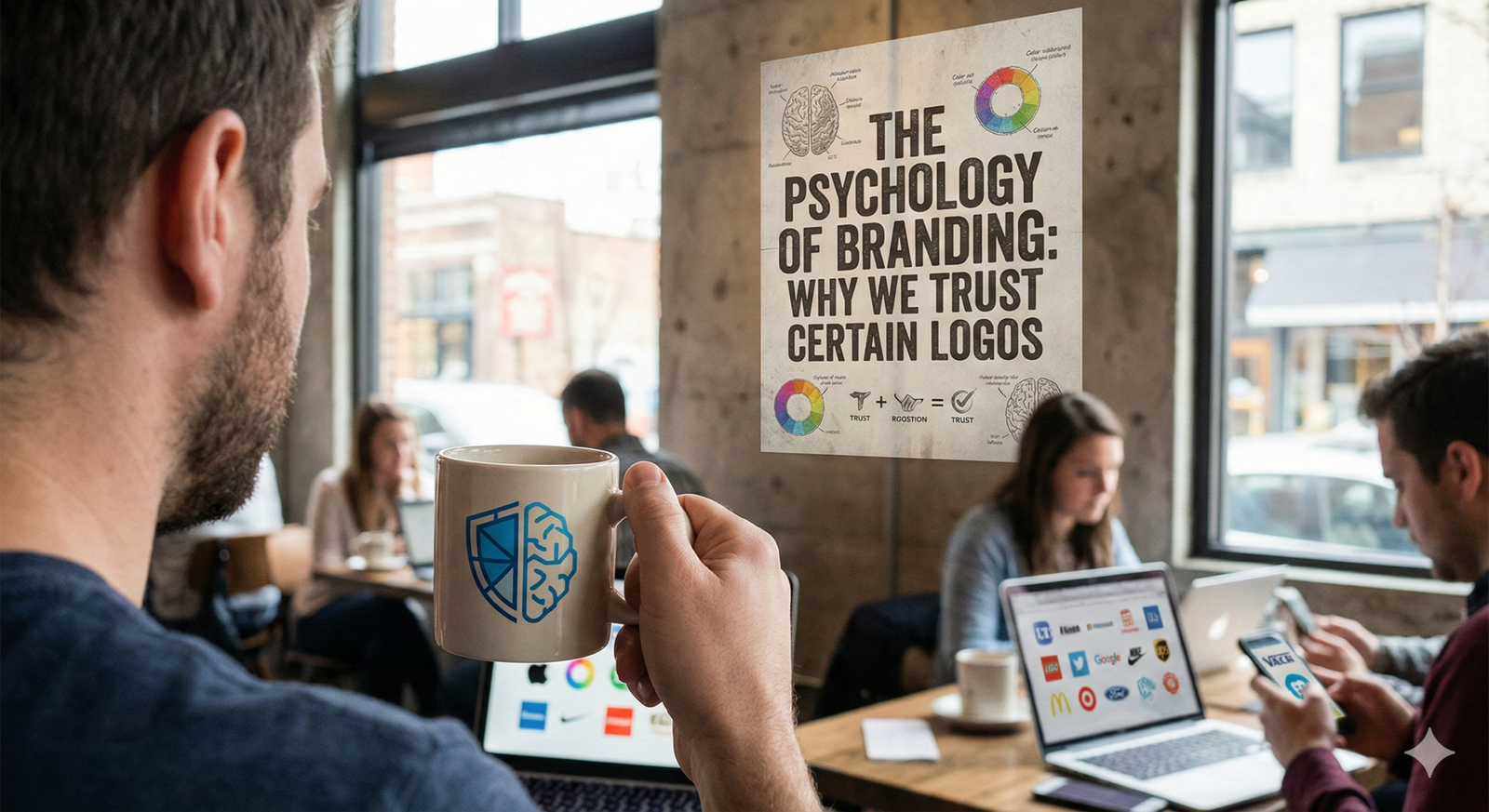
A logo is not merely a graphic; it is a psychological trigger. It is a visual shorthand that communicates a brand’s personality and promise in milliseconds. But why do we inherently trust a blue square (like American Express) over a red triangle? The answer lies in the intersection of evolutionary psychology, color theory, and cognitive neuroscience.
1. The Brain on Brands: Processing Fluency
To understand why we trust logos, we must first understand processing fluency. This psychological concept refers to the ease with which our brains process information.
- Simplicity Wins: The human brain prefers high fluency. Simple, uncluttered logos are easier to process, and in psychology, “easy” often translates to “true” and “safe.”
- The Familiarity Heuristic: A complex or abstract logo forces the brain to expend energy to decode it. A clear, simple logo (think Apple or Nike) feels familiar even if we haven’t seen it often, creating an immediate, subconscious sense of trust.
2. The Color of Credibility
Color is perhaps the most primal component of visual recognition. Research suggests that up to 90% of snap judgments made about products can be based on color alone. Our emotional response to color is often rooted in evolutionary biology and cultural conditioning.
Blue: The Color of Trust
Why do banks (Chase, Citi), social networks (Facebook, LinkedIn), and tech giants (Intel, HP) overwhelmingly use blue?
- Psychological Effect: Blue is associated with the sky and the ocean—constants in our environment. It signals stability, calm, and reliability.
- Trust Factor: It lowers the heart rate and implies fiscal responsibility and security.
Red: Urgency and Appetite
Red is the color of blood and fire. It triggers the pituitary gland, increasing heart rate and creating a sense of urgency.
- Use Case: It is used by brands that want you to act impulsive (Target, Netflix) or feel hungry (McDonald’s, Coca-Cola). While it builds excitement, it does not inherently build “safety” in the same way blue does.
Yellow: Optimism vs. Caution
Yellow captures attention faster than any other color (hence its use in warning signs). In branding, it signals youth, optimism, and clarity (IKEA, Snapchat), but too much can trigger anxiety.
Shutterstock
3. The Geometry of Emotion: Shapes Speak Louder Than Words
While color dictates emotion, shape dictates personality. Our brains attribute human traits to geometric forms based on their physical characteristics.
Circles and Curves (Community & Love)
Our brains are hardwired to view sharp objects as potential threats (a survival mechanism). Conversely, curves are viewed as safe and welcoming.
- Examples: The Olympic Rings, Pepsi, Target.
- Psychology: Circular logos suggest community, unity, and femininity. They imply that the brand is inclusive and harmless.
Squares and Rectangles (Stability & Balance)
Straight lines and right angles do not exist often in nature; they are human-made structures.
- Examples: Microsoft, BBC, LEGO.
- Psychology: These shapes communicate efficiency, professionalism, and strength. We trust these logos when we are looking for a solid foundation or reliable service.
Triangles (Power & Direction)
Triangles are dynamic. They have energy and point in a specific direction.
- Examples: Adidas, Delta Airlines, Mitsubishi.
- Psychology: These represent masculinity, power, and hierarchy. They are often used by brands that promise to move you forward or elevate your status.
4. Cognitive Biases in Branding
Trust is not just about design; it is about how that design interacts with our cognitive biases.
The Mere Exposure Effect
This is a psychological phenomenon where people tend to develop a preference for things merely because they are familiar with them.
- Application: This is why “rebranding” is so risky. We trust the Starbucks siren not because she is logically related to coffee, but because repeated exposure has wired our neural pathways to associate that green circle with a caffeine reward.
The Halo Effect
This occurs when one positive trait of a person or object dominates the way that person or object is viewed by others.
- Application: If a logo is aesthetically pleasing (high symmetry, Golden Ratio), our brains assume the company is also organized, high-quality, and reliable. A poorly designed logo creates a “Horn Effect,” where we assume the product is as sloppy as the design.
5. Brand Archetypes: The Personality Connection
Swiss psychiatrist Carl Jung introduced the concept of archetypes—universally understood symbols or patterns of behavior. Great brands align their visual identity with a specific archetype to build a deeper connection.
- The Caregiver (Johnson & Johnson): Soft colors, rounded fonts. We trust them to protect us.
- The Ruler (Rolex, Mercedes): Black, gold, angular logos. We trust them to provide status.
- The Innocent (Dove, Coca-Cola): Simple, wholesome imagery. We trust them to be honest.
When a brand’s visual identity aligns with its archetype, it creates psychological resonance. We don’t just buy the product; we buy into the character.
Conclusion
The psychology of branding proves that we do not view logos with our eyes, but with our minds. Trust is a biological reaction to visual stimuli. By leveraging the stability of squares, the calm of the color blue, and the cognitive ease of simplicity, brands can bypass our skepticism and speak directly to our subconscious.
For consumers, understanding these triggers is the first step toward conscious consumption. For psychologists and marketers, it is a reminder that in the battle for attention, biology always wins.