
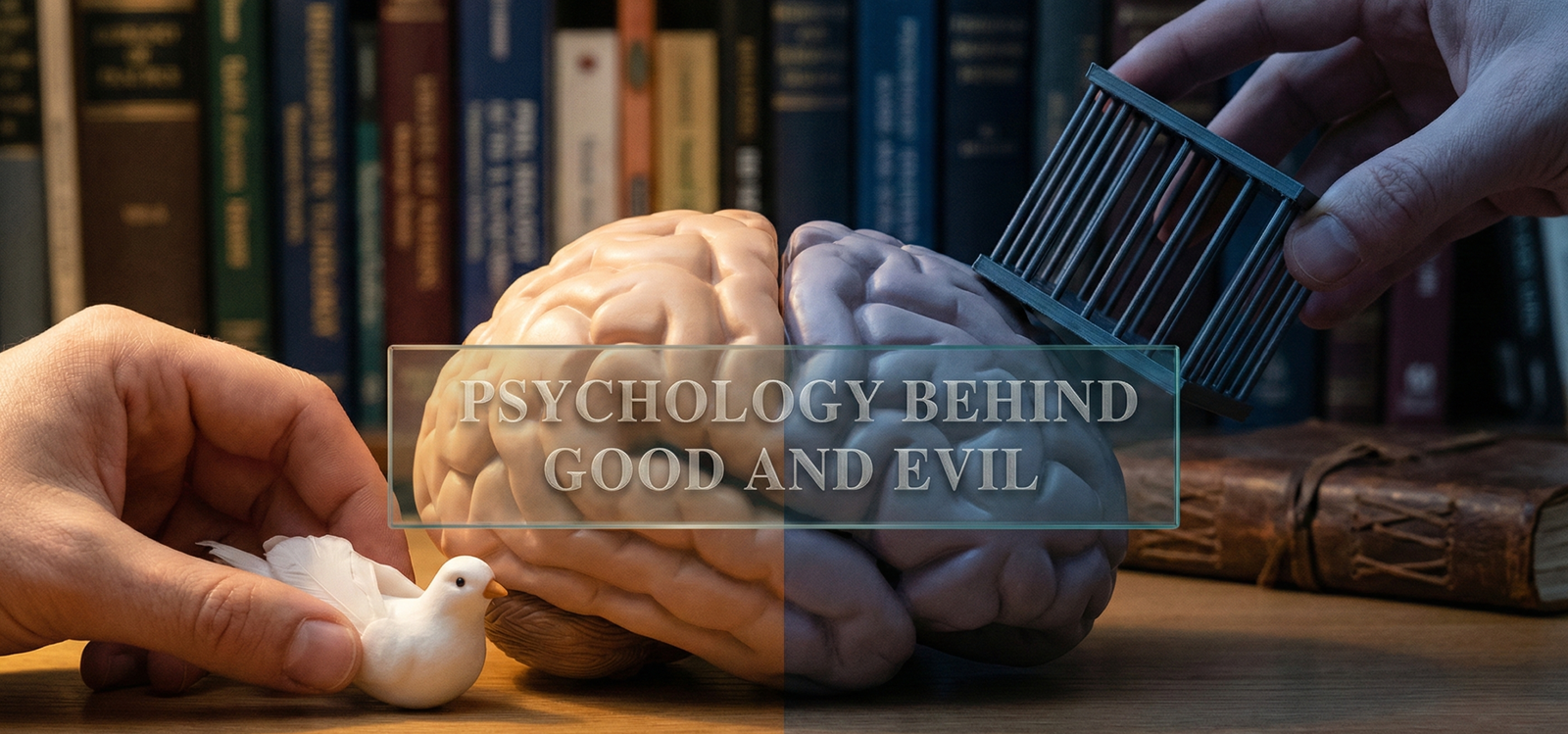

The coThe psychology behind good and evil is one of the most complex and fascinating areas of behavioral science, bridging the gap between biological impulses and social conditioning. While philosophy and theology treat these concepts as abstract cosmic forces, Formal Psychology approaches them as observable patterns of human behavior rooted in neuroscience, evolution, and situational pressure.
To truly understand why one individual risks their life to save a stranger (altruism) while another commits unspeakable acts of cruelty (malevolence), we must analyze the interplay between the brain, the situation, and the self.
1. Defining the Terms in a Psychological Context
Psychologists rarely use the absolute labels of “good” and “evil” in clinical settings. Instead, we analyze behaviors through specific frameworks:
- Prosocial Behavior (Good): Voluntary actions intended to benefit others, such as helping, sharing, or comforting.
- Antisocial/Malevolent Behavior (Evil): Actions intended to harm or exploit others, often characterized by a lack of empathy.
The central question remains: Are we born this way, or are we made?
2. The Neuroscience of Morality
Research suggests that human beings are hardwired for empathy, but specific brain structures dictate our capacity for moral reasoning.
The Role of the Prefrontal Cortex
The prefrontal cortex (PFC) is the brain’s executive center.
- In Prosocial Behavior: A healthy PFC regulates emotional impulses, allowing us to choose long-term social harmony over immediate selfish gain.
- In Antisocial Behavior: Studies on violent offenders often reveal reduced activity or structural deficits in the PFC and the amygdala. This disconnection results in “cold empathy”—cognitively understanding someone is in pain but feeling no emotional distress.
The “Warrior Gene” (MAOA)
The Monoamine Oxidase A (MAOA) gene has been linked to aggression. Individuals with the low-activity variant (MAOA-L) may be more prone to impulsive violence, particularly if they suffered severe maltreatment in childhood. This confirms that the psychology behind good and evil is often a result of nature interacting with nurture.
3. The Situation: How “Normal” People Turn Evil
One of the most disturbing findings in social psychology is that you do not need to be a psychopath to commit evil acts. Often, the situation dictates the behavior.
The Milgram Experiment: Obedience to Authority
Stanley Milgram’s research in the 1960s shocked the world by showing that average citizens would administer potentially lethal electric shocks to a stranger if an authority figure commanded it. This demonstrated that blind obedience often overrides personal morality.
The Stanford Prison Experiment: The Lucifer Effect
Philip Zimbardo’s famous study illustrated how social roles transform behavior. Ordinary students assigned as “guards” quickly became sadistic, while “prisoners” became submissive.
- Key Concept: Deindividuation. When people lose their self-awareness in a group or behind a uniform, they are more likely to violate their own moral standards.
4. The Dark Tetrad: Personality Traits of Malevolence
While situations are powerful, some individuals have a predisposition toward malevolence. Psychology identifies the “Dark Tetrad” of personality traits:
- Narcissism: Grandiosity and entitlement.
- Machiavellianism: Strategic manipulation.
- Psychopathy: Impulsivity and low empathy.
- Sadism: Deriving pleasure from inflicting pain.
Individuals high in these traits engage in “evil” behaviors regardless of the situation, often viewing other humans merely as tools for their own success.
5. The Psychology of Heroism: The Banality of Good
Just as ordinary people can commit evil, ordinary people can perform extraordinary acts of good. This is known as the Banality of Heroism.
What Makes a Hero?
Zimbardo argues that heroism is a learned behavior, not a mystical trait. Key factors include:
- Empathy: Vividly imagining the suffering of others.
- Non-Conformity: The courage to break social norms (e.g., being the first to help in an emergency).
- Self-Efficacy: The belief that one’s actions matter.
6. Dehumanization: The Engine of Mass Evil
To understand systemic evil—such as genocide or slavery—we must look at dehumanization. This is a psychological process where a group denies the humanity of another group. By labeling others as “vermin” or “objects,” the moral inhibition against harming them is removed. The brain literally processes these “out-groups” differently, failing to register them as human beings worthy of compassion.
Conclusion
The psychology behind good and evil reveals a humbling truth: The line between a hero and a villain is often permeable. While our genetics and brain structure lay the foundation, our environment and choices build the house. Understanding these mechanisms is the first step toward a more ethical society.