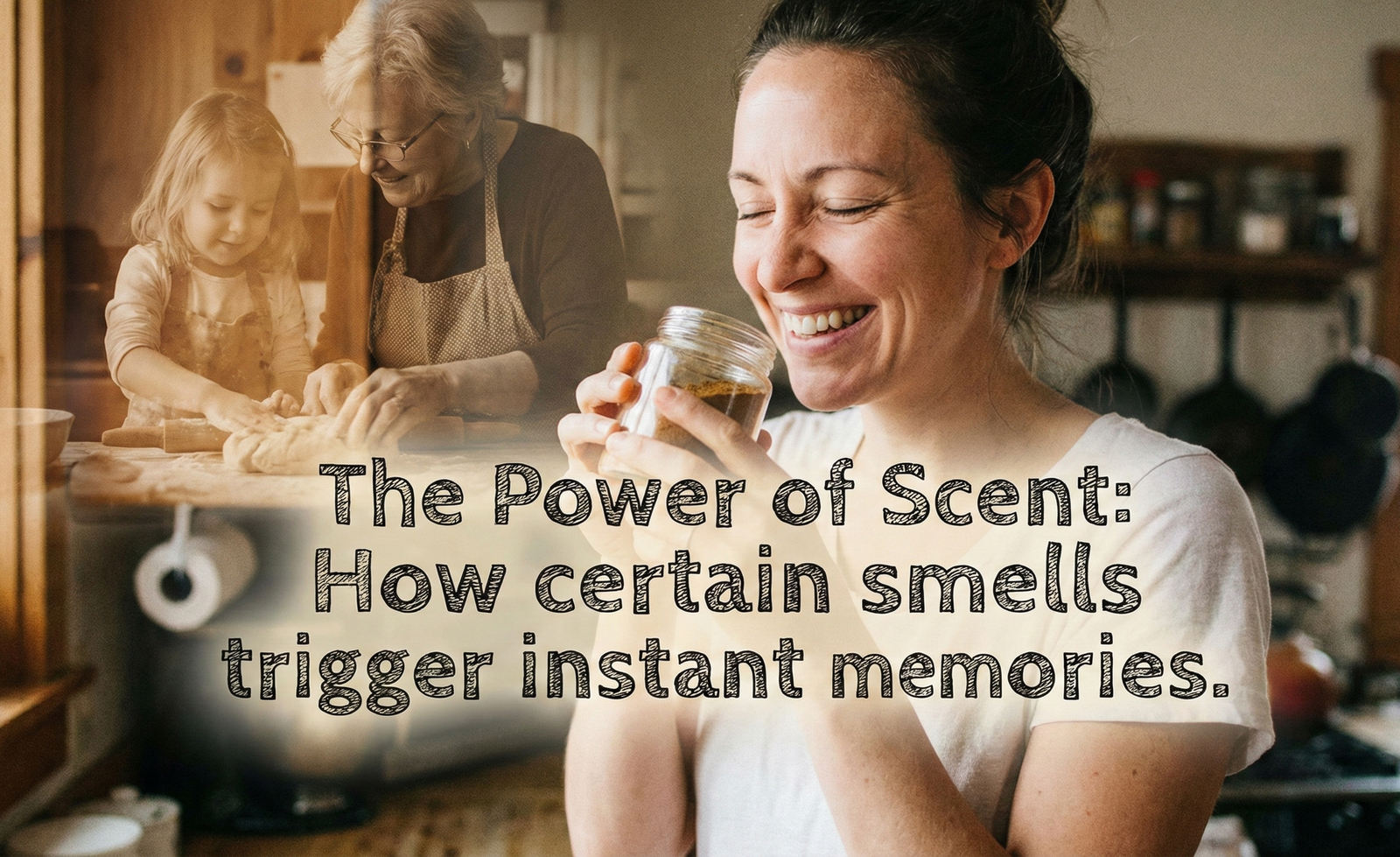

Have you ever caught a fleeting whiff of a specific perfume on a crowded street and been instantly transported back to a childhood summer? Or perhaps the smell of rain on dry pavement evokes a localized sense of nostalgia you can’t quite put into words?
In psychology, this phenomenon is known as the Proustian Effect (or the Proust Phenomenon), named after French author Marcel Proust, who famously described how a tea-soaked madeleine cake unleashed a torrent of childhood memories. Unlike sight or sound, the sense of smell has a “fast pass” to the emotional centers of the brain.
The Neurobiology of Smell: A Direct Wire to the Heart
To understand why scents are so powerful, we have to look at the brain’s unique architecture. Most sensory information (vision, hearing, touch) travels through the thalamus, which acts as a switchboard, relaying data to the rest of the brain.
Smell, however, bypasses the thalamus entirely.
When you inhale a scent molecule, it travels through the olfactory bulb, which has direct structural connections to two key areas:
- The Amygdala: The center for emotional processing.
- The Hippocampus: The headquarters for memory formation and storage.
Because of this direct physical link, an odor can trigger an emotional response before our conscious brain even identifies what the smell is.
Why Scent Memories Are Different
Research suggests that olfactory memories are distinct from other types of recollection in three specific ways:
- Emotional Intensity: Scents trigger “autobiographical memories” that feel more lived-in and emotionally charged than those triggered by visual cues.
- Resilience: Olfactory memories are remarkably resistant to time. You may forget the face of a primary school teacher, but the specific smell of the wax used on the classroom floor can remain “locked” for decades.
- Early Childhood Bias: Most scent-linked memories are formed during the first decade of life, creating a sensory “foundation” for our nostalgic experiences.
The “Proust Effect” in Clinical Practice
In formal psychology, the power of scent isn’t just a curiosity—it’s a tool.
1. Trauma and PTSD
Because the amygdala processes both scent and fear, certain odors can become “triggers” for individuals with PTSD. Conversely, therapists often use grounding scents (like lavender or peppermint) to help patients remain present during difficult sessions.
2. Treating Memory Loss
For patients with Alzheimer’s or dementia, “reminiscence therapy” often involves using familiar scents from the patient’s youth to stimulate cognitive pathways that have otherwise become dormant.
3. Mood Regulation
The burgeoning field of aromapsychology studies how specific scents can alter neurotransmitter activity. For instance, citrus scents have been shown in clinical settings to potentially reduce stress hormones and improve perceived well-being.
Summary Table: Scent vs. Other Senses
Conclusion
The nose is a silent time machine. By understanding the link between the olfactory bulb and our emotional centers, we gain a deeper appreciation for how our environment shapes our internal world. Whether it’s the comfort of a home-cooked meal or the sharpness of a specific cleaning product, these scents are the invisible threads that bind our present selves to our past experiences.