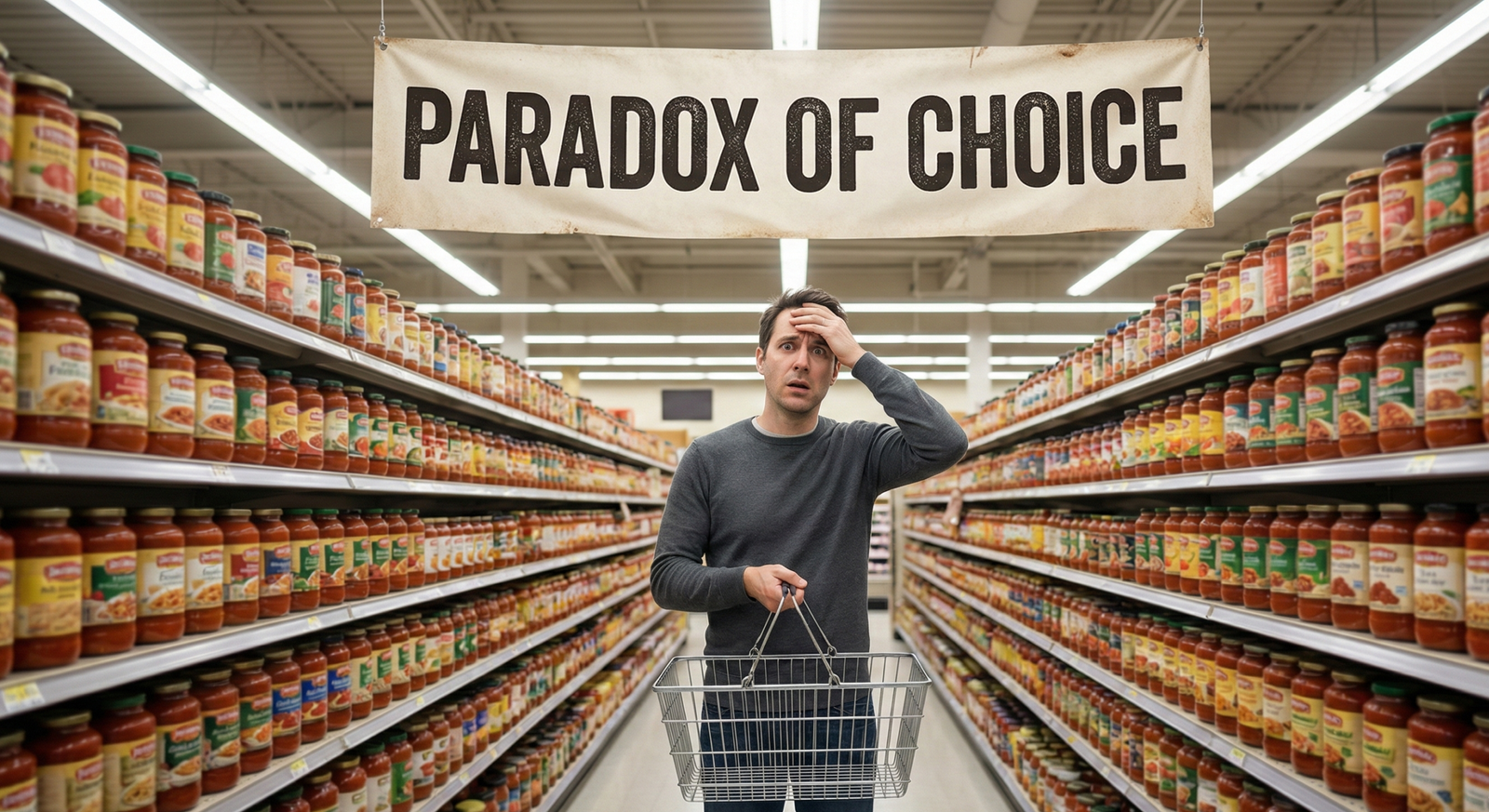

Walk into a modern supermarket to buy a jar of pasta sauce, and you are faced with a wall of options: spicy, sweet, chunky, smooth, organic, garlic-infused, or classic basil. Logically, this abundance should feel like freedom. We assume that more choice allows us to find the product that perfectly matches our desires, thereby increasing our satisfaction.
However, psychological research suggests the exact opposite. This phenomenon is known as the Paradox of Choice.
Coined by psychologist Barry Schwartz, the Paradox of Choice posits that while some choice is better than none, an abundance of choice does not lead to more freedom, but to paralysis and dissatisfaction. Here is the psychological breakdown of why having 50 options makes us less happy than having five.
The Famous “Jam Study”: Evidence of Paralysis
To understand the core of this phenomenon, we must look at the foundational study conducted by psychologists Sheena Iyengar and Mark Lepper in 2000.
They set up a tasting booth at an upscale grocery store.
- Scenario A: They displayed 24 varieties of gourmet jam.
- Scenario B: They displayed only 6 varieties of gourmet jam.
The results were staggering. While the large display attracted more attention (more people stopped to look), the sales told a different story.
- Of the people who saw 24 jams, only 3% bought a jar.
- Of the people who saw 6 jams, 30% bought a jar.
The Conclusion: When the cognitive load of making a decision becomes too heavy, the brain defaults to decision paralysis. Rather than risking the “wrong” choice among complex options, we often choose nothing at all.
The Four Psychological Killers of Happiness
Why does having more options make us feel worse, even after we’ve made a choice? Schwartz identifies four key psychological mechanisms that turn abundance into anxiety.
1. Decision Paralysis (Analysis Paralysis)
The brain has a limited amount of cognitive energy. Evaluating 50 different options requires a massive amount of processing power. We have to weigh variables, compare features, and predict outcomes. This leads to decision fatigue. The effort required to make the decision often outweighs the benefit of the decision itself, leading us to procrastinate or avoid choosing entirely.
2. Opportunity Cost
In economics and psychology, “opportunity cost” refers to the value of the best alternative you give up when making a choice.
- If you have Option A and Option B, choosing A means you only lose B.
- If you have 50 Options, choosing A means you are “losing” the potential benefits of 49 other options.
When the number of choices grows, the psychological weight of the “missed opportunities” accumulates. We find ourselves thinking less about the utility of what we chose, and more about the phantom features of what we didn’t choose.
3. Escalation of Expectations
When you only have two styles of jeans to choose from, you don’t expect them to be perfect; you just expect them to fit. However, when you are presented with 50 styles (slim, tapered, boot-cut, acid-wash, distress, etc.), your expectations skyrocket.
With so many options, you logically assume there must be one pair that is absolutely perfect.
- The Result: Even if you choose a great pair of jeans, you will likely feel less satisfied because they are not “perfect.” The abundance of choice raised the bar so high that reality can rarely meet it.
4. Self-Blame
This is perhaps the most damaging aspect for our mental health.
- Low Choice: If you buy a car and there were only two models available, and the car breaks down, you blame the manufacturer or the lack of options. “It’s not my fault; the world didn’t offer me anything better.”
- High Choice: If you have 500 cars to choose from and you pick a lemon, who is to blame? You are.
With infinite choice comes total responsibility. If you are dissatisfied, it is because you failed to make the right calculation. This shift from external attribution to internal attribution is a major driver of modern anxiety and regret.
Maximizers vs. Satisficers
Not everyone is affected by the Paradox of Choice in the same way. Psychology distinguishes between two types of decision-makers:
The Maximizer
Maximizers are individuals who need to be assured that every purchase or decision was the best that could be made. They read every review, check every price comparison, and obsess over the details.
- Outcome: Maximizers usually achieve objectively better outcomes (e.g., they get a slightly better job or a cheaper flight), but they feel subjectively worse about it. They are more prone to regret and depression.
The Satisficer
Satisficers operate on a threshold of acceptability. They have criteria for what they want (e.g., “I need a hotel with a pool for under $150”). The moment they find an option that meets those criteria, they take it and stop looking.
- Outcome: Satisficers may not always get the absolute “best” deal, but they are generally happier, less stressed, and have more mental energy for things that matter.
Conclusion: How to Escape the Paradox
In a world designed to offer infinite variety, protecting your psychological well-being requires intentionality. To combat the Paradox of Choice:
- Practice “Satisficing”: Aim for “good enough” rather than “perfect.” Perfection is an illusion created by too many options.
- Artificially Limit Your Options: When shopping or making decisions, restrict yourself to looking at only three items or visiting only two websites.
- Practice Gratitude: Focus on the positive attributes of the choice you made, rather than the hypothetical benefits of the choices you discarded.
At Formal Psychology, we understand that while autonomy is essential to human dignity, unconstrained choice is a burden. By understanding these mechanisms, we can learn to choose less and live more.