
Human visual perception is a complex interplay between the external environment, the optical structures of the eye, and the brain’s intricate neural networks. In biological psychology and neuroanatomy, the cranial nerves serve as the primary communication pathways for this system. Among them, the oculomotor nerve, or Cranial Nerve III (CN III), is arguably the most dynamic, governing the majority of our eye movements and autonomic visual reflexes.
Understanding the oculomotor nerve is essential for neuropsychologists, medical professionals, and students alike, as its proper functioning dictates how we visually interact with and navigate the world.
What is the Oculomotor Nerve?
The oculomotor nerve is the third of the twelve cranial nerves. It is an efferent (motor) nerve, meaning it carries signals from the brain outward to the muscles. Unlike sensory nerves that bring information to the brain, CN III is responsible for executing the brain’s commands regarding eye movement, eyelid elevation, and pupil constriction.
Anatomical Pathway
To fully grasp how the oculomotor nerve functions, it is helpful to trace its pathway from the brainstem to the eye:
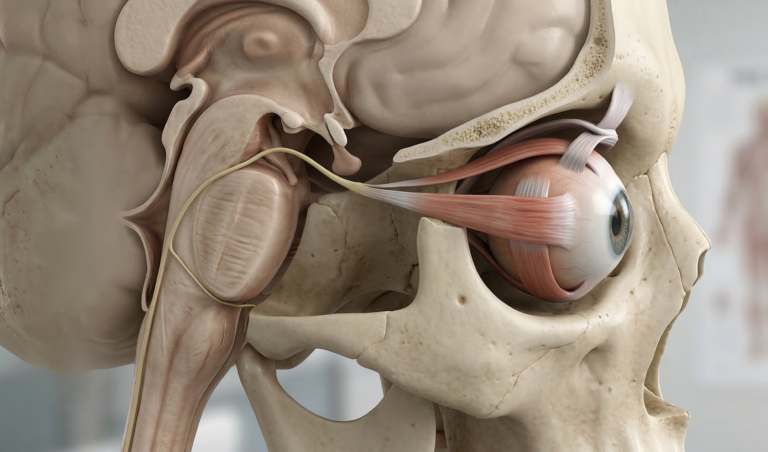
- Origin: The nerve originates in the midbrain (a part of the brainstem) from two specific nuclei: the oculomotor nucleus (which controls voluntary muscle movement) and the Edinger-Westphal nucleus (which controls involuntary, autonomic responses).
- Exit: The nerve fibers emerge from the anterior side of the midbrain.
- Pathway: It travels forward, passing through the cavernous sinus—a hollow space behind the eye socket housing vital veins and nerves.
- Entry into the Orbit: It enters the bony orbit (eye socket) through an opening called the superior orbital fissure.
- Bifurcation: Upon entering the orbit, the nerve splits into a superior (upper) branch and an inferior (lower) branch to innervate different target muscles.
Primary Functions of the Oculomotor Nerve
The oculomotor nerve has two distinct functional components: somatic motor (voluntary) and visceral motor (involuntary/parasympathetic).
1. Somatic Motor Function (Voluntary Movement)
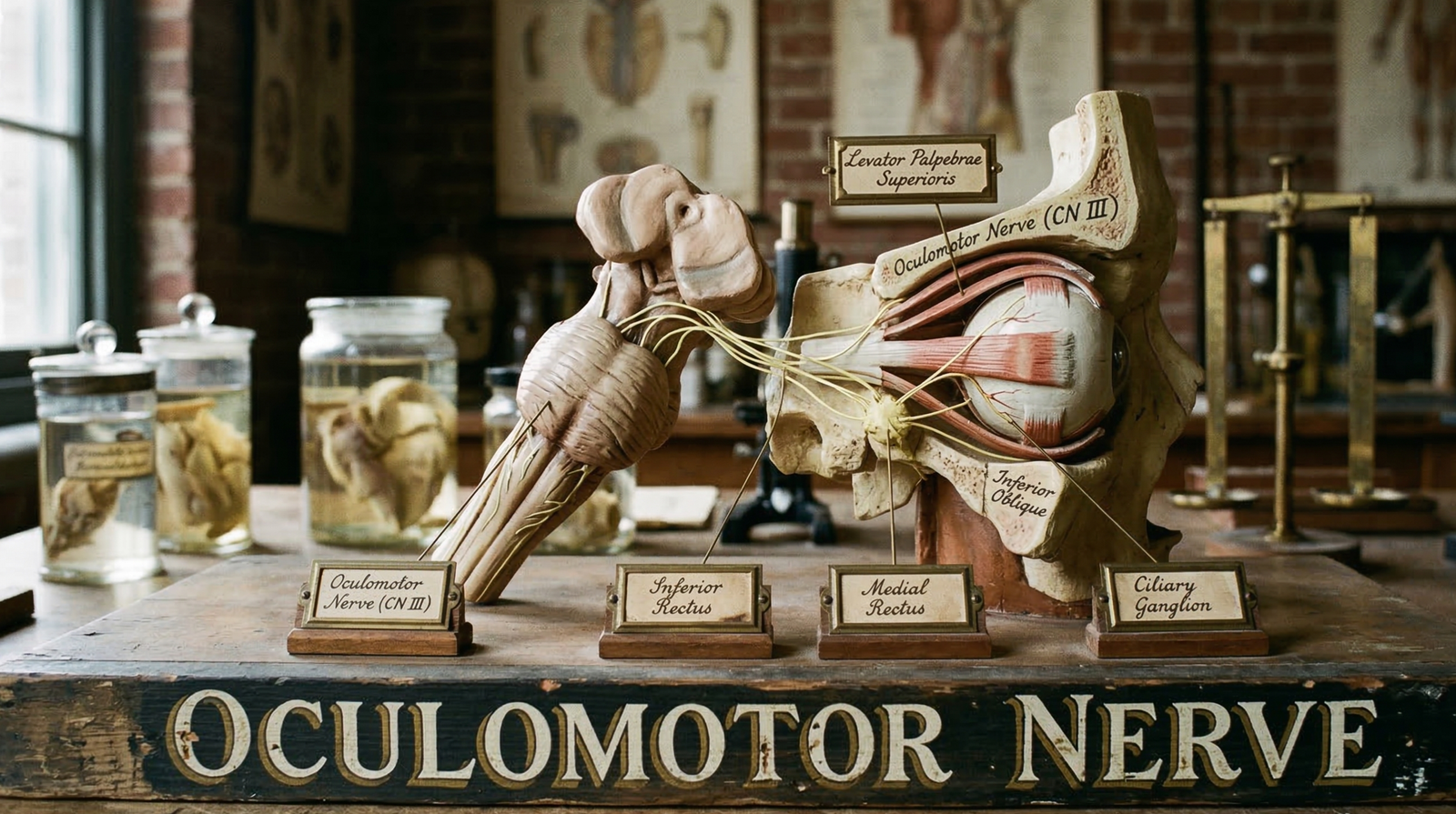
The somatic motor fibers of CN III innervate five critical muscles surrounding the eye:
- Levator Palpebrae Superioris: This muscle is responsible for elevating the upper eyelid. Without it, the eye would remain closed.
- Superior Rectus: Moves the eye upward (elevation).
- Medial Rectus: Moves the eye inward toward the nose (adduction).
- Inferior Rectus: Moves the eye downward (depression).
- Inferior Oblique: Moves the eye upward and outward (extorsion and elevation).
(Note: The remaining two extraocular muscles are controlled by the trochlear nerve (CN IV) and the abducens nerve (CN VI).)
2. Visceral Motor Function (Involuntary Responses)
The parasympathetic fibers originating from the Edinger-Westphal nucleus control critical autonomic reflexes:
- Sphincter Pupillae: This muscle constricts the pupil in response to bright light (the pupillary light reflex), protecting the retina from damage.
- Ciliary Muscle: This muscle controls the shape of the lens. When it contracts, the lens thickens, allowing the eye to focus on near objects—a process known as accommodation.
Clinical Significance: Oculomotor Nerve Palsy
When the oculomotor nerve is damaged, it results in a condition known as Oculomotor Nerve Palsy (or Third Nerve Palsy). Because CN III controls so many distinct functions, damage to it presents with a highly specific and recognizable set of symptoms.
Common Symptoms
- Ptosis (Drooping Eyelid): Caused by the paralysis of the levator palpebrae superioris.
- “Down and Out” Eye Position: Because the medial, superior, and inferior recti are paralyzed, the two remaining healthy muscles (controlled by CN IV and CN VI) pull the resting eye downward and outward.
- Diplopia (Double Vision): The misalignment of the eyes causes the brain to receive two different images, leading to significant visual and spatial disorientation.
- Dilated Pupil (Mydriasis): If the parasympathetic fibers are damaged, the pupil cannot constrict in response to light.
- Loss of Accommodation: The inability to focus on close objects.
Causes of Damage
Damage to the oculomotor nerve can be a critical diagnostic indicator in neurology. Common causes include:
- Microvascular Ischemia: Often associated with diabetes or hypertension, where tiny blood vessels supplying the nerve become blocked.
- Aneurysms: A bulging blood vessel (particularly the posterior communicating artery) can compress the nerve. This is a medical emergency.
- Trauma: Head injuries can stretch or sever the nerve fibers.
- Tumors: Growths in the brain or cavernous sinus can exert pressure on the nerve pathway.
Psychological and Cognitive Impacts
From a psychological standpoint, the sudden onset of an oculomotor disorder can be profoundly distressing. Vision is our primary sensory modality; disruptions like severe diplopia and loss of depth perception can lead to acute anxiety, loss of independence, and an inability to perform daily tasks such as reading or driving. In biological psychology, studying CN III helps researchers understand the vital link between physical neurological health and psychological well-being.
Conclusion
The oculomotor nerve is an extraordinary feat of neuroanatomy. By seamlessly integrating voluntary eye tracking with automatic adjustments to light and focus, Cranial Nerve III allows us to interact dynamically with our environment. Understanding its anatomy, functions, and the consequences of its impairment provides invaluable insight into the delicate intersection of neurology, vision, and human psychology.