


Useful for learners -:
- Students
- Teachers
- Trainers
- Parents
- Therapist
- Managers
B.F. Skinner (1904–1990) was an American psychologist, behaviorist, and author who is best known for developing the theory of operant conditioning, a fundamental concept in behavioral psychology.
Background and Influences
Skinner was heavily influenced by John B. Watson, the founder of behaviorism, and Edward Thorndike, who proposed the Law of Effect — the idea that behaviors followed by positive outcomes are likely to be repeated.
Development of Operant Conditioning
In the 1930s, Skinner expanded on Thorndike’s ideas and introduced the concept of operant behavior, which he defined as behavior that is influenced by its consequences. Unlike classical conditioning (developed by Pavlov), which deals with involuntary responses, operant conditioning focuses on voluntary behavior.
What is Operant Conditioning?
Operant conditioning is a learning process through which behaviors are strengthened or weakened based on the consequences that follow them.
- If a behavior is rewarded, it is more likely to happen again.
- If a behavior is punished, it is less likely to happen again.
This idea was developed by B.F. Skinner, who believed that most of our actions are shaped by what happens after we do them.
Key Elements of Operant Conditioning
- Reinforcement – Encourages behavior to happen again
- Positive Reinforcement = Adding something good after a behavior
Example: A child gets a chocolate for finishing homework → The child is more likely to do homework again. - Negative Reinforcement = Removing something unpleasant after a behavior
Example: A car stops beeping when you wear your seatbelt → You’re more likely to wear the seatbelt in future.
Remember: Both types of reinforcement increase behavior.
- Punishment – Reduces the chance of behavior happening again
- Positive Punishment = Adding something unpleasant after a behavior
Example: A child is scolded for drawing on the wall → The child stops drawing on walls. - Negative Punishment = Taking away something pleasant after a behavior
Example: A teenager loses phone privileges for breaking rules → The teenager may follow rules next time.
Note: Both types of punishment decrease behavior.
Reinforcement Schedules – How Often Rewards Are Given
Skinner found that how often a reward is given also affects behavior. Here are the four main types:
| Schedule | Description | Example |
| Fixed Ratio | Reward after a set number of actions | Candy after every 5 math problems |
| Variable Ratio | Reward after a random number of actions | Winning in slot machines |
| Fixed Interval | Reward after a set amount of time | Weekly salary regardless of performance |
| Variable Interval | Reward after a random amount of time | Checking phone for messages (unpredictable timing) |
The Skinner Box
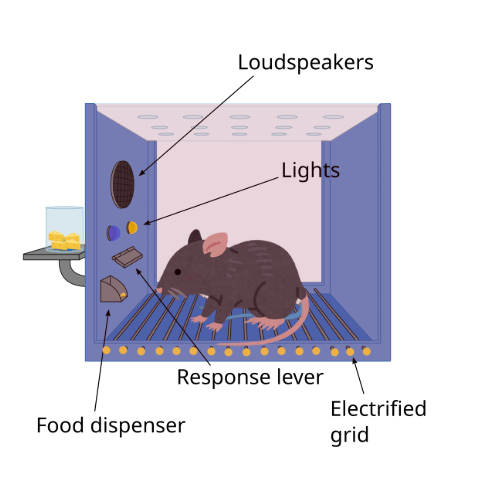
To test his theory, Skinner created a device called the Skinner Box:
- A rat placed in the box would learn to press a lever to get food (positive reinforcement).
- Sometimes, the floor would give a small shock, and pressing the lever would stop it (negative reinforcement).
Real-Life Examples of Operant Conditioning
| Situation | Type | Effect |
| Student gets praise for raising hand | Positive Reinforcement | Increases hand-raising behavior |
| Alarm clock stops buzzing when button is pressed | Negative Reinforcement | Increases the behavior of turning off alarm |
| Child is given extra homework for being late | Positive Punishment | Decreases tardiness |
| Teen’s video game is taken away for bad grades | Negative Punishment | Decreases poor academic performance |
Practical Applications and Relevance of Operant Conditioning
- Education
- Use: Rewards like praise or extra marks encourage good behavior and learning.
- Relevance: Helps manage classrooms and boost student motivation.
- Parenting
- Use: Giving treats for chores (positive reinforcement), or taking away privileges for misbehavior (punishment).
- Relevance: Shapes good habits and discipline in children.
- Workplace
- Use: Bonuses for good performance or warnings for poor behavior.
- Relevance: Improves motivation, productivity, and discipline.
- Therapy
- Use: Behavior therapy uses rewards to encourage positive actions.
- Relevance: Effective in treating behavioral issues and mental health conditions.
- Animal Training
- Use: Giving treats or removing discomfort to train animals.
- Relevance: Common in pet training, service animal preparation, and zoos.
- Correctional Facilities
- Use: Privileges for good behavior or restrictions for rule-breaking.
- Relevance: Aids in inmate rehabilitation and discipline.
References
- Skinner, B. F. (1938). The Behavior of Organisms: An Experimental Analysis. New York: Appleton-Century.
- Original work where Skinner introduced operant conditioning.
- Skinner, B. F. (1953). Science and Human Behavior. New York: Macmillan.
- Comprehensive overview of operant conditioning and its applications.
- Cherry, K. (2022). Operant Conditioning and How It Works. Verywell Mind.
- https://www.verywellmind.com/operant-conditioning-a2-2794863
- A clear explanation of operant conditioning concepts and examples.
- McLeod, S. (2018). Operant Conditioning. Simply Psychology.
- https://www.simplypsychology.org/operant-conditioning.html
- Summary of operant conditioning theory and practical uses.
- Ormrod, J. E. (2017). Educational Psychology: Developing Learners (9th Ed.). Pearson.
- Application of operant conditioning in education.
- Miltenberger, R. G. (2011). Behavior Modification: Principles and Procedures (5th Ed.). Wadsworth.
- Use of operant conditioning in therapy and behavior modification.




Latest porn platforms provide cutting-edge content
for mature audiences. Choose reliable platforms for safe viewing.
Feel free to surf to my blog post cheap cialis india details
Hello my loved one! I wish to say that this post is amazing, great written and come with approximately all important infos. I would like to see extra posts like this .
Its good as your other content : D, appreciate it for posting. “Talent does what it can genius does what it must.” by Edward George Bulwer-Lytton.
slot365 apk Nhà cái ghi điểm ở việc ứng dụng AI và Big Data để phân tích hành vi người chơi, từ đó tối ưu hóa giao diện và tính năng theo thói quen của từng thị trường.
I used to be very pleased to search out this internet-site.I needed to thanks on your time for this wonderful read!! I definitely enjoying every little little bit of it and I’ve you bookmarked to check out new stuff you weblog post.
Sau đây là phần giới thiệu đôi nét về nhà cái slot365 apk. Đây là một nhà cái thuần Việt, nên có đầy đủ các game mà người Việt hay chơi. Tại nhà cái chúng tôi, bạn có thể tìm thấy những trò chơi quen thuộc như Mậu Liêng, bài Tiến Lên, Xóc đĩa và nhiều trò chơi hấp dẫn khác.
Hello there, You’ve done a fantastic job. I will definitely digg
it and personally recommend tto my friends. I’m confident they’ll be benefited from this web site.
Deference to author, some great information .
Impressive write-up
Greetings! I know this is kinda off topic however , I’d figured I’d ask. Would you be interested in trading links or maybe guest authoring a blog post or vice-versa? My website covers a lot of the same topics as yours and I feel we could greatly benefit from each other. If you happen to be interested feel free to shoot me an email. I look forward to hearing from you! Fantastic blog by the way!
Thanx for the effort, keep up the good work Great work, I am going to start a small Blog Engine course work using your site I hope you enjoy blogging with the popular BlogEngine.net.Thethoughts you express are really awesome. Hope you will right some more posts.
Real wonderful info can be found on website. “We should be eternally vigilant against attempts to check the expression of opinions that we loathe.” by Oliver Wendell Holmes.
Hey there just wanted to give you a quick heads up. The text in your post seem to be running off the screen in Safari. I’m not sure if this is a formatting issue or something to do with web browser compatibility but I thought I’d post to let you know. The design and style look great though! Hope you get the problem resolved soon. Kudos
That is the fitting blog for anybody who desires to find out about this topic. You realize a lot its almost laborious to argue with you (not that I truly would want…HaHa). You positively put a new spin on a topic thats been written about for years. Nice stuff, just great!
It¦s actually a cool and useful piece of info. I am happy that you just shared this useful information with us. Please keep us up to date like this. Thanks for sharing.
I used to be suggested this blog by means of my cousin. I’m no longer certain whether this put up is written by means of him as no one else understand such precise approximately my difficulty. You are wonderful! Thanks!
You can definitely see your enthusiasm within the work you write. The world hopes for more passionate writers such as you who aren’t afraid to say how they believe. At all times follow your heart.
hey there and thank you for your info – I have certainly picked up anything new from right here. I did however expertise several technical issues using this website, since I experienced to reload the website lots of times previous to I could get it to load properly. I had been wondering if your web host is OK? Not that I’m complaining, but slow loading instances times will often affect your placement in google and can damage your high-quality score if advertising and marketing with Adwords. Well I’m adding this RSS to my email and could look out for much more of your respective fascinating content. Make sure you update this again soon..
I need to to thank you for this fantastic read!! I absolutely loved every little bit of it. I have you bookmarked to check out new stuff you
Ahaa, its pleasant conversation concerning this paragraph at this place at this webpage, I have read all that, so at this time me also commenting at this place.
Hi, just required you to know I he added your site to my Google bookmarks due to your layout. But seriously, I believe your internet site has 1 in the freshest theme I??ve came across. It extremely helps make reading your blog significantly easier.
I found the information layout very user‑friendly, which made exploring the product surprisingly comfortable. The overview of tadalafil 10mg side effects was presented in a calm, neutral tone that helped me feel well‑oriented. Everything came together nicely and left me satisfied with the clarity and transparency.
It’s very easy to find out any topic on net as compared to books, as I found this article at this web page.
Ahaa, its fastidious conversation on the topic of this article here at this website, I have read all that, so now me also commenting here.
Those are yours alright! . We at least need to get these people stealing images to start blogging! They probably just did a image search and grabbed them. They look good though!
I am sure this article has touched all the internet visitors, its really really fastidious piece of writing on building up new weblog.
I will immediately take hold of your rss as I can not in finding your e-mail subscription hyperlink or e-newsletter service. Do you’ve any? Please allow me recognize in order that I could subscribe. Thanks.
I am sure this paragraph has touched all the internet viewers, its really really nice paragraph on building up new website.
I’m not certain where you’re getting your info, but good topic. I must spend some time finding out more or figuring out more. Thank you for excellent info I was in search of this information for my mission.
Wat mij is opgevallen, voelt spelen in eeen casino met echt
gel duidelik anders dan gratis spellen. Zodra er echt geld bij
komt kijken, gaan mensen meestal voorzichtiger om met hun keuzes.
Veel gebruikers benaderen dit soort casino’s niet alleen omm te winnen, maar ook om de
spellen beter te begrijpen. Zaken zoals duidelijke regels lijken belangrijker dan opvallende functies oof grote beloftes.
Als ik andere reacties lees, hangt de ervaring sterk af van realistische verwachtingen. Wanneer iemand zijn uitgaven bijhoudt, kan een casino met
echt ggeld een evenwichtige ervaring bieden. Uiteindelijk draait het vooral om de houding van de speler. https://naserion.com/biggerz-casino-je-superieure-gaming-bestemming-in-12/
Hi there, its nice post regarding media print, we all know media is a great source of information.
I am actually grateful to the holder of this web page who has shared this impressive paragraph at at this place.
Wow, incredible blog structure! How lengthy have you ever been blogging for? you make running a blog glance easy. The total glance of your web site is excellent, let alone the content!
Everyone loves what you guys tend to be up too. This type of clever work and reporting! Keep up the superb works guys I’ve included you guys to my personal blogroll.
You are a very clever person!
Thanks for some other informative site. The place else could I am getting that kind of info written in such an ideal method? I have a venture that I’m just now running on, and I’ve been at the look out for such info.
Way cool! Some extremely valid points! I appreciate you penning this post plus the rest of the website is extremely good.
Your way of telling the whole thing in this piece of writing is truly pleasant, all be capable of effortlessly know it, Thanks a lot.
I just could not go away your site before suggesting that I extremely enjoyed the usual info an individual supply in your guests? Is gonna be again regularly in order to check out new posts
Top pokies experiences linked to Australia stand
out for entertaining visual designs. Players often enjoy engagikng spin dynamics.
Different special mechanics add additional motivation. Intuitive controls support comfortable play.
In general,these pokies create a positive gaming atmosphere for diverse player
types.