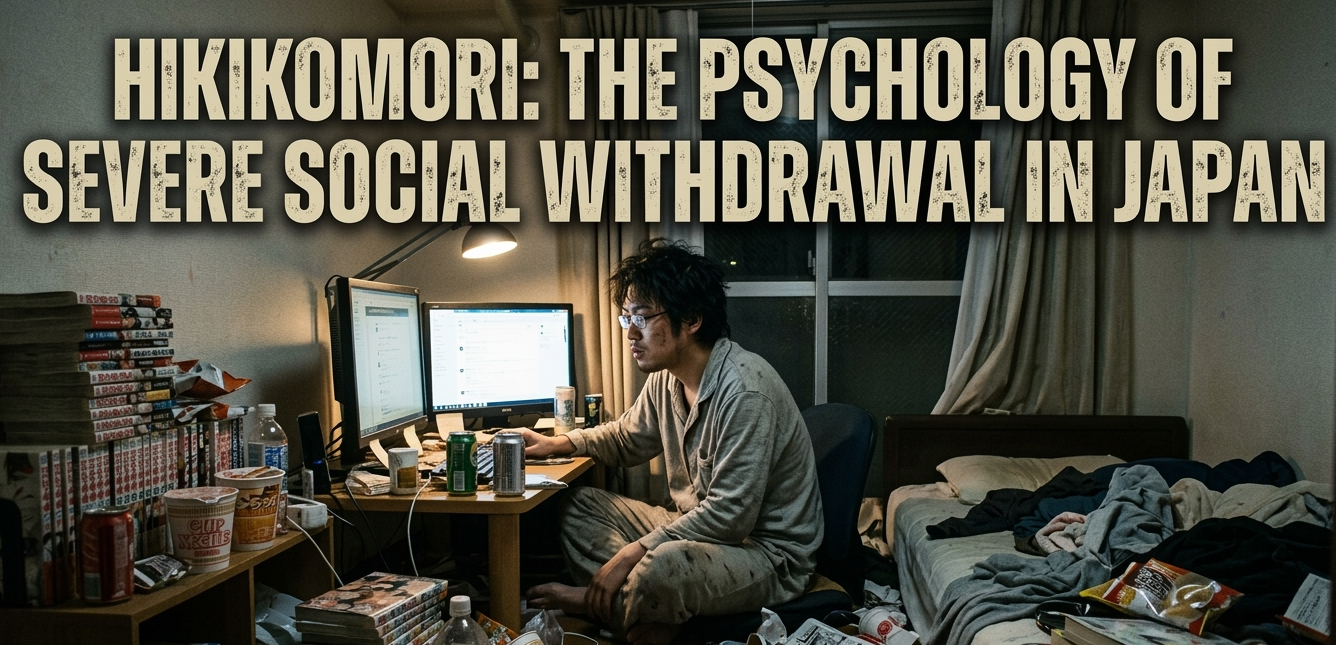

Imagine a life confined entirely to a single bedroom. The door remains closed, the curtains drawn, and the outside world is experienced only through the glow of a computer screen. Weeks turn into months, and months turn into years, sometimes decades.
In Japan, this phenomenon of severe, prolonged social withdrawal is known as Hikikomori.
Coined by Japanese psychologist Tamaki Saitō in the late 1990s, the term translates roughly to “pulling inward” or “being confined.” Today, the Japanese government estimates that over one million individuals live as hikikomori. While initially viewed as a uniquely Japanese cultural syndrome, modern psychology increasingly recognizes hikikomori as a complex, multifaceted condition reflecting a profound crisis of mental health and social integration that is beginning to surface globally.
What Constitutes Hikikomori?
The Japanese Ministry of Health, Labour and Welfare defines hikikomori through specific behavioral criteria. To be classified as hikikomori, an individual must exhibit the following:
- Prolonged Isolation: Spending almost all of their time at home for a period of six months or longer.
- Social Disengagement: Avoiding school, work, and most social interactions outside the immediate family.
- Absence of Other Underlying Causes: The withdrawal is not primarily the result of a physical illness, nor is it the direct consequence of a severe psychiatric disorder like schizophrenia, although psychological comorbidities are highly common.
Hikikomori is not currently recognized as an independent diagnosis in the DSM-5 (Diagnostic and Statistical Manual of Mental Disorders), but psychologists often view it as a severe behavioral syndrome heavily influenced by environmental, cultural, and psychological factors.
The Psychological Roots of Withdrawal
Understanding hikikomori requires untangling the deeply personal psychological factors that lead an individual to reject society.
1. Trauma and the Fear of Failure
Many hikikomori trace the beginning of their withdrawal to a specific traumatic or deeply humiliating event. In Japan, academic and professional environments are notoriously high-pressure. A failure to pass a university entrance exam, severe bullying at school (ijime), or a public reprimand at work can shatter an individual’s self-esteem. The resulting shame can be so overwhelming that withdrawal becomes a psychological defense mechanism—a way to avoid future pain or judgment.
2. Comorbid Mental Health Conditions
While hikikomori is a distinct behavioral pattern, it rarely exists in a vacuum. Psychological assessments of individuals in severe withdrawal often reveal underlying conditions:
- Avoidant Personality Disorder (AvPD): Characterized by extreme sensitivity to negative evaluation and social inadequacy.
- Depression and Anxiety: Major depressive disorder and social anxiety are frequent companions to isolation, often trapping the individual in a vicious cycle of low motivation and fear.
- Autism Spectrum Disorder (ASD): Undiagnosed neurodivergence can make navigating rigid social expectations exhausting, leading to burnout and eventual withdrawal.
3. Apathy and the “Avolition” Spiral
As isolation drags on, psychological inertia sets in. The lack of social stimuli, disrupted sleep cycles, and heavy reliance on the internet or video games can lead to anhedonia (the inability to feel pleasure) and profound avolition (lack of drive). The longer the withdrawal lasts, the harder it becomes to cross the threshold back into the outside world.
The Sociocultural Context: Why Japan?
While severe social withdrawal happens everywhere, the sheer scale of hikikomori in Japan suggests unique sociocultural catalysts.
- Sekentei (Social Appearance): Japanese culture places a massive emphasis on sekentei—one’s reputation and how one is viewed by the community. When an individual fails to meet societal expectations, the shame affects not just them, but their entire family. Paradoxically, out of shame, families often hide their hikikomori child rather than seeking outside help, enabling the withdrawal.
- Amae (Dependence): The concept of amae refers to a culturally accepted dependence, often between a child and their mother. In Japan, it is highly common for adult children to live at home. This social safety net, while supportive, can sometimes inadvertently facilitate long-term withdrawal by removing the financial necessity to leave the house.
- Rigid Life Trajectories: Historically, Japan has offered a rigid path to success: graduate from a top school, enter a stable company, and stay there for life. Those who step off this path—or fail to get on it—often find it nearly impossible to reintegrate, leading to a profound sense of hopelessness.
The Looming Crisis: The “8050 Problem”
One of the most pressing psychological and societal issues tied to hikikomori today is the “8050 Problem”. This refers to the demographic time bomb of parents in their 80s who are still financially and emotionally supporting their hikikomori children, who are now in their 50s.
As the parents age, fall ill, or pass away, the middle-aged individuals who have been isolated for decades are left entirely unequipped to survive. This creates a severe psychological crisis, often leading to deep depression, starvation, or homelessness if early intervention does not occur.
Treatment and Reintegration
Treating hikikomori requires immense patience, empathy, and a multidisciplinary approach. Because the individual is unlikely to seek help themselves, intervention usually begins with the family.
Effective Psychological Interventions:
- Family Therapy and Psychoeducation: Psychologists first work with the parents to change the family dynamic. This involves breaking the cycle of shame, stopping enabling behaviors, and teaching parents how to rebuild communication with their isolated child.
- Gradual Exposure: Reintegration is a slow process. It may start with simply having the individual open their bedroom door, progressing to eating meals with the family, and eventually taking short walks outside at night when few people are around.
- Support Groups and “Drop-in” Centers: Organizations in Japan run safe spaces where recovering hikikomori can interact without the pressure of typical social expectations.
- Home Visitation Programs: In some cases, specialized counselors (sometimes called “rental sisters” or rental oneesan) visit the home regularly over months to gently build rapport and coax the individual out of isolation.
Conclusion
Hikikomori is not simply a symptom of laziness or video game addiction; it is a profound psychological distress signal. It represents a complex collision of personal vulnerability, societal pressure, and family dynamics. As the modern world becomes increasingly digital and, paradoxically, more isolating, understanding the psychology of hikikomori is no longer just a Japanese imperative—it is a global necessity. Recognizing the signs, dismantling the stigma, and fostering compassionate psychological interventions are critical steps in bringing these individuals back into the light.