
The future of formal psychology is arriving faster than anticipated, fundamentally shifting how we understand the human mind. Psychology has traditionally been a discipline of face-to-face interaction, pen-and-paper assessments, and the human interpretation of behavior. However, we are currently standing on the precipice of a paradigm shift. The future of formal psychology—the rigorous, evidence-based study of the mind—is no longer just about biological or cognitive models; it is about the integration of these models with advanced computation.
As we move deeper into the 21st century, the bridge between psychological theory and technology is not just being built; it is becoming the foundation of modern practice. Here is how the landscape is evolving.
1. The Rise of Computational Psychiatry and AI
The most significant disruptor in the field is Artificial Intelligence (AI). For decades, psychological diagnosis relied heavily on subjective reporting and clinician observation. While these remain vital, AI offers a new layer of objectivity that is defining the future of formal psychology.
- Predictive Analytics: Machine learning algorithms can now analyze vast datasets to predict mental health crises before they occur. By identifying subtle patterns in speech, sleep, and activity, AI models can flag early signs of depressive episodes or manic shifts.
- AI-Assisted Diagnosis: Tools are being developed to assist clinicians by cross-referencing patient symptoms with global databases of psychological case studies, reducing the margin of error in diagnosis.
This does not replace the psychologist; rather, it supercharges their toolkit, allowing formal psychology to become more precise and data-driven.
2. Digital Phenotyping: The New Observable Behavior
In traditional behaviorism, we observed what a person did in a lab or natural setting. Today, we all carry a digital lab in our pockets. Digital Phenotyping is the quantification of the individual-level human phenotype in situ using data from personal digital devices.
- Passive Sensing: Smartphones can track socialization (via call logs), physical activity (via accelerometers), and sleep patterns.
- Keyboard Dynamics: Research suggests that how a person types (typing speed, error rates, pause times) can correlate with cognitive function and emotional states.
For the future of formal psychology, this means we can move from “snapshot” assessments (how the patient feels right now in the clinic) to “continuous” assessment (how the patient has functioned over the last month).
3. Virtual Reality (VR): Immersive Exposure and Training
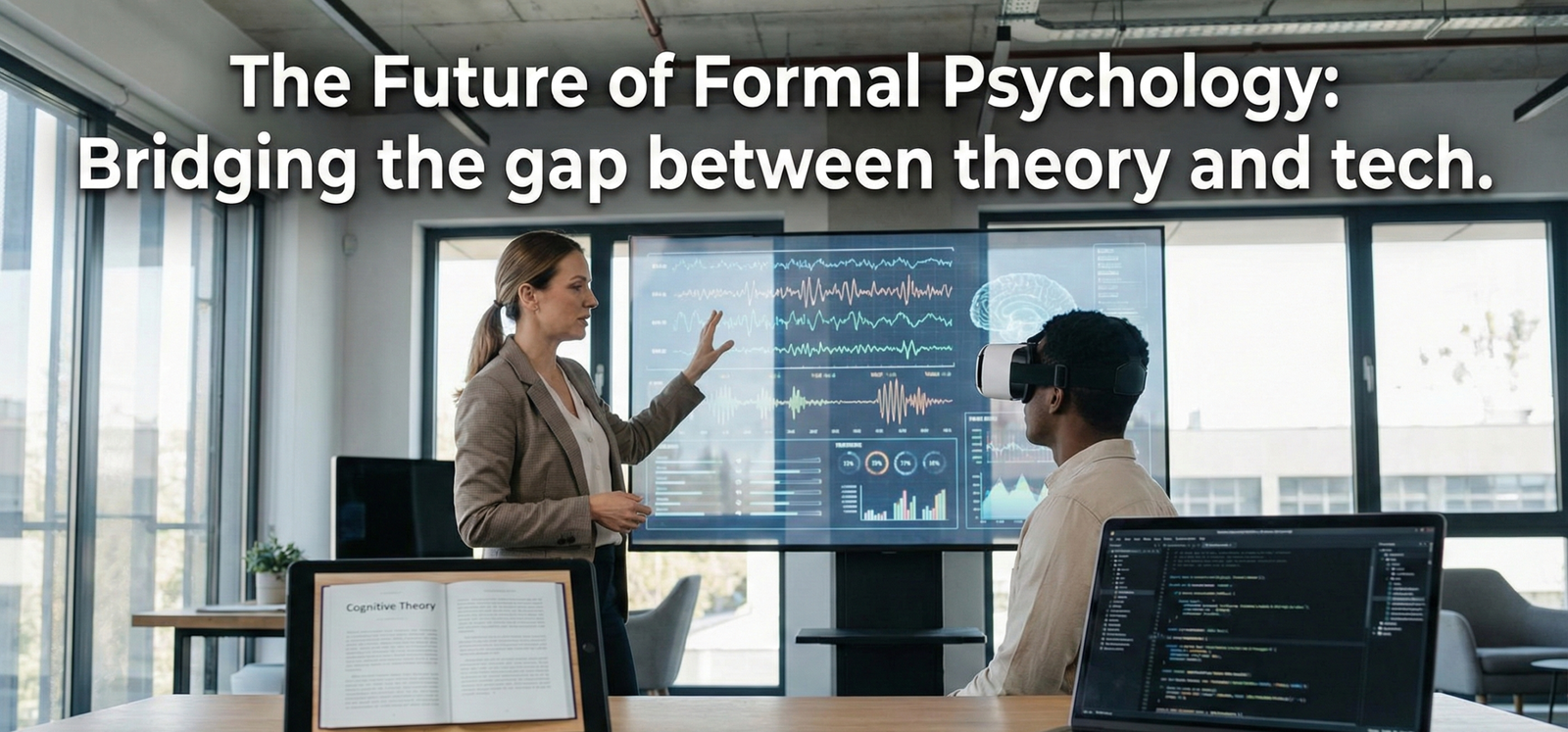
Virtual Reality has moved beyond gaming and into the therapist’s office. It bridges the gap between imagining a stressor and experiencing it.
- VRET (Virtual Reality Exposure Therapy): For conditions like PTSD and phobias, VR allows patients to confront triggers in a completely controlled, safe environment. A veteran can process trauma in a simulated convoy, or a patient with arachnophobia can interact with virtual spiders.
- Social Skills Training: For individuals with autism spectrum disorder (ASD) or social anxiety, VR provides a low-stakes environment to practice social cues and interactions without the fear of real-world rejection.
4. Telepsychology: Beyond the Zoom Call
The pandemic forced a global experiment in telepsychology, but the future of formal psychology goes further than video calls. We are moving toward hybrid care models.
- Asynchronous Care: Text-based therapy and AI chatbots (like Woebot) provide support between sessions, helping patients manage “in-the-moment” anxiety.
- Democratization of Access: Technology bridges the geographic gap, allowing specialists in niche fields (e.g., neuropsychology) to treat patients in remote rural areas who previously had no access to formal psychological care.
5. The Ethical Frontier: The “Black Box” Problem
With great power comes great responsibility. The intersection of tech and psychology introduces complex ethical hurdles that the future of formal psychology must address:
- Data Privacy: Mental health data is the most sensitive data that exists. How do we ensure that digital phenotyping data is not sold to advertisers or insurance companies?
- The Depersonalization Risk: There is a risk that relying too heavily on data could reduce a patient to a set of metrics. Formal psychology must champion the “human in the loop,” ensuring that technology supports empathy rather than replacing it.
- Algorithmic Bias: If the data used to train AI models is biased, the diagnostic suggestions will be biased. Psychologists must work closely with developers to ensure diversity and fairness in algorithmic training.
Conclusion: The Psychologist of the Future
The psychologist of the future will not just be a master of cognitive theory; they will be a data scientist, an ethicist, and a tech-collaborator. The “gap” between theory and tech is closing, and in that space lies the potential for a more accessible, accurate, and effective mental healthcare system.
At Formal Psychology, we believe that while the tools may change, the core mission remains the same: understanding the human mind to alleviate suffering. The future of formal psychology ensures that technology is simply the newest, most powerful lens through which we can view the human experience.