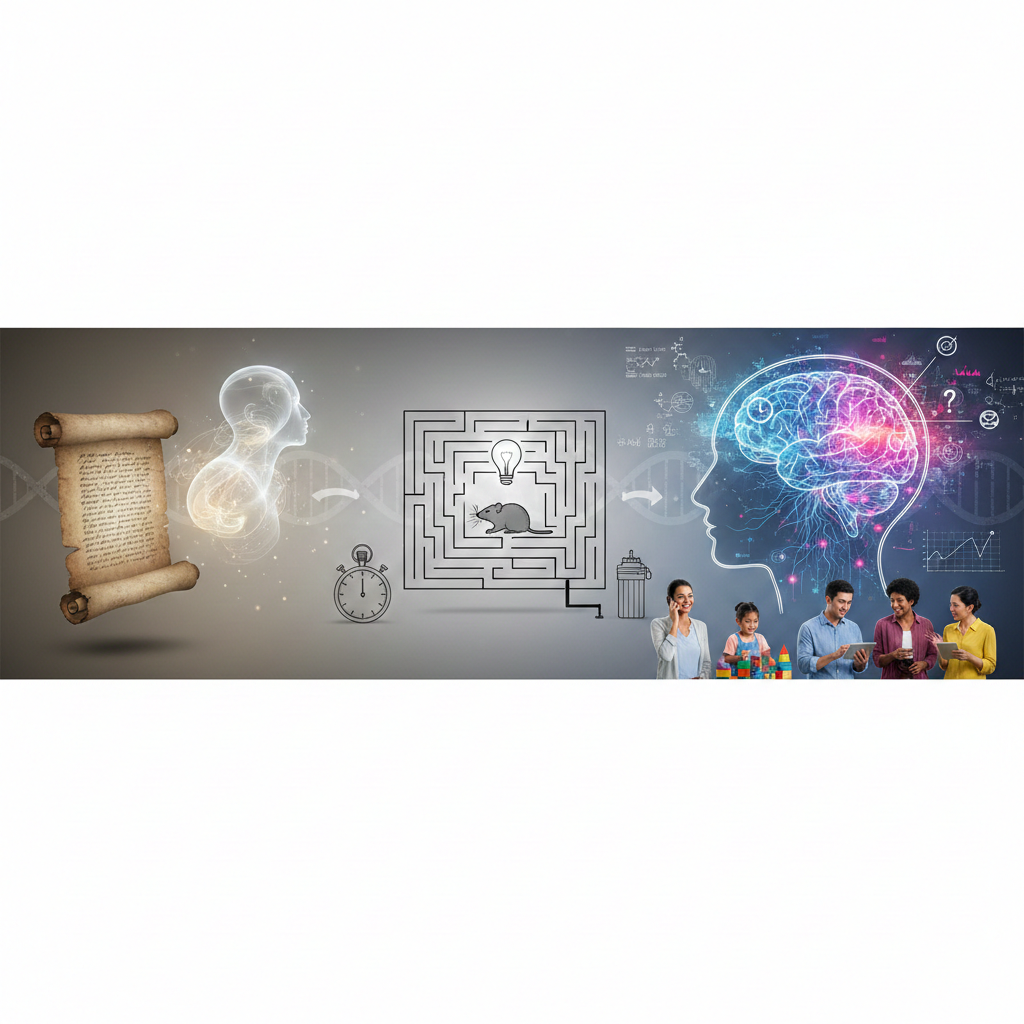

Defining psychology is a bit like trying to catch lightning in a bottle. Because the field is constantly evolving, its definition has shifted over the centuries—moving from the study of the “soul” to the rigorous scientific measurement of behavior and brain activity.
For students and professionals alike, understanding these definitions isn’t just a vocabulary exercise; it’s about understanding the framework through which we view human nature.
1. The Etymological Root
The word Psychology is derived from two Greek words:
- Psyche: Meaning “soul,” “spirit,” or “mind.”
- Logos: Meaning “study of” or “knowledge.”
In its earliest sense, psychology was the “study of the soul.” During this era, it was a branch of philosophy rather than a hard science.
2. Formal Historical Definitions
As the field matured, the focus shifted based on the prevailing “school of thought” at the time:
A. The Study of Consciousness (Late 1800s)
Wilhelm Wundt (the father of psychology) and Edward Titchener defined psychology as the study of conscious experience. They used “introspection” to look inward and analyze the structure of the mind.
B. The Study of Behavior (1920s–1950s)
Led by John B. Watson and B.F. Skinner, Behaviorism rejected the “mind” as something too invisible to study. They redefined psychology strictly as “the scientific study of observable behavior.” If you couldn’t see it or measure it, it didn’t belong in a lab.
C. The Cognitive Revolution (1960s–Present)
Eventually, psychologists realized that ignoring thoughts was like ignoring the engine of a car. Psychology was redefined again to include mental processes (memory, perception, and decision-making) alongside behavior.
3. The Modern Comprehensive Definition
Today, the most widely accepted definition used by the American Psychological Association (APA) and academic institutions is:
“Psychology is the scientific study of the mind and behavior.”
Breaking Down the Definition:
- Scientific Study: Psychology uses systematic methods of observation, experimentation, and analysis to draw conclusions. It is evidence-based, not just “common sense.”
- The Mind: This refers to the internal, subjective experiences—thoughts, memories, emotions, and motives that cannot be seen directly.
- Behavior: This refers to any observable action or reaction an organism makes—from a facial expression to a complex social interaction.
4. Why Multiple Definitions Matter
Psychology is a “hub science.” Depending on which professional you ask, the emphasis of the definition might change:
| Perspective | Focus of the Definition |
| Neuroscience | The study of brain structures and chemicals that dictate behavior. |
| Clinical | The study and treatment of mental distress and dysfunction. |
| Industrial/Org | The study of human behavior in the workplace. |
| Social | The study of how people influence one another’s thoughts and actions. |
5. Misconceptions: What Psychology Is NOT
To truly define psychology, we must clear away the “pop-psych” clutter:
- It is not mind-reading: Psychologists use data to predict patterns, not telepathy to “see” your thoughts.
- It is not just therapy: While clinical work is huge, many psychologists work in research labs, NASA, or marketing firms.
- It is not “just common sense”: Many psychological findings (like the Bystander Effect or Cognitive Dissonance) actually contradict what we intuitively think is true.
Final Thoughts
Psychology is the bridge between biology and sociology. It seeks to answer the “why” behind every human action. Whether you are a student or a professional, viewing psychology as the scientific study of the intersection between internal thought and external action provides the clearest lens for understanding the world around you.