
Why do you automatically check your phone when it buzzes? Why do you feel anxious when you hear a specific song? Why do you work harder when a bonus is on the line?
The answers lie in the foundational theories of behavioral psychology: Classical Conditioning and Operant Conditioning.
While these terms are often used interchangeably in casual conversation, they represent two distinct mechanisms of learning. Understanding the difference is not just an academic exercise—it is the key to unlocking how your habits are formed, how addictions develop, and how you can rewire your brain for success.
1. Classical Conditioning: Learning Through Association
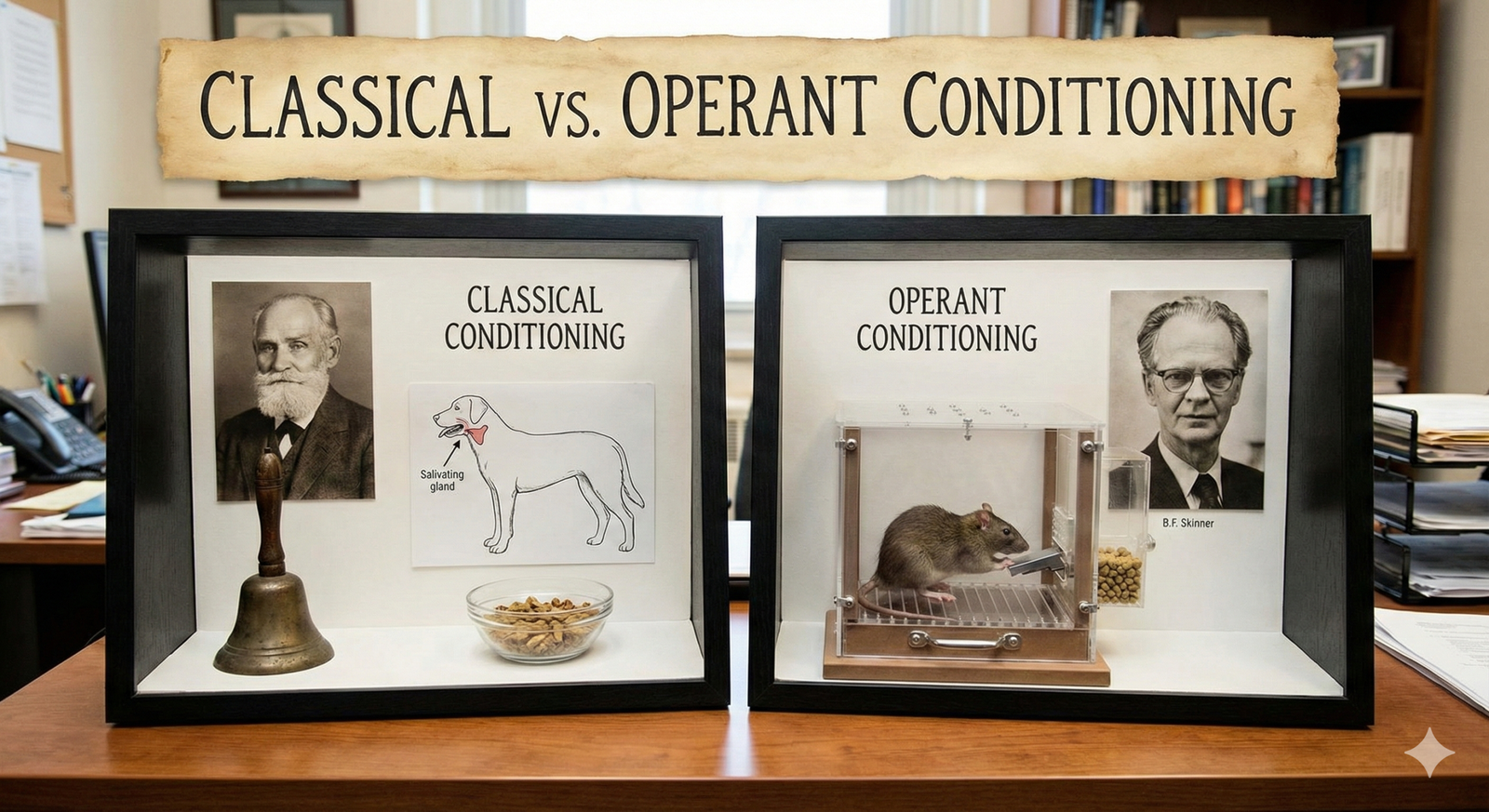
Classical conditioning was famously discovered by Ivan Pavlov (a name well-known to us here at Formal Psychology!). It focuses on involuntary, automatic, and reflexive responses.
How It Works
Classical conditioning occurs when a neutral stimulus becomes associated with a meaningful stimulus, eventually triggering a conditioned response. It is about anticipation.
- The Unconditioned Stimulus (US): Something that naturally triggers a response (e.g., food).
- The Unconditioned Response (UR): The natural reaction (e.g., salivating at food).
- The Conditioned Stimulus (CS): A previously neutral trigger (e.g., a bell).
- The Conditioned Response (CR): The learned reaction to the neutral trigger (e.g., salivating at the bell).
Real-World Habit Example: The Morning Coffee
- Stimulus: You smell coffee brewing (CS).
- Response: You instantly feel more alert or crave the caffeine (CR), even before you take a sip.
- Habit Formation: Your brain has associated the smell with the chemical kick of caffeine. The smell alone now triggers the physiological preparation for the drug.
2. Operant Conditioning: Learning Through Consequence
While Classical conditioning is about passive association, Operant Conditioning, championed by B.F. Skinner, is about voluntary action and consequences. It posits that behavior is shaped by what happens after the action.
How It Works
This method uses Reinforcement (to increase a behavior) and Punishment (to decrease a behavior).
- Positive Reinforcement: Adding something good to increase behavior (e.g., getting a treat for sitting).
- Negative Reinforcement: Removing something bad to increase behavior (e.g., turning off a loud alarm by waking up).
- Positive Punishment: Adding something bad to decrease behavior (e.g., a fine for speeding).
- Negative Punishment: Removing something good to decrease behavior (e.g., taking away a phone for bad grades).
Real-World Habit Example: Social Media Scrolling
- Action: You post a photo on Instagram.
- Consequence: You receive likes and comments (Positive Reinforcement).
- Habit Formation: The dopamine hit from the “likes” reinforces the behavior, making you more likely to post again. If you received no likes (Lack of Reinforcement), the habit might fade (Extinction).
The Core Differences: At a Glance
| Feature | Classical Conditioning | Operant Conditioning |
| Primary Researcher | Ivan Pavlov | B.F. Skinner |
| Nature of Response | Involuntary (Reflexive) | Voluntary (Active behavior) |
| Timing of Stimulus | Precedes the response | Follows the response (Consequence) |
| Role of Learner | Passive | Active |
| Main Mechanism | Association | Reinforcement/Punishment |
The Synthesis: How They Build Habits Together
Most complex human behaviors are a mix of both. To understand habit formation fully, we must look at the Habit Loop: Cue, Routine, Reward.
- The Cue (Classical Conditioning):The trigger that starts the habit is usually established via Classical Conditioning. For example, stress (Stimulus) makes you feel the need to smoke or eat sugar (Response). You didn’t choose to feel that craving; it was a conditioned association.
- The Routine & Reward (Operant Conditioning):The action you take (smoking or eating) is voluntary. You do it because, in the past, it provided relief or pleasure (Positive Reinforcement).
Case Study: The “Notification” Loop
- Classical: You hear a “ping” (Conditioned Stimulus). Your heart rate rises slightly in anticipation (Conditioned Response).
- Operant: You check your phone (Voluntary Behavior). You see a message from a friend (Positive Reinforcement).
- Result: The habit is cemented.
Applying This to Your Life
If you want to break a bad habit or form a new one, you need to address both systems:
- To Break a Habit:
- Disrupt the Classical Trigger: Remove the cue. If you eat junk food when you watch TV, stop eating in the living room.
- Change the Operant Consequence: Make the bad habit difficult or unrewarding (e.g., delete the app that wastes your time).
- To Build a Habit:
Conclusion
Whether it is the involuntary anxiety we feel before a test or the voluntary hustle we put in for a promotion, our lives are shaped by these two psychological pillars. By understanding the mechanics of Classical and Operant Conditioning, we stop being passengers in our own minds and start becoming the drivers.