
Why do some people navigate intimacy with ease, while others feel trapped in a cycle of anxiety or emotional distance? Why do we often find ourselves repeating the same relationship patterns with different partners? The answer often lies not in our current circumstances, but in our earliest history.
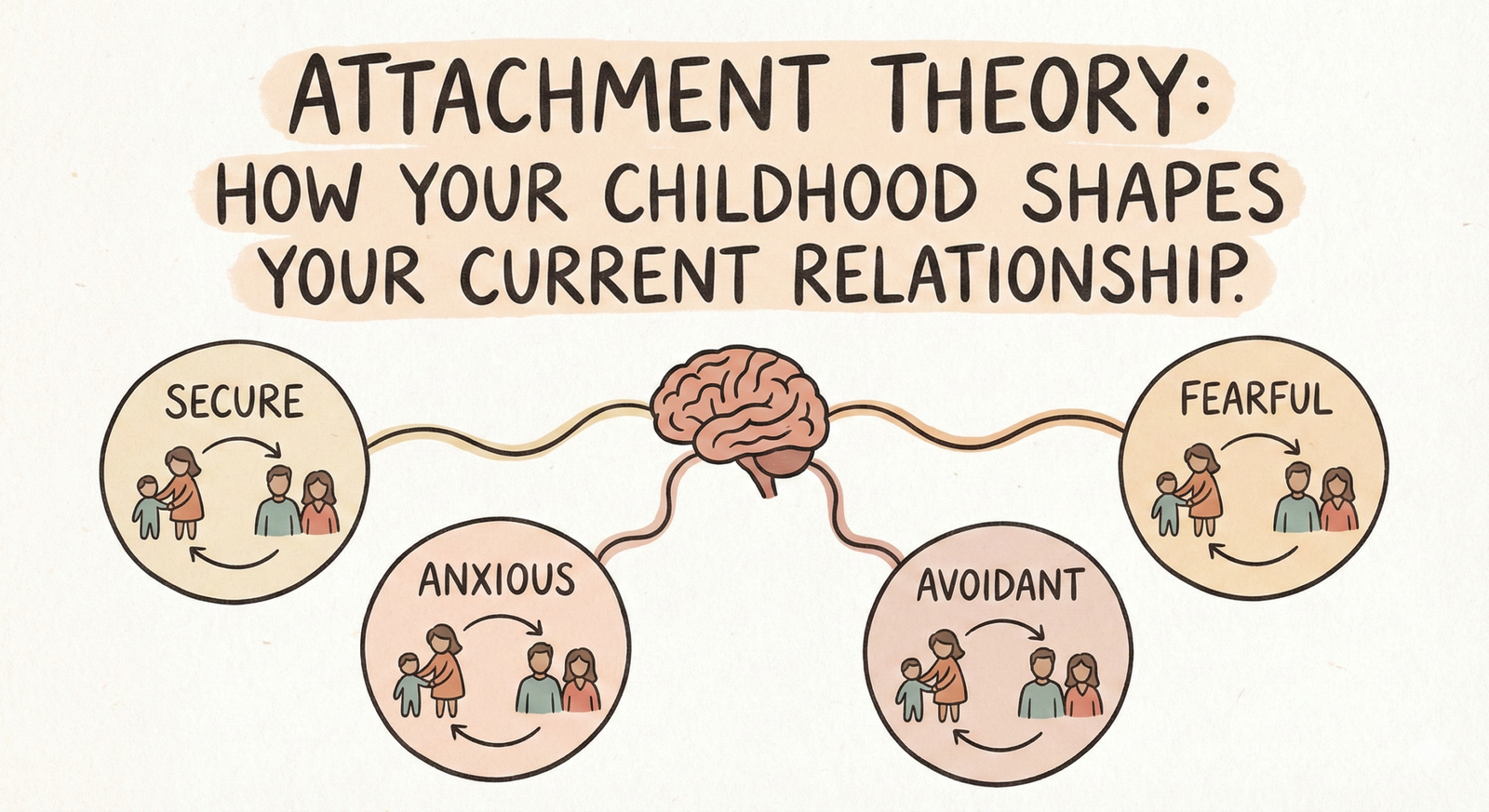
Attachment Theory, a cornerstone of developmental psychology, suggests that the bond formed with our primary caregivers during infancy creates a blueprint for how we perceive, respond to, and interact with romantic partners as adults.
The Origins: The Internal Working Model
Developed by British psychologist John Bowlby and later expanded by Mary Ainsworth, Attachment Theory posits that humans are biologically wired to seek connection for survival.
Bowlby introduced the concept of the “Internal Working Model.” This is a mental framework based on a child’s early interactions. If a caregiver is responsive and consistent, the child learns: “I am worthy of love, and others are trustworthy.” If the caregiver is inconsistent, rejecting, or frightening, the child learns: “I am not safe, and I must adapt to survive.”
These early adaptations evolve into adult attachment styles.
The Four Attachment Styles
Psychologists generally categorize attachment into four distinct styles. Understanding which one resonates with you is the first step toward relationship health.
1. Secure Attachment (The Anchor)
Roughly 50-60% of the population possesses a secure attachment style.
- Childhood Origin: Caregivers were consistent, responsive, and attuned to the child’s distress. The child felt safe exploring the world, knowing they had a “secure base” to return to.
- Adult Relationships: Secure adults are comfortable with intimacy and independence. They don’t fear being alone, nor do they fear being engulfed by a relationship. They communicate needs clearly, handle conflict without attacking or withdrawing, and offer support when their partner is down.
2. Anxious-Preoccupied Attachment (The Pursuer)
- Childhood Origin: Caregivers were often inconsistent—warm and responsive one moment, but distracted or unavailable the next. The child learned to hyper-activate their attachment system (crying, clinging) to ensure they weren’t abandoned.
- Adult Relationships: Anxious adults often battle a deep-seated fear of rejection. They may need constant reassurance and validation. In relationships, they can be perceived as “clingy” or overly sensitive to their partner’s moods/actions. They often equate anxiety with love and may struggle to trust their partner’s affection.
3. Dismissive-Avoidant Attachment (The Distancer)
- Childhood Origin: Caregivers were often emotionally unavailable, distant, or rejected the child’s attempts at closeness. To avoid the pain of rejection, the child learned to suppress their needs and become “self-reliant.”
- Adult Relationships: These individuals equate intimacy with a loss of independence. When a relationship gets too close, they subconsciously pull away. They often prioritize logic over emotion, may label partners as “too needy,” and maintain distance to protect themselves from vulnerability.
4. Fearful-Avoidant (Disorganized) Attachment
- Childhood Origin: This style is often associated with childhood trauma, abuse, or neglect. The caregiver was a source of fear rather than safety. The child faced an impossible biological paradox: the instinct to flee from fear, and the instinct to flee toward the caregiver for protection.
- Adult Relationships: Adults with this style desire intimacy but are terrified of it. They often oscillate between anxious and avoidant behaviors. Their relationships can be chaotic or intense, characterized by high highs and low lows. They often believe they are unlovable and that others are incapable of loving them properly.
How Attachment Plays Out in Love
These styles act as lenses through which we interpret our partner’s actions.
- The Anxious-Avoidant Trap: A common pairing occurs between an anxious person and an avoidant person. The anxious person pushes for closeness (pursues), causing the avoidant person to pull away (distance). This confirms the anxious person’s fear of abandonment and the avoidant person’s fear of engulfment, creating a painful cycle.
Can You Change Your Style? (Earned Security)
The most important takeaway from Attachment Theory is that your style is not a life sentence. Our brains remain neuroplastic throughout our lives.
Through a process called “Earned Security,” individuals with insecure attachments can develop secure patterns. This is achieved through:
- Therapy: Cognitive Behavioral Therapy (CBT) and psychodynamic therapy can help rewire internal models.
- Relationships: Being with a securely attached partner can “teach” the nervous system what safety feels like.
- Self-Regulation: Learning to self-soothe rather than relying solely on a partner (for anxious types) or learning to open up (for avoidant types).