
The human nervous system is a marvel of biological engineering, and at the heart of our ability to interact with the world around us are the cranial nerves. These nerves serve as the direct communication lines between the brain and the various regions of the head, neck, and torso.
Understanding the cranial nerves is a fundamental component of biological psychology and neuroscience, as they dictate everything from our sense of smell to our heart rate.
Where Do Cranial Nerves Originate?
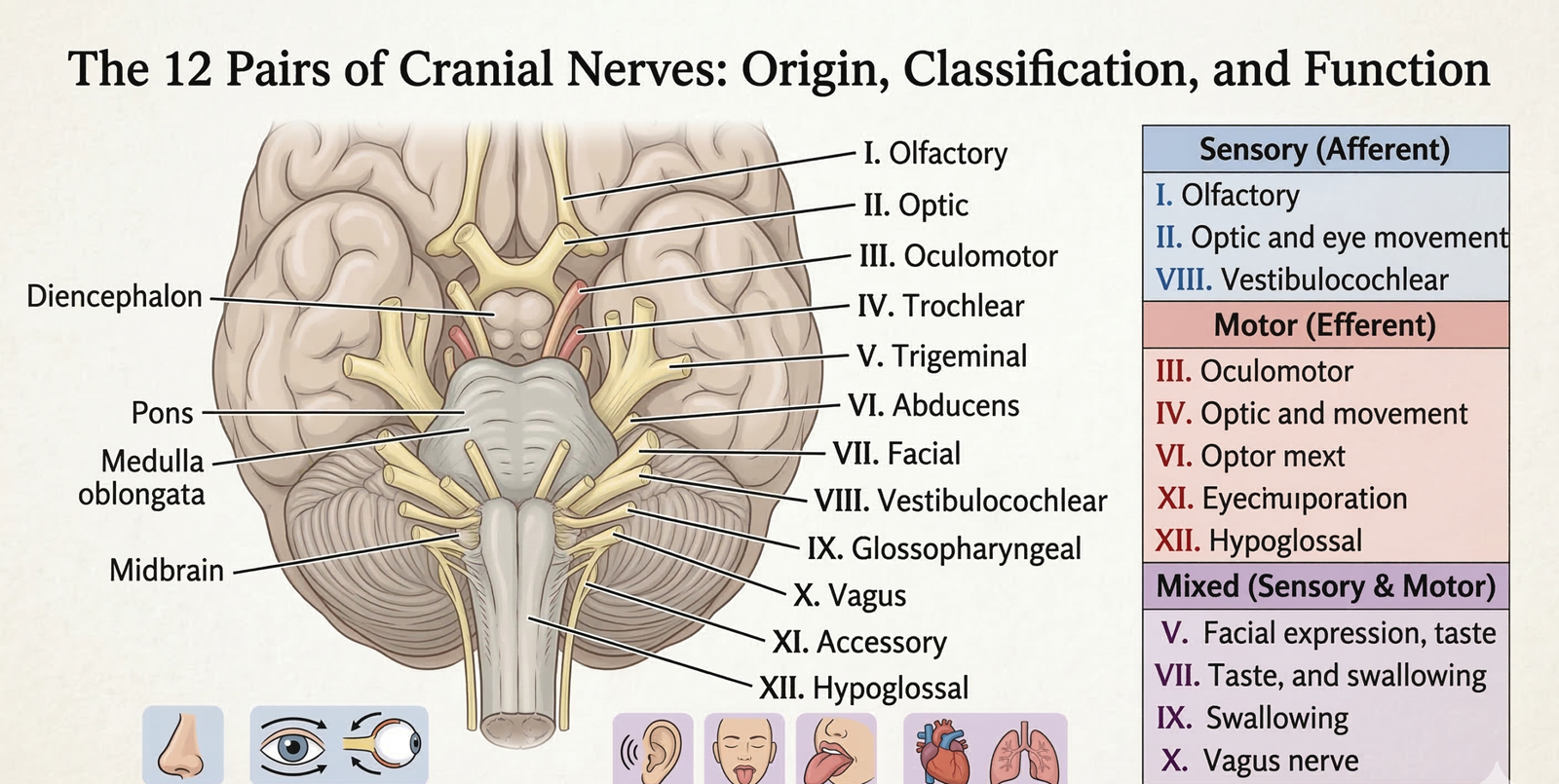
A common misconception is that all cranial nerves emerge from the brainstem. While they are a set of 12 paired nerves that arise directly from the brain (as opposed to the spinal cord), there is an important anatomical distinction to make:
- The Cerebrum: The first two cranial nerves (Olfactory and Optic) emerge directly from the cerebrum (forebrain).
- The Brainstem: The remaining ten pairs (Cranial Nerves III through XII) emerge from various sections of the brainstem, including the midbrain, pons, and medulla oblongata.
Why Are Cranial Nerves Essential?
Cranial nerves are vital to our survival and quality of life for several reasons:
- Sensory Processing: They allow us to process the five primary senses. Without them, we would not be able to see, hear, taste, smell, or feel sensations on our face.
- Motor Control: They govern the intricate movements of the eyes, face, jaw, tongue, and neck. This is essential for non-verbal communication (facial expressions), eating, speaking, and looking around our environment.
- Autonomic Functions (Parasympathetic): Several cranial nerves (most notably the Vagus nerve) carry parasympathetic fibers. These regulate involuntary, life-sustaining functions such as heart rate, digestion, breathing, and glandular secretions (like tears and saliva).
The Classification of Cranial Nerves
Cranial nerves are classified based on the type of nerve fibers they contain. They fall into one of three distinct categories:
- Sensory (Afferent): Nerves that transmit information from the body’s sensory organs to the brain (e.g., sight, hearing).
- Motor (Efferent): Nerves that carry signals from the brain to the muscles and glands to trigger movement or secretion.
- Both (Mixed): Nerves that contain both sensory and motor fibers, allowing them to perform dual functions.
Medical students and psychologists often use the popular mnemonic “Some Say Marry Money, But My Brother Says Big Brains Matter More” to remember whether each of the 12 nerves is Sensory (S), Motor (M), or Both (B).
The 12 Pairs of Cranial Nerves: A Complete Breakdown
Below is a detailed guide to each of the 12 cranial nerves, denoted by Roman numerals (I – XII), along with their specific classifications and functions.
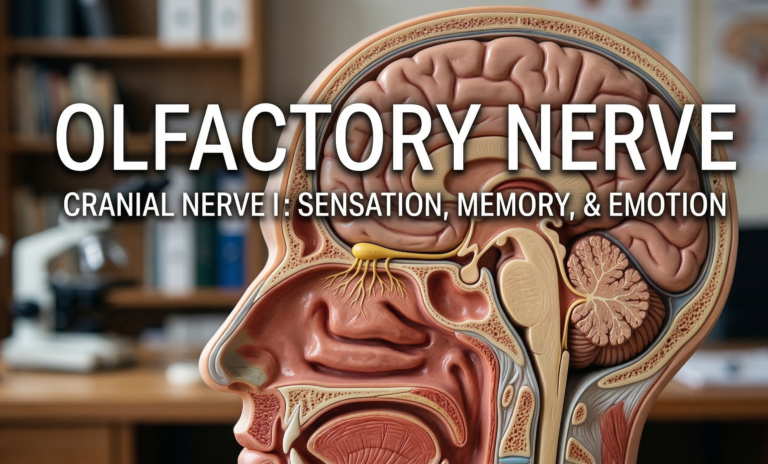
I. Olfactory Nerve
- Classification: Sensory
- Function: Responsible for the sense of smell. It relays odor information from the nasal cavity directly to the brain’s olfactory bulb.
II. Optic Nerve
- Classification: Sensory
- Function: Responsible for vision. It transmits visual information from the retina to the brain for processing.
III. Oculomotor Nerve
- Classification: Motor
- Function: Controls the majority of eye movements, including the constriction of the pupil and the lifting of the upper eyelid.
IV. Trochlear Nerve
- Classification: Motor
- Function: Controls the superior oblique muscle of the eye, allowing for downward and inward eye movements.
V. Trigeminal Nerve
- Classification: Both (Mixed)
- Function: This is the largest cranial nerve. It provides sensory information (touch, pain, temperature) from the face and head, and controls the motor functions required for chewing (mastication).
VI. Abducens Nerve
- Classification: Motor
- Function: Controls the lateral rectus muscle of the eye, allowing the eye to move outward (away from the nose).
VII. Facial Nerve
- Classification: Both (Mixed)
- Function: Controls the muscles of facial expression. It also provides the sense of taste to the anterior two-thirds of the tongue and supplies glands that produce tears and saliva.
VIII. Vestibulocochlear Nerve
- Classification: Sensory
- Function: Composed of two parts. The vestibular branch is responsible for balance and spatial orientation, while the cochlear branch is responsible for hearing.
IX. Glossopharyngeal Nerve
- Classification: Both (Mixed)
- Function: Provides sensory information from the back of the throat, the inner ear, and the posterior one-third of the tongue (taste). It also controls voluntary muscles used in swallowing.
X. Vagus Nerve
- Classification: Both (Mixed)
- Function: The longest and most complex cranial nerve. It interfaces with parasympathetic control of the heart, lungs, and digestive tract. It is essential for lowering heart rate, stimulating digestion, and controlling the vocal cords.
XI. Accessory Nerve (Spinal Accessory)
- Classification: Motor
- Function: Controls the sternocleidomastoid and trapezius muscles in the neck and shoulders, allowing for head rotation and shoulder shrugging.
XII. Hypoglossal Nerve
- Classification: Motor
- Function: Controls the muscles of the tongue, making it essential for speech, swallowing, and food manipulation.
Conclusion
The 12 pairs of cranial nerves form a highly specialized, complex network that bridges the central nervous system with the head, neck, and vital organs. By classifying these nerves into sensory, motor, and mixed categories, neuroscientists and psychologists can better understand how brain injuries or neurological disorders manifest in human behavior and bodily function.