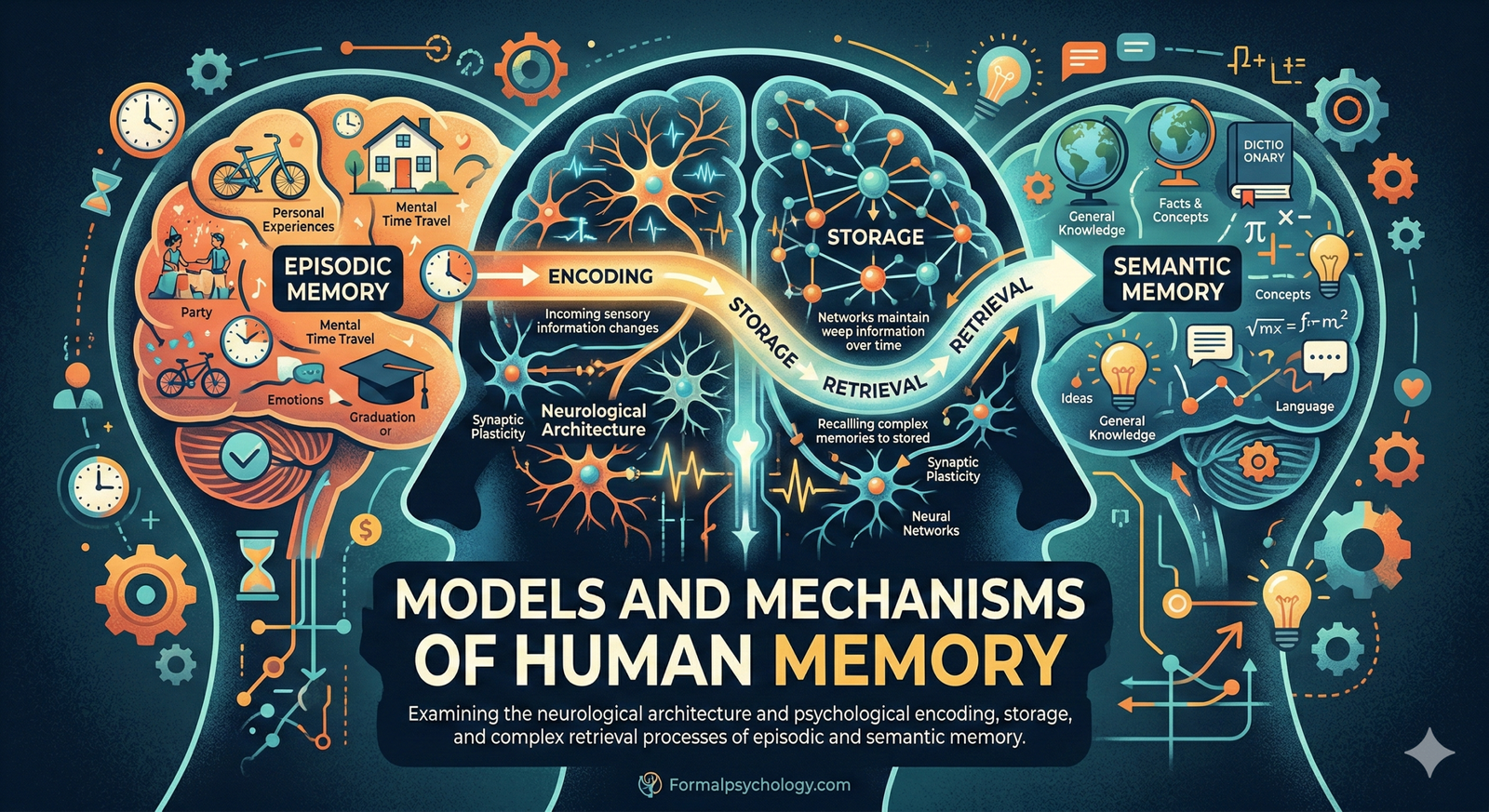

The Models and Mechanisms of Human Memory describe one of the most sophisticated and dynamic biological systems in the natural world. Far from acting like a computer’s hard drive that simply records and retrieves static files, human memory is a reconstructive, highly subjective, and constantly evolving cognitive process. To truly understand how we retain the narrative of our personal lives (episodic memory) alongside the objective facts of our environment (semantic memory), we must examine both the established theoretical frameworks and the underlying neural cellular machinery.
I. Structural Models: Mapping the Cognitive Architecture
To conceptualize how information flows from our senses into permanent storage, cognitive psychologists have developed several foundational models.
1. The Multi-Store Model (Atkinson & Shiffrin, 1968)
This is the classic framework that compartmentalizes memory into three distinct, sequential stages based on capacity and duration.
- Sensory Memory: The initial gateway. It holds raw, unanalyzed sensory information for a fraction of a second. It is subdivided into Iconic memory (visual stimuli, lasting roughly 0.5 seconds) and Echoic memory (auditory stimuli, lasting 3 to 4 seconds). Information must be attended to, or it decays instantly.
- Short-Term Memory (STM): If attended to, data enters STM. This is a limited-capacity store. George Miller famously quantified this capacity as “the magical number seven, plus or minus two” items, though modern research suggests it may be closer to four. Without active rehearsal, information here lasts roughly 15 to 30 seconds.
- Long-Term Memory (LTM): Through sustained rehearsal and meaningful association, information transfers to LTM, which is theoretically infinite in both capacity and duration.
2. The Working Memory Model (Baddeley & Hitch, 1974)
Recognizing that STM is not a passive waiting room but an active computational space, Baddeley and Hitch proposed the Working Memory model.
- The Central Executive: The “boss” of the system. It allocates cognitive resources, directs attention, and suppresses irrelevant information.
- The Phonological Loop: Temporarily stores verbal and acoustic information (the “inner ear” and “inner voice”).
- The Visuo-spatial Sketchpad: Temporarily stores visual and spatial information, allowing us to navigate our environment and mentally rotate objects.
- The Episodic Buffer (added in 2000): Acts as a backup storage area that communicates with both LTM and the components of working memory, integrating various stimuli into a cohesive chronological sequence.
3. Levels of Processing Theory (Craik & Lockhart, 1972)
This model posits that memory is not about where information is stored, but how deeply it is processed. Information processed at a “shallow” level (e.g., the physical font of a word) is quickly forgotten. Information processed at a “deep,” semantic level (e.g., the meaning of the word and its relationship to your life) creates strong, enduring memory traces.
II. The Psychological Lifecycle: Encoding, Storage, and Retrieval
The functional mechanism of memory relies on three distinct psychological stages. An error at any stage results in forgetting.
Stage 1: Encoding (The Acquisition Phase)
Encoding is the biological and psychological translation of physical energy (light, sound waves) into neural codes.
- Semantic Encoding: Processing meaning. This is the most powerful form of encoding for long-term retention.
- The Spacing Effect: Hermann Ebbinghaus discovered that encoding is significantly more effective when study sessions are spaced out over time (distributed practice) rather than crammed into one session (massed practice).
- The Testing Effect: Actively retrieving information during the encoding phase (e.g., taking a practice quiz) strengthens the memory trace far more than simply re-reading the material.
Stage 2: Storage and Consolidation
Once encoded, a memory trace is highly vulnerable to disruption. Consolidation is the stabilizing process.
- Synaptic Consolidation: Occurs rapidly (within minutes to hours) and involves structural changes at the neuronal synapses.
- Systems Consolidation: A prolonged process (taking days, months, or even years) where the hippocampus gradually “teaches” the neocortex the memory trace until the neocortex can retrieve the memory independently of the hippocampus. Sleep, particularly Slow-Wave Sleep (SWS), is the primary biological driver of this process.
Stage 3: Retrieval (The Reconstructive Act)
Retrieving a memory means successfully accessing it from LTM and bringing it back into working memory. This relies heavily on retrieval cues. According to the Encoding Specificity Principle, retrieval is most successful when the cues present at the time of recall match the cues present at the time of encoding. This explains state-dependent memory—why you might recall information better if you are in the same physical or emotional state as when you learned it.
III. Episodic vs. Semantic Memory: The Declarative Divide
Long-Term Memory is broadly divided into Implicit (unconscious, procedural skills like riding a bike) and Explicit (Declarative) memory. Declarative memory is further bifurcated:
| Feature | Episodic Memory | Semantic Memory |
| Core Definition | Autobiographical events; the conscious recall of personal experiences. | General knowledge, objective facts, vocabulary, and concepts. |
| Subjective Experience | Involves “mental time travel”—reliving the past. | “Knowing” without necessarily remembering when you learned it. |
| Vulnerability | Highly susceptible to distortion, suggestion, and age-related decline. | Relatively stable and resistant to age-related decay. |
| Neurological Basis | Right prefrontal cortex and medial temporal lobe (Hippocampus). | Left prefrontal cortex and widely distributed across lateral temporal cortices. |
IV. Neurological Architecture: The Cellular Mechanisms
Memory does not reside in a single “filing cabinet” in the brain. It is a highly distributed network of neurons.
- The Hippocampus: Located in the medial temporal lobe, it is essential for spatial memory and the consolidation of declarative memories. Damage here (as seen in the famous patient H.M.) results in severe anterograde amnesia—the inability to form new explicit memories.
- The Amygdala: Situated adjacent to the hippocampus, it processes emotional reactions. It modulates memory consolidation based on emotional arousal, ensuring that threatening or highly rewarding events are permanently etched into our neural circuitry.
- The Prefrontal Cortex (PFC): Crucial for working memory, executive function, and the strategic retrieval of LTMs. It helps us reconstruct the order of past events.
Long-Term Potentiation (LTP): Memory at the Micro-Level
At the cellular level, the physical mechanism of memory is Long-Term Potentiation (LTP).
LTP is the persistent strengthening of a synaptic connection based on high-frequency, repeated stimulation. When a presynaptic neuron repeatedly fires and successfully activates a postsynaptic neuron, their connection strengthens, primarily mediated by the neurotransmitter glutamate and its receptors (NMDA and AMPA). This cellular plasticity is the biological foundation of learning.
V. Mechanisms of Forgetting: Why Memory Fails
To fully grasp the models and mechanisms of human memory, we must understand its failures. The German psychologist Hermann Ebbinghaus demonstrated via his Forgetting Curve that memory decay is exponential: we lose the vast majority of newly learned, meaningless information within the first 24 hours unless it is reviewed.
Beyond simple decay, forgetting is largely driven by Interference:
- Proactive Interference: Old memories disrupt the retrieval of new memories (e.g., accidentally writing last year’s date on a document).
- Retroactive Interference: New memories disrupt the retrieval of old memories (e.g., learning a new password makes you forget your old one).
Conclusion
The study of memory bridges the gap between abstract psychological theory and hard neurobiology. The models and mechanisms of human memory reveal a system that is incredibly adaptive, allowing us to navigate the present by referencing the past. However, because memory relies on reconstructive processes rather than exact replication, it remains intrinsically fragile. By understanding these structural architectures and cellular processes, formal psychology is better equipped to treat memory deficits, mitigate the impacts of cognitive decline, and optimize educational practices for the modern mind.