
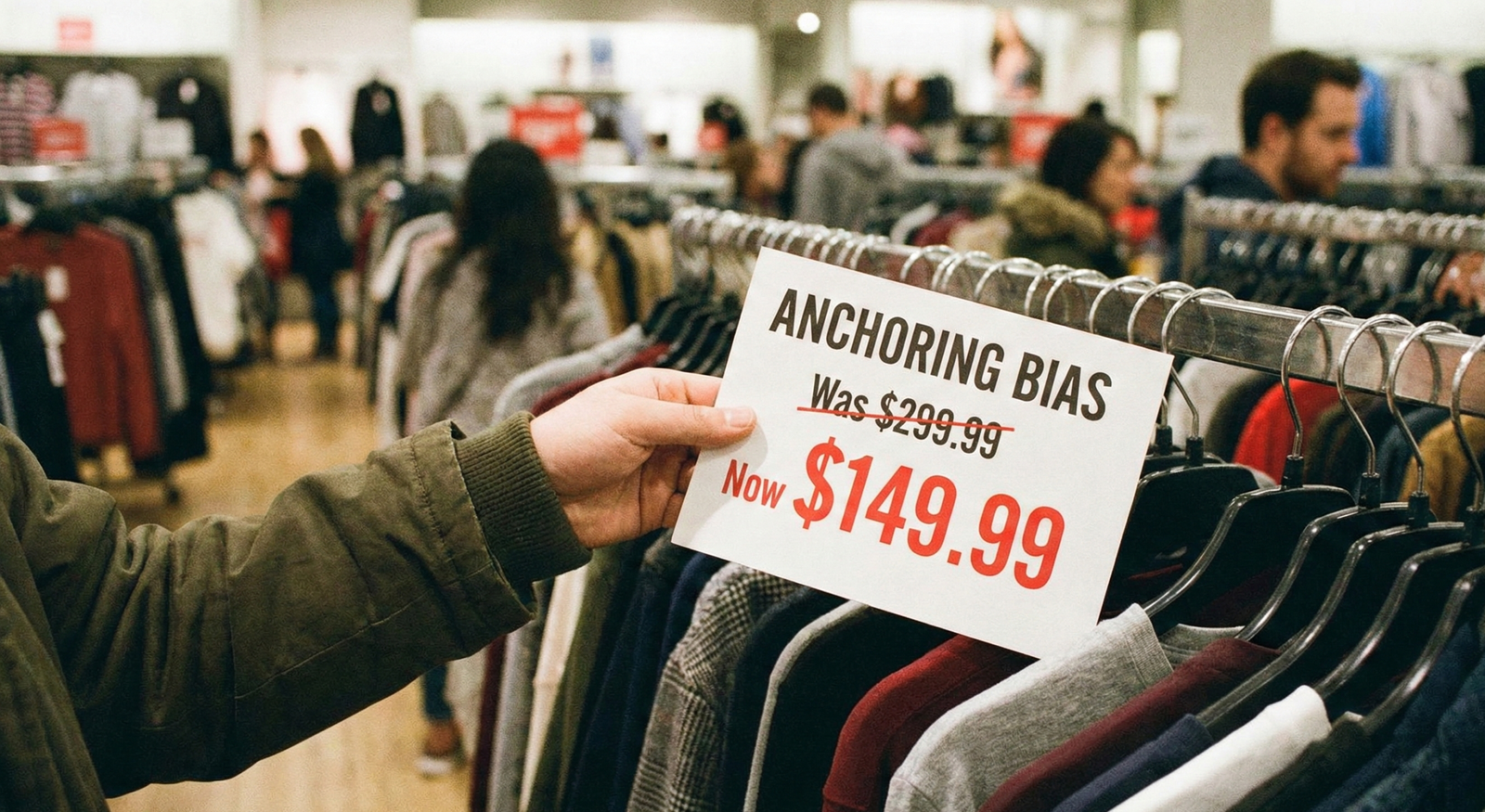
Have you ever walked into a high-end designer store and seen a jacket priced at $2,000? You likely walked away thinking it was ridiculously expensive. But if you later found a similar jacket for $400, it suddenly felt like a “steal.” In isolation, $400 is still a significant amount of money, but compared to the initial $2,000, it seems reasonable.
This phenomenon is not just clever marketing; it is a fundamental cognitive glitch known as Anchoring Bias.
At Formal Psychology, we believe in understanding the underlying mechanisms of the mind to make better decisions. In this article, we dissect the psychology of the anchoring effect, how it manipulates your perception of value, and why it might be the biggest enemy of your monthly budget.
What is Anchoring Bias?
Anchoring Bias is a cognitive bias where an individual relies too heavily on an initial piece of information (the “anchor”) when making decisions. Once an anchor is set, subsequent judgments are made by adjusting away from that anchor, but there is a bias toward interpreting other information around the anchor.
In simpler terms: the first number you see sets the standard for everything that follows.
The Origins: Tversky and Kahneman
The concept was first theorized by psychologists Amos Tversky and Daniel Kahneman in the 1970s. In a famous study, they asked participants to estimate the percentage of African nations in the United Nations. Before guessing, a wheel of fortune was spun to generate a random number (either 10 or 65).
- Participants who saw the number 10 estimated the percentage was around 25%.
- Participants who saw the number 65 estimated the percentage was around 45%.
Even though the wheel was completely random and irrelevant, the number it showed “anchored” the participants’ estimates.
The Psychology Behind the Anchor: The Adjustment Heuristic
Why does our brain do this? The leading theory is the Anchoring-and-Adjustment Heuristic.
When we face an uncertain value (like the “fair” price of a used car or a house), we start with a reference point (the anchor) and adjust up or down to reach a plausible estimate. However, our adjustments are often insufficient. We stop adjusting as soon as we reach a value that feels “plausible,” leaving our final estimate biased toward the initial anchor.
How Anchoring Hijacks Your Budget
The anchoring effect is pervasive in consumerism and financial planning. Here are the three primary ways it dictates your spending:
1. The “Original Price” Trap
Retailers are masters of anchoring. When you see a price tag that says ~~”$100″~~ (crossed out) and implies a sale price of “$70,” the $100 serves as the anchor.
- The Reality: The item may only be worth $50 in terms of utility or market value.
- The Perception: You feel you are “saving” $30, rather than spending $70. The anchor distorts your perception of value, making the expenditure feel like a gain rather than a loss.
2. The Decoy Effect in Menus and Subscriptions
Have you ever noticed the most expensive item on a restaurant menu is often placed at the top right? This is strategic. That $80 steak acts as an anchor. You might not buy it, but it makes the $35 chicken dish look incredibly reasonably priced by comparison. Without the $80 anchor, you might have considered $35 too expensive for chicken.
3. Salary Negotiations
Anchoring isn’t just about spending; it’s about earning. In salary negotiations, the first number thrown out sets the anchor.
- If a recruiter states a range of “$50k – $60k,” the discussion anchors around those lower figures.
- If you open with “$80k,” even if the employer negotiates down, the final offer is likely to be higher than if you had let them set the anchor first.
Case Study: Real Estate & Car Dealerships
Real Estate: Listing prices are powerful anchors. A house listed for $500,000 that sells for $480,000 feels like a victory for the buyer. However, if the same house had been listed at $460,000 and sold for $480,000, the buyer would feel they overpaid. The intrinsic value of the house hasn’t changed—only the anchor has.
Car Dealerships: The “Sticker Price” (MSRP) on a car window is almost never the selling price. It exists primarily to establish a high anchor so that the negotiated price feels like a hard-won bargain.
How to Defeat the Anchor
Understanding the bias is the first step, but overcoming it requires active cognitive effort. Here are strategies to protect your wallet:
- Establish a Baseline First: Before looking at the price of a product (or a salary offer), do your research. Determine what the item is worth to you or what the market average is. If you walk in knowing a laptop should cost $800, a $1,500 anchor won’t phase you.
- Generate Counter-Anchors: If you are negotiating, introduce a new anchor immediately. If a seller asks for $100, and you think it’s worth $50, don’t just say “too high.” Counter with $40. This resets the psychological playing field.
- Ignore the “Was” Price: When shopping online, train your eyes to ignore the crossed-out original price. Focus strictly on the current price and ask: “Is this item worth this amount of money right now?”
- Wait and Reflect: The adjustment heuristic often happens largely unconsciously and quickly. Slowing down your decision-making process (System 2 thinking) allows you to critically evaluate the price without the emotional weight of the anchor.
Conclusion
Anchoring Bias acts as an invisible hand, guiding our estimates and valuations toward arbitrary numbers. Whether it’s the MSRP on a car or the first salary figure mentioned in an interview, these initial numbers have a sticky quality that is hard to shake.
At Formal Psychology, we encourage our readers to look beyond the initial numbers. By recognizing when an anchor is being set, you can cut the line, drift away from the bias, and make financial decisions based on real value, not manipulated perception.