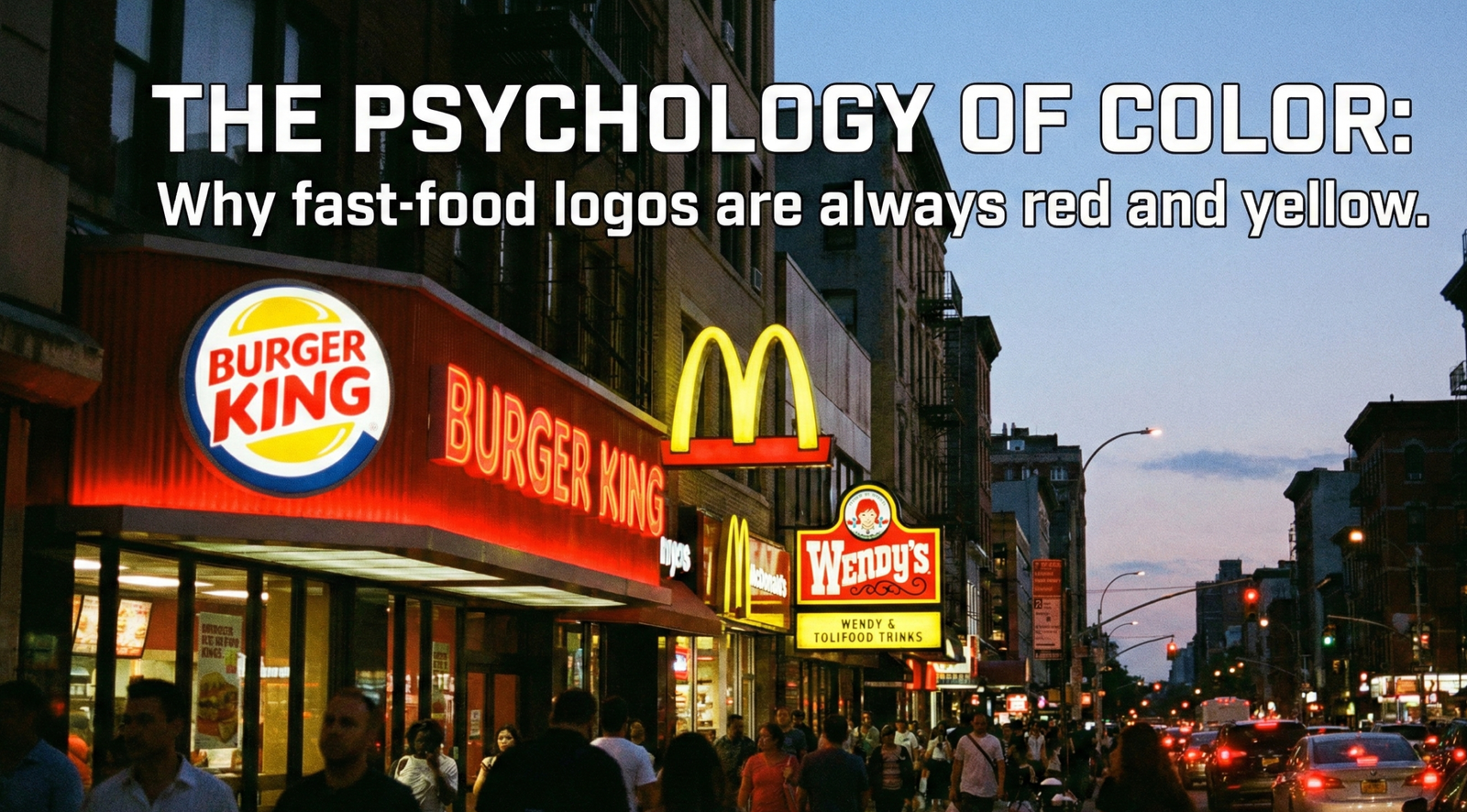
Drive down any highway or walk through any food court, and you will be bombarded by a very specific spectrum of light. The Golden Arches of McDonald’s, the bun-halves of Burger King, the star of Carl’s Jr., and the typography of In-N-Out all rely on the same two dominant hues: Red and Yellow.
In the world of Formal Psychology and consumer behavior, this is not a coincidence. It is a calculated application of neuro-marketing known colloquially as the “Ketchup and Mustard Theory.”
This article explores the physiological and psychological mechanisms that make this color combination irresistible to the human brain.
1. The Science of Color and the Brain
Before dissecting the specific colors, it is important to understand why color influences decision-making. Color is not just a visual experience; it is a psychological trigger.
Research suggests that between 60% and 90% of a consumer’s initial assessment of a product is based on color alone. Colors act as a shortcut for the brain, communicating mood, status, and expectation without a single word being read. In the fast-food industry, the goal is to communicate two things very quickly: “Be Hungry” and “Be Quick.”
2. Red: The Trigger for Urgency and Appetite
Red is the most intense color in the psychological spectrum. It has a longer wavelength than other visible colors, making it appear closer to the viewer than it actually is.
Physiological Effects
Red is stimulating. Studies in environmental psychology have shown that exposure to red light or bright red environments can:
- Increase heart rate.
- Elevate blood pressure.
- Stimulate metabolism.
The Hunger Connection
Because red stimulates the metabolism and increases energy levels, the brain interprets this physiological arousal as appetite. Red screams “vitality” and “meat.” Evolutionarily, bright reds in nature often signaled ripe fruit or fresh meat, wiring our brains to pay attention to this hue when seeking sustenance.
Creating Urgency
Fast food is a volume business. They do not want you to linger; they want you to buy, eat, and leave to make room for the next customer. Red creates a subtle sense of urgency and excitement, encouraging faster eating habits.
3. Yellow: The Beacon of Happiness and Visibility
While red provides the urgency, yellow provides the emotional hook. Yellow is widely recognized in color psychology as the color of optimism, happiness, and youthfulness.
The “Daylight” Effect
Yellow mimics the effect of sunlight. It triggers the release of serotonin, the neurotransmitter associated with feelings of well-being. When you see the yellow arches, your brain unconsciously anticipates a positive, comforting experience (like a “Happy Meal”).
The Visibility Factor
From a practical standpoint, yellow is the most visible color in daylight. This is why caution signs and taxi cabs are yellow. For a fast-food chain trying to capture the attention of a driver moving at 70 mph on a highway, yellow is the only color that can compete with the blue of the sky and the gray of the road.
4. The “Ketchup and Mustard Theory”
When you combine Red and Yellow, you get the “Ketchup and Mustard Theory.”
This combination creates a psychological Perfect Storm:
- Red makes you stop, look, and feel hungry (Physiological).
- Yellow makes you feel happy and welcome (Emotional).
Together, they communicate: “Stop here, eat now, and you will feel good.”
Note: This combination is so effective that it can make customers feel hungry even if they aren’t. It triggers a conditioned response—Pavlovian style—where the visual input of red/yellow signals the brain to prepare the stomach for food.
5. The Exceptions: Why Not Blue or Green?
To fully understand the power of red and yellow, we must look at the colors that fast food strictly avoids (or uses very selectively).
The Blue Appetite Suppressant
Blue is virtually non-existent in traditional fast-food logos (with rare exceptions like Taco Bell or Domino’s, which position themselves as “late-night” or “alternative”).
- Evolutionary Warning: In nature, blue food is rare. Blueberries are an outlier. Generally, if food turns blue or purple, it is spoiled or poisonous.
- Calming Effect: Blue is a sedative. It lowers heart rate and suppresses appetite—the exact opposite of what a burger joint wants.
The Green Shift: The “Healthy” Rebrand
Recently, you may have noticed a shift. McDonald’s in Europe often uses a hunter-green background behind the golden arches. Subway and Starbucks rely heavily on green.
Why? Green represents health, freshness, and nature. As the public becomes more health-conscious, “Fast Food” is pivoting to “Fast Casual.” Brands that want to emphasize fresh ingredients (Subway, Chipotle) or relaxation (Starbucks) swap the urgency of red for the relaxation of green.
Conclusion
The ubiquity of red and yellow in the fast-food industry is a testament to the power of Formal Psychology in marketing. It is not an aesthetic choice; it is a biological hack.
By leveraging the physiological arousal of red and the emotional warmth of yellow, brands bypass our logic centers and speak directly to our primitive instincts. The next time you feel a sudden pang of hunger while driving past a bright red and yellow sign, remember: it’s not just your stomach talking; it’s your brain reacting to the Ketchup and Mustard Theory.