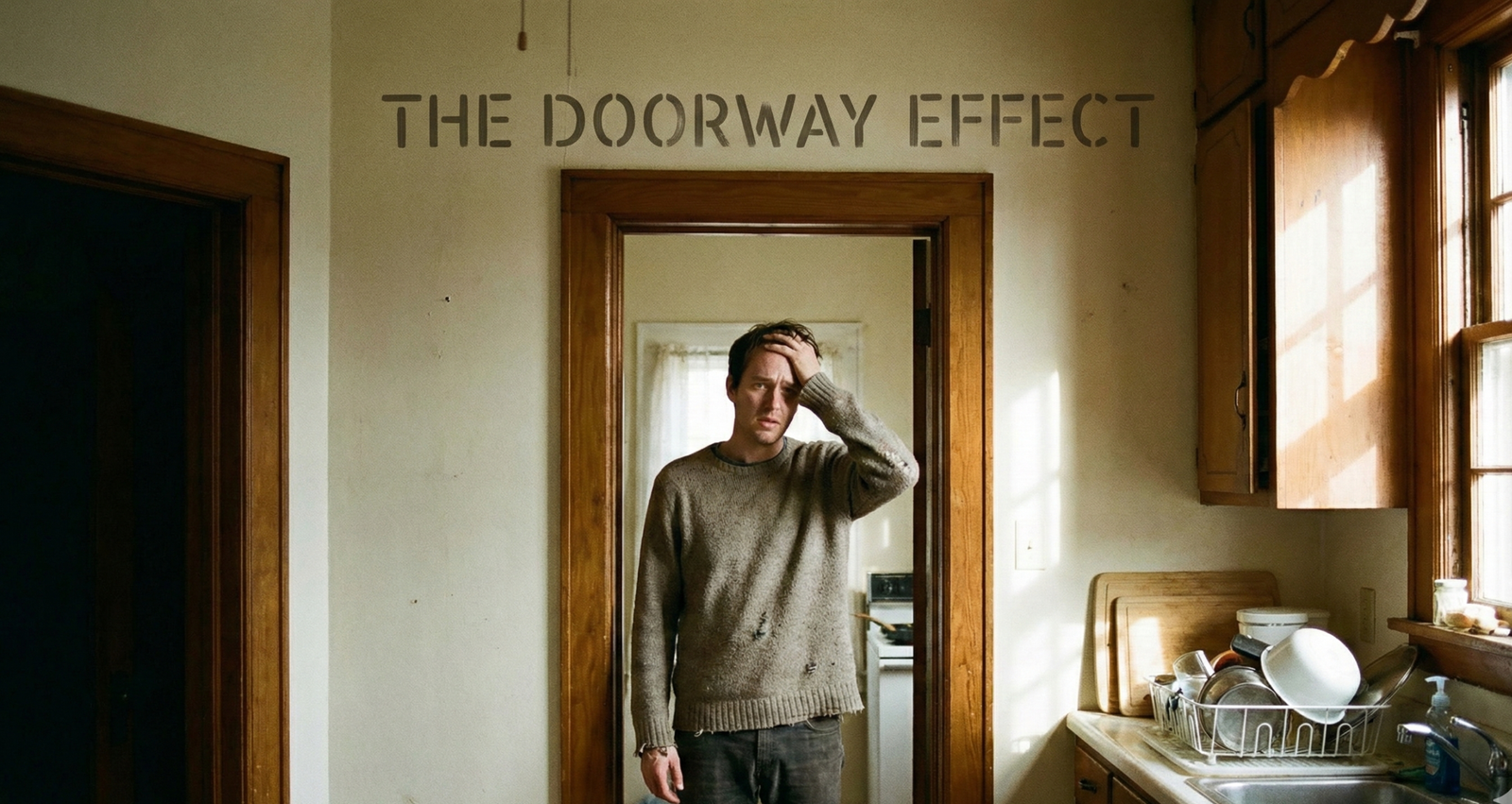
It is a scenario as old as doorways themselves. You are sitting on the couch, and you suddenly realize you need to grab the scissors from the kitchen. You stand up, walk with purpose across the hallway, pass through the doorframe, and then… nothing. You stand in the middle of the kitchen, looking around in confusion, asking yourself, “Why did I come in here?”
This isn’t a sign of early-onset dementia or a “glitch in the matrix.” In psychology, this phenomenon is formally known as the Doorway Effect (or the Location Updating Effect). It is a well-documented cognitive quirk that reveals fascinating details about how our brains organize memories and navigate the world.
What is the Doorway Effect?
The Doorway Effect is a psychological phenomenon where passing through a physical boundary—like a door—hinders our ability to recall memories formed in the previous room. Essentially, the act of moving from one distinct environment to another causes a “purge” of short-term memory.
While it can be frustrating, this mechanism is actually a feature of a healthy, efficient brain, not a bug. It suggests your brain is actively managing its limited resources to focus on the immediate environment.
The Science: Event Segmentation Theory
To understand why this happens, we must look at Event Segmentation Theory.
The human brain does not record life like a continuous video stream. If it did, the sheer volume of information would be impossible to search through when you needed to recall a specific detail. Instead, the brain functions more like a video editor. It chops your daily experience into distinct scenes or “episodes.”
The “Event Horizon” Model
Psychologist Gabriel Radvansky and his colleagues at the University of Notre Dame have conducted the most prominent studies on this effect. Their research proposes the “Event Horizon Model,” which suggests:
- Event Models: When you are in a room (Context A), your brain constructs a “model” of that situation. This model includes your current actions, the layout of the room, and your immediate goals (e.g., “I need scissors”).
- The Boundary: When you walk through a doorway, your brain perceives this as an Event Boundary. It signals the end of the “Living Room Episode” and the start of the “Kitchen Episode.”
- The Reset: To free up cognitive processing power for the new environment (Context B), the brain “archives” the old event model. The information from the previous room (including your goal to get scissors) is moved from active working memory to long-term storage.
When you arrive in the kitchen, the memory isn’t gone; it just isn’t “loaded” in your active RAM anymore. You have to expend mental energy to retrieve it from the archive, which causes that moment of blankness.
The Evidence: Radvansky’s Experiments
In a series of famous experiments (2011), Radvansky and his team tested this theory using both virtual and real-world environments.
- The Setup: Participants had to pick up an object on a table (e.g., a colored wedge) and carry it to another table to swap it.
- The Variables: Sometimes the participants walked across a large room to the next table; other times, they walked the same distance but passed through a doorway into a separate room.
- The Result: Participants consistently had more trouble remembering what object they were carrying or what they were supposed to do after passing through a doorway compared to walking the same distance in a single room.
Crucially, the study showed that this memory dump happens even if you simply imagine walking through a doorway, or if you are navigating a video game character through a door. The “door” acts as a powerful psychological cut.
It’s Not Just Physical Doors
The Doorway Effect applies to digital environments as well. Have you ever opened a new browser tab to search for something, only to stare at the Google search bar and forget what you were looking for?
Changing windows or tabs acts as a digital event boundary. Your brain treats the new window as a “new room,” and the thought you had in the previous tab gets archived.
Evolution: Why Do We Have This?
Why would evolution design a brain that forgets its goals? The answer lies in survival and efficiency.
In our ancestral past, entering a new environment (like stepping from a cave into a forest) brought new threats and opportunities. A predator might be lurking in the new area, or the terrain might change. It was evolutionarily advantageous for the brain to dump old, irrelevant information (the safety of the cave) to fully focus its processing power on the new environment.
The Doorway Effect is your brain saying: “Focus on where you are right now. The past doesn’t matter as much as the present.”
How to Overcome the Doorway Effect
While you cannot turn off this biological mechanism, you can use cognitive tricks to maintain your “event model” across boundaries.
1. “Carry” the Context
If you need to fix a loose screw in the kitchen, carry the screwdriver with you from the living room. Holding a physical object associated with the task acts as a constant cue, anchoring the memory in your working RAM even as you cross the threshold.
2. Verbalize Your Intention
As you approach the door, say out loud (or mutter to yourself): “I am going to get the scissors.” Phonological loops (repeating sounds) use a different part of working memory than spatial navigation. By speaking, you create a backup of the memory.
3. The “Look Back” Technique
If you forget why you entered the room, physically turn around and look through the door at the room you just came from. Often, seeing the previous context will “reactivate” the old event model and trigger the memory retrieval.
4. Visualize the End Goal
Don’t just think “scissors.” Visualize yourself holding the scissors in the kitchen. Focusing on the destination rather than the journey can sometimes help bridge the event boundary.
Conclusion
The Doorway Effect is a humbling reminder that our memory is not a perfect filing cabinet, but a dynamic, context-dependent system. It highlights the complex way our minds segment the world to help us focus on the “here and now.”
So, the next time you find yourself standing in a room, confused and empty-handed, don’t worry. Your brain isn’t failing; it’s just doing a very good job of moving on to the next chapter—perhaps a little too quickly.