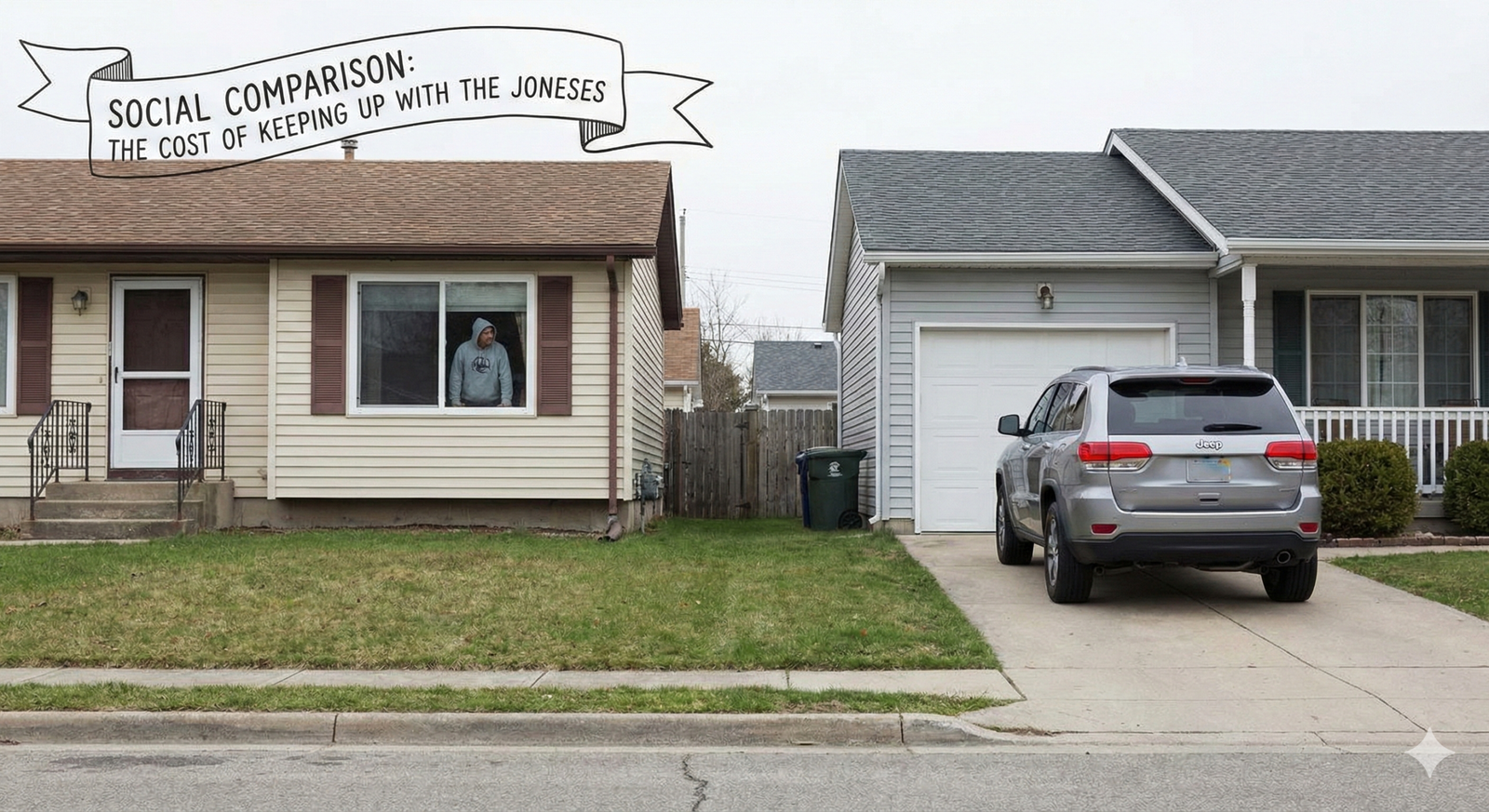
The idiom “Keeping up with the Joneses” originated in a comic strip in the early 20th century, depicting the social climbing of a family struggling to match their neighbors’ lifestyle. A century later, the Joneses are no longer just next door; they are in our pockets, on our screens, and broadcasting their highlight reels 24/7.
While the phrase suggests a financial race, the engine driving it is deeply psychological. It is rooted in Social Comparison Theory, a fundamental mechanism of how human beings evaluate their self-worth. In this deep dive, we explore why we compare, the psychological toll of the “status trap,” and how to reclaim your own definition of success.
1. The Science: What is Social Comparison Theory?
To understand why we try to keep up with the Joneses, we must look at the work of social psychologist Leon Festinger. In 1954, Festinger proposed Social Comparison Theory, suggesting that humans have an innate drive to evaluate their own opinions and abilities. Without an objective standard (like a ruler to measure height), we rely on comparing ourselves to others to gauge where we stand.
Shutterstock
Explore
Psychologists categorize these comparisons into two distinct types:
- Upward Social Comparison: Comparing ourselves to those we perceive as “better” or having more (e.g., a wealthier neighbor or a more fit influencer). While this can sometimes inspire motivation, it more often triggers feelings of inferiority, envy, and dissatisfaction.
- Downward Social Comparison: Comparing ourselves to those we perceive as “worse” off. This is often a defensive mechanism to boost self-esteem or gratitude.
“Keeping up with the Joneses” is a chronic form of Upward Social Comparison focused on material wealth and social status.
2. The Evolutionary Trap: Why Can’t We Stop?
If comparing ourselves to others makes us miserable, why do we do it? Evolutionary psychology suggests that status was once a matter of survival. In early human tribes, higher status meant better access to food, mates, and protection. Being “left behind” could mean death.
Today, our survival is rarely at risk because our neighbor bought a luxury car, but our ancient brain still fires the same anxiety signals. We experience Relative Deprivation—the feeling that we are worse off than the people we compare ourselves to, regardless of our actual level of comfort or wealth.
3. The Digital Joneses: Social Media as an Accelerant
The dynamic of social comparison has shifted drastically in the digital age. Previously, you only had to compete with the neighbors on your street. Today, you are psychologically competing with the curated lives of millions.
- The Highlight Reel Effect: We compare our “behind-the-scenes” (our struggles, debt, and insecurities) with everyone else’s “highlight reel” (vacations, new cars, and promotions).
- The Quantified Self: Likes, followers, and views provide tangible, addictive metrics of social worth, reinforcing the need for external validation.
4. The Hidden Costs of the Chase
The pursuit of status is not a victimless crime against the self. The costs manifest in three critical areas:
A. The Financial Cost (The Hedonic Treadmill)
Psychologically, the “Joneses” represent a moving target. This is known as the Hedonic Treadmill. As we acquire more (a bigger house, a faster car), our expectations rise in tandem. We quickly adapt to the new level of luxury, and it ceases to bring happiness, forcing us to seek the next upgrade to feel the same dopamine hit. This leads to:
- Chronic debt.
- Financial anxiety.
- Lack of savings for genuine emergencies.
B. The Mental Health Cost
Chronic upward comparison is strongly correlated with:
- Depression and Anxiety: The constant feeling of “not enoughness.”
- Low Self-Esteem: Basing self-worth on external possessions rather than internal values.
- Envy and Resentment: These toxic emotions can erode our ability to feel empathy or happiness for others.
C. The Relational Cost
When we view peers as competitors rather than community members, relationships suffer. The stress of maintaining a façade can lead to marital conflict, particularly regarding finances, and creates superficial friendships based on status rather than connection.
5. Signs You Are Caught in the Trap
Are you unconsciously trying to keep up? Ask yourself these questions:
- Do you buy things you didn’t know you wanted until you saw someone else with them?
- Do you feel a pang of failure when a friend succeeds?
- Do you go into debt to fund lifestyle choices (vacations, cars, clothes)?
- Is your self-worth tied to your job title or net worth?
6. Psychological Interventions: Breaking Free
Escaping the comparison trap requires a cognitive shift from external validation to internal referencing.
Define Your “Enough”
The antidote to the Hedonic Treadmill is defining what “enough” looks like for you, independent of society.
- Action: Write down your top 5 core values (e.g., freedom, creativity, family). Does your spending align with these values, or with the Joneses’ values?
Practice Conscious Gratitude
Gratitude effectively short-circuits the brain’s tendency toward relative deprivation.
- Action: Keep a gratitude journal. Research shows that focusing on what you have reduces the impulse to acquire what you don’t.
Curate Your Digital Environment
If social media is the trigger, you must change the input.
- Action: Unfollow accounts that trigger feelings of inadequacy. Follow accounts that inspire learning, humor, or genuine connection.
Shift to “Vertical” Growth
Instead of looking horizontally (at others), look vertically (at your past self).
- Action: Compare yourself today only to who you were yesterday. Are you kinder, wiser, or more skilled than you were a year ago?
Conclusion
The Joneses may look happy, but statistics on debt and depression suggest otherwise. “Keeping up” is a race with no finish line, run on a track that circles back to dissatisfaction. By understanding the psychology of social comparison, we can step off the treadmill. True psychological wealth is found not in having more than your neighbor, but in wanting exactly what you already have.