
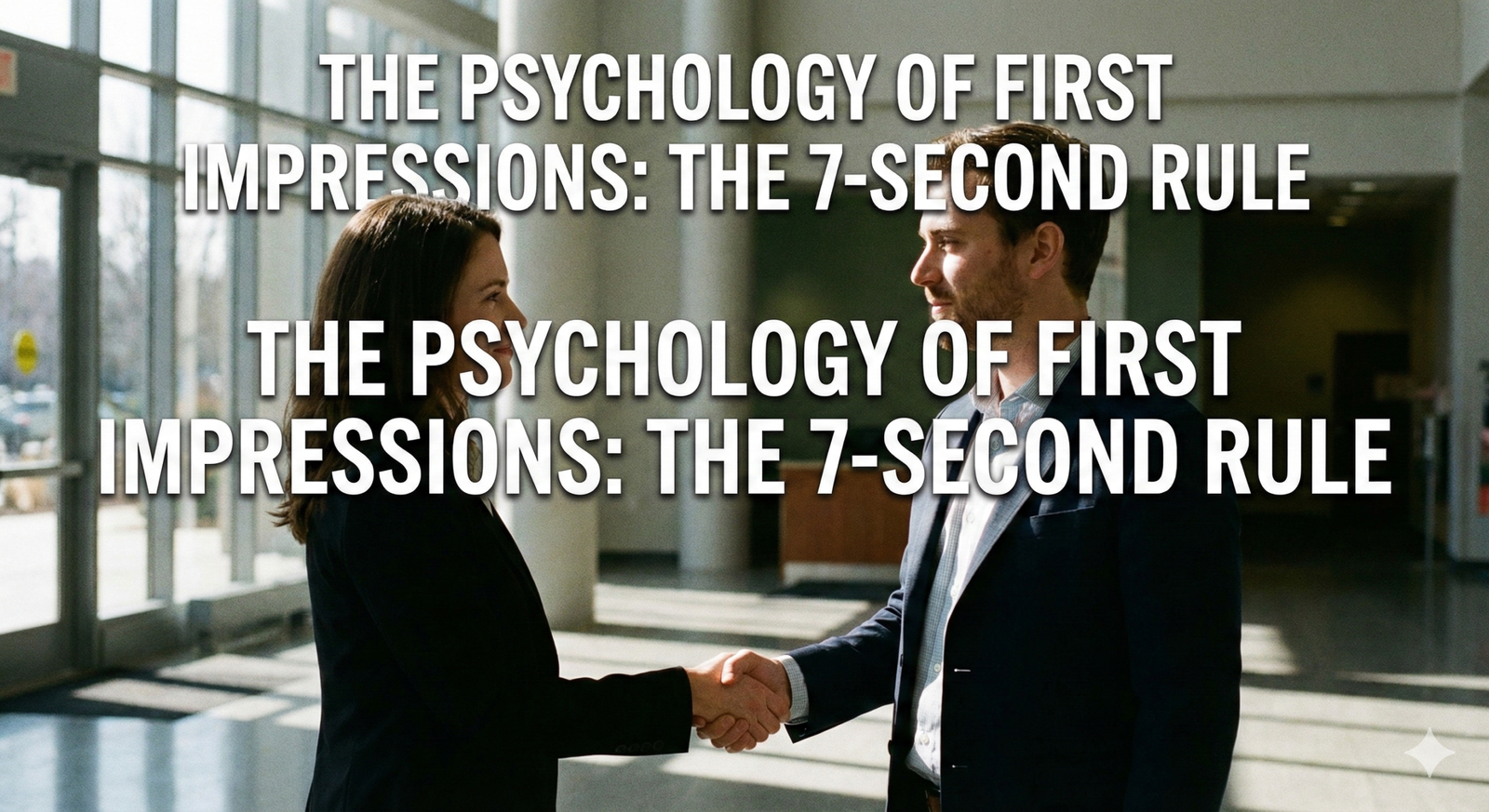
7-Second Rule Psychology: How to Master First Impressions
7-second rule psychology dictates that within moments of meeting a stranger, your brain makes a permanent judgment about them. It takes less time to form this opinion than it does to tie your shoelaces. Research in social psychology suggests that this brief window is all you have to establish trust, competence, and likeability.
At Formal Psychology, we understand that 7-second rule psychology isn’t just about superficial judgments—it is rooted in evolutionary survival mechanisms. Whether you are walking into a job interview or a first date, your brain is running a high-speed analysis that determines if you are trustworthy, competent, and likeable.
What is 7-Second Rule Psychology?
The core of 7-second rule psychology posits that within the first few moments of interaction, the human brain makes a subconscious decision about a person.
Research by Princeton psychologists Janine Willis and Alexander Todorov revealed that it might happen even faster—sometimes in a tenth of a second. However, this 7-second window provides the timeframe in which that initial spark solidifies into a conscious opinion. Once this window closes, the confirmation bias sets in.
The Neuroscience of “Thin-Slicing”
Psychologists call this rapid cognition “thin-slicing.” This is the ability of our unconscious mind to find patterns in situations based on very narrow slices of experience.
Shutterstock
- The Amygdala’s Role: When we meet someone new, the amygdala activates instantly.
- The Prefrontal Cortex: Seconds later, the prefrontal cortex kicks in to analyze personality traits.
The 3 Pillars of a First Impression
According to Professor Albert Mehrabian’s communication model, words account for only a fraction of how we are perceived. To understand 7-second rule psychology fully, we must look at the breakdown:
1. Visuals (55%)
Before you speak, you are seen. Your posture and eye contact make up the majority of the impression.
2. Vocal Tone (38%)
It’s not what you say, but how you say it. A warm, steady voice signals competence.
3. Words (7%)
Surprisingly, the content matters least in the initial window. The brain prioritizes safety over intellect during these first seconds.
The Halo Effect: Why It Sticks
Why is it so hard to change a bad first impression? In 7-second rule psychology, this is often attributed to the Halo Effect.
This is a cognitive bias where one positive trait (like being well-dressed) influences the perception of other unrelated traits. If you make a great first impression, people assume you are also smart and kind.
Practical Psychology: How to Master the First 7 Seconds
Knowing the science allows you to hack the system. Here are strategies to optimize your first interaction:
- The “Eyebrow Flash”: A subtle raising of the eyebrows signals friendliness.
- Adjust Your Attitude: People can spot “micro-expressions” of stress.
- The Power of the Palm: Keep your palms open or visible to signal honesty.
- Mirroring: Subtly match the other person’s energy.
Conclusion
7-second rule psychology is a reminder that human interaction is as much biological as it is social. While we like to think we are logical creatures, our initial bonds are formed through rapid, unconscious assessments. However, this knowledge is not an invitation to be inauthentic; rather, it is a tool for alignment. By understanding these mechanisms, you can ensure that your non-verbal cues accurately reflect your true intentions, preventing anxiety or poor posture from misrepresenting your character.
In an era of shrinking attention spans, where both digital and physical interactions are increasingly fleeting, mastering this skill is crucial. It empowers you to cut through the noise and establish a foundation of trust instantly. Ultimately, by taking control of these first moments, you are not just designing a superficial image; you are designing the pathway for a deeper, more genuine human connection.