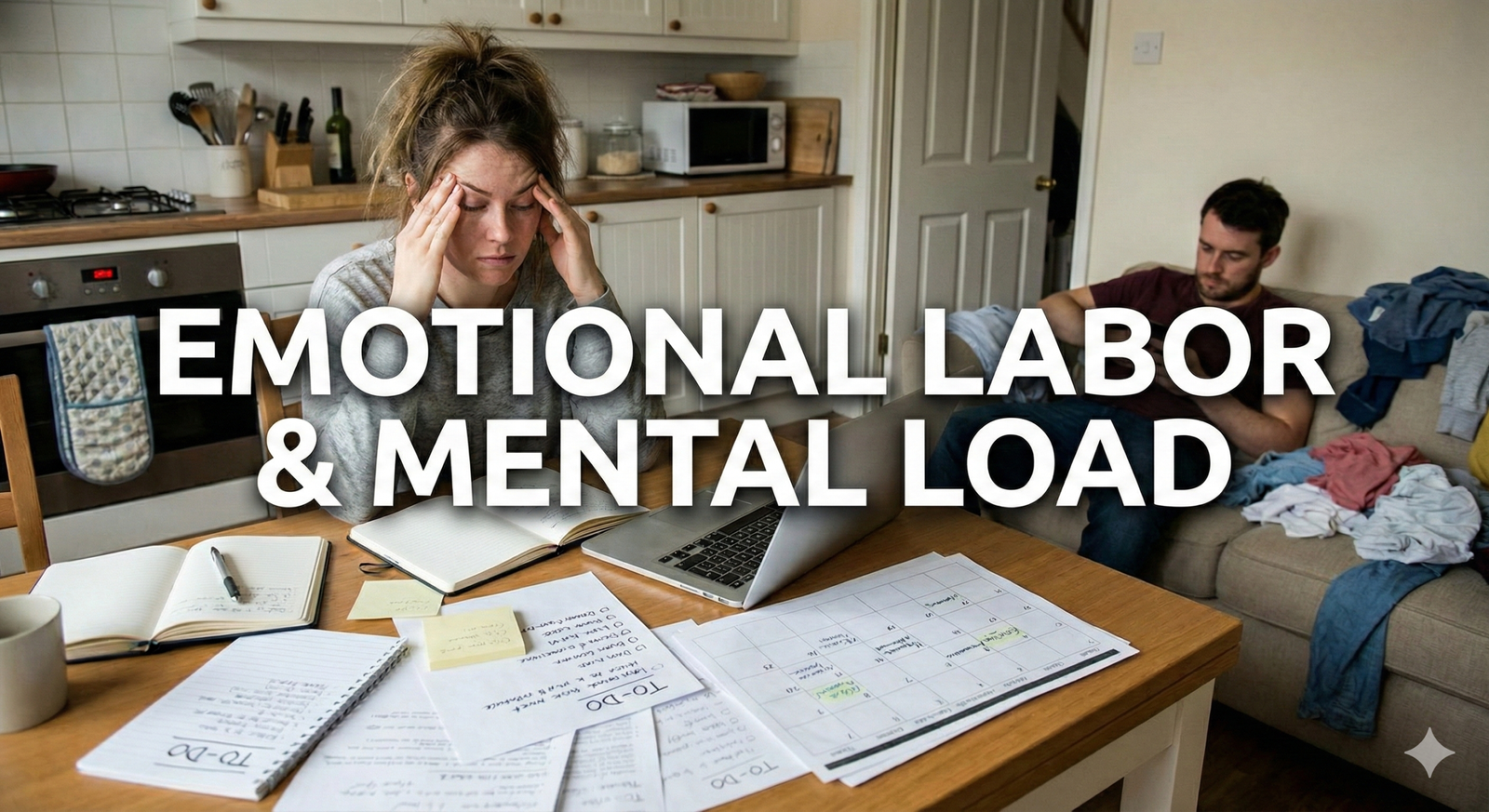
The concept of emotional labor in relationships has moved from sociological theory into the heart of modern discourse, yet it remains one of the most misunderstood aspects of partnership. For your readers at Formal Psychology, it is crucial to dissect this topic not just as a domestic issue, but as a psychological phenomenon that directly impacts mental health and relationship longevity.
In the architecture of a relationship, visible tasks like paying bills or washing dishes are the bricks. But emotional labor is the mortar—the invisible substance that holds the structure together. When that mortar is applied unevenly, cracks begin to form.
Often conflated with the “mental load,” emotional labor refers to the cognitive and emotional effort required to manage life, soothe egos, and maintain harmony. When this burden falls disproportionately on one partner, it creates a silent crisis: relationship burnout.
What Is Emotional Labor? (Defining the Invisible)
The term “emotional labor” was originally coined by sociologist Arlie Hochschild in 1983 to describe the effort workers (like flight attendants) must exert to manage their emotions for a wage. In the context of intimate relationships, it has evolved to describe the unpaid, often unnoticed effort of managing the emotional climate of a household.+1
While often used interchangeably, it is vital to distinguish between two key concepts:
- The Mental Load: The cognitive “project management” of a household (e.g., remembering a child’s vaccination schedule, noticing the toothpaste is low, or planning a birthday dinner).
- Emotional Labor: The execution of that load with empathy and regulation (e.g., suppressing your own stress to soothe a partner, or delicately bringing up a difficult topic to avoid conflict).
The Psychology of the “Manager-Helper” Dynamic
Why does this imbalance occur? Psychology points to deeply ingrained social scripts.
1. The “Default Parent” Syndrome
Even in egalitarian households, one partner often becomes the “default” for processing needs. This partner holds the “master plan” in their head. The other partner may be willing to help but waits for instructions. This creates a Manager-Helper dynamic, where the “manager” is exhausted not just by the task, but by the cognitive effort of delegation.
2. Weaponized Incompetence
This occurs when one partner feigns inability or clumsiness to avoid a task (e.g., “I do the laundry wrong, so you should just do it”). While often not malicious, it forces the other partner to take over the task permanently to ensure it is done correctly, adding to their mental load.
3. Differential Thresholds
Partners often have different thresholds for disorder. If Partner A notices a dirty floor after 2 days and Partner B notices after 7 days, Partner A will always end up cleaning it first. Over time, Partner A feels like the only one who cares, while Partner B feels constantly criticized.
The Road to Burnout: The Psychological Toll
When the mental load is chronically unbalanced, the psychological impact on the “manager” is profound. This is not just “being tired”; it is a state of emotional depletion.
- Decision Fatigue: The human brain has a limited capacity for decision-making. Making 1,000 micro-decisions a day (What’s for dinner? Did we RSVP? Does the dog need vet meds?) drains the prefrontal cortex, leading to irritability, brain fog, and paralysis.
- The “Nagging” Trap: The burdened partner does not want to nag; they want a proactive teammate. However, when they are forced to ask for help repeatedly, they are cast in the role of the “nag,” which creates a cycle of resentment and withdrawal.
- Erosion of Intimacy: It is difficult to feel romantic attraction toward someone you feel you are “managing” or “parenting.” The mental load acts as a libido killer, replacing passion with transactional interactions.
Psychological Insight: Chronic emotional labor triggers the body’s stress response. High levels of cortisol (the stress hormone) can lead to anxiety, sleep disturbances, and a feeling of being “touched out.”+1
Signs Your Relationship Has a Labor Imbalance
How do you know if emotional labor is eroding your partnership? Look for these symptoms:
| Symptom | Description |
| Hyper-Vigilance | One partner is constantly scanning the environment for problems to solve before they escalate. |
| The “Guest” Mentality | One partner acts like a helpful guest in their own home, waiting to be told what to do. |
| Scorekeeping | A toxic pattern where partners track tasks to prove who does more, fostering an adversarial dynamic. |
| Loneliness | The burdened partner feels alone in the relationship, despite being physically present with someone. |
5 Strategies to Rebalance the Load
Recovery from emotional labor burnout requires a structural shift, not just a chore chart.
1. Make the Invisible Visible
Sit down and conduct a “Labor Audit.” List every recurring task, from “paying the mortgage” to “emotional check-ins with in-laws.” Seeing the sheer volume of invisible tasks on paper is often a reality check for the under-contributing partner.
2. Shift from “Helping” to “Owning”
The goal is Total Responsibility. If one partner takes over “dinner,” they don’t just cook. They plan the menu, check the pantry, buy the ingredients, and cook the meal. This removes the mental load entirely from the other partner.
3. Establish “Minimum Standards of Care”
Agree on what “done” looks like. If one partner thinks “cleaning the bathroom” means wiping the sink, and the other thinks it means scrubbing the grout, conflict is inevitable. Agree on a standard so the “manager” doesn’t have to inspect the work.
4. Scheduled “State of the Union” Meetings
Institute a 20-minute weekly meeting to discuss logistics, schedules, and emotional needs. This creates a dedicated container for household business, preventing it from leaking into date nights or relaxation time.
5. Validate and Appreciate
Emotional labor is often thankless. A simple, “I see how much effort you put into planning that trip for us, thank you,” validates the work and reduces resentment.
Conclusion: Moving Toward a Partnership of Equals
Emotional labor is not inherently negative; it is the currency of care that builds a life together. However, it must be a shared investment. By recognizing the weight of the mental load and redistributing it fairly, couples can move away from the brink of burnout and build a relationship grounded in true partnership and mutual respect.