
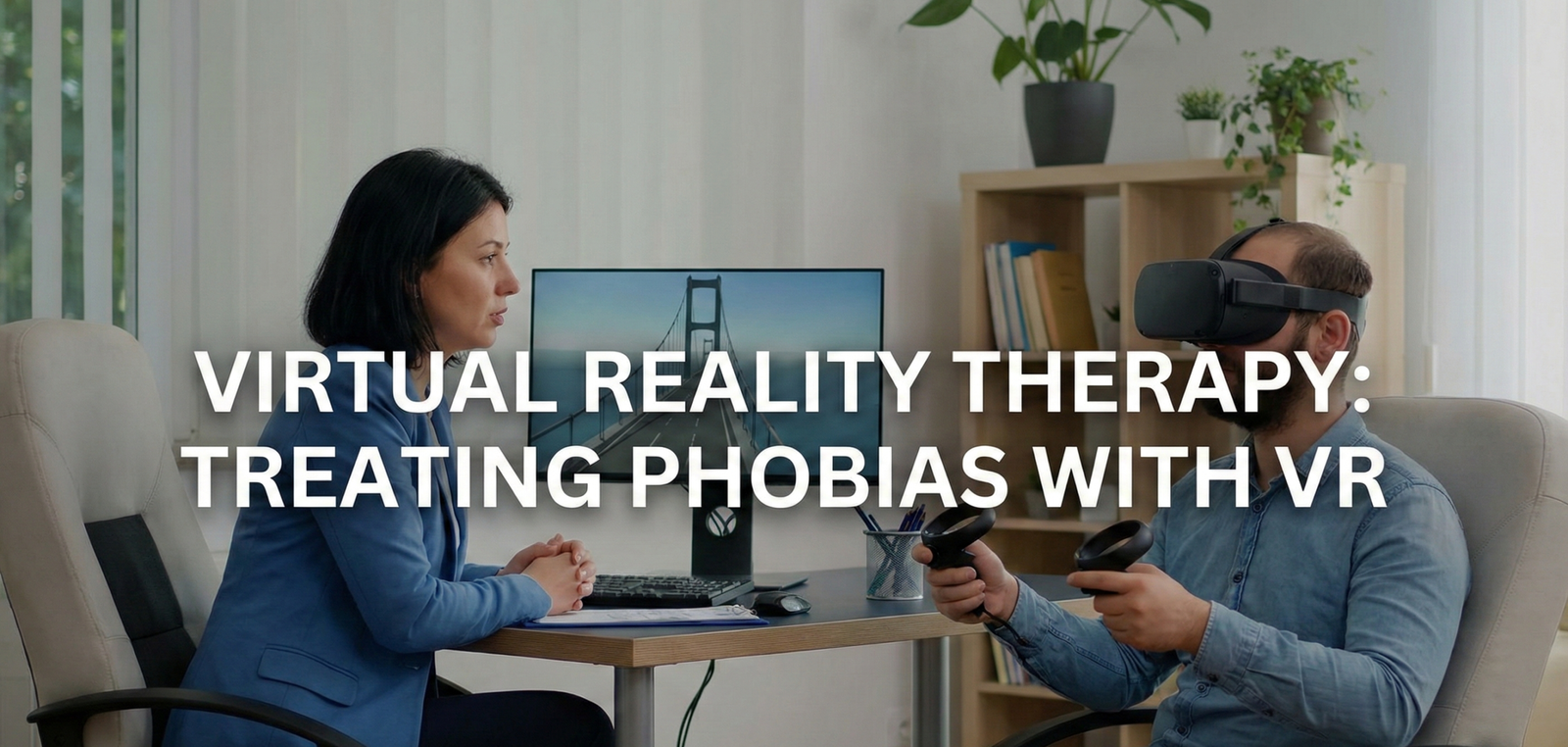

Virtual Reality Therapy treating phobias with VR is rapidly becoming one of the most transformative tools in modern clinical psychology. As we move further into the digital age, the integration of immersive technology with traditional behavioral science is offering new hope for those suffering from debilitating anxiety disorders.
This article provides a fully explained analysis of this topic, covering the mechanisms, procedures, and benefits of using this cutting-edge approach.
Understanding Virtual Reality Therapy Treating Phobias with VR
To fully understand Virtual Reality Therapy treating phobias with VR, we must first look at the foundation of exposure therapy. Traditional exposure therapy involves helping patients confront their fears in a safe environment to break the cycle of avoidance. However, replicating certain scenarios—like a crowded airplane or a high-altitude balcony—can be logistically difficult or expensive in a standard clinical setting.
This is where VRET (Virtual Reality Exposure Therapy) changes the game. By using a Head-Mounted Display (HMD), clinicians can simulate these feared environments with high fidelity. The brain, perceiving the visual and auditory cues as real, activates the same neural pathways associated with fear. This allows the process of habituation—the reduction of fear over time—to occur within the safety of a therapist’s office.
The Mechanism: Why It Works
The success of Virtual Reality Therapy treating phobias with VR relies on a psychological concept called “presence.” Even though the patient knows they are in a clinic, the immersive nature of VR triggers a genuine physiological response.
- Emotional Processing Theory: For fear to be reduced, the fear structure must be activated. VR effectively activates this structure.
- Safety Learning: The patient learns that the feared outcome (e.g., falling, being bitten) does not happen, creating new “safety memories” that inhibit the old fear response.
The Clinical Procedure
When a psychologist implements Virtual Reality Therapy treating phobias with VR, they typically follow a structured protocol ensuring patient safety and therapeutic efficacy.
1. Assessment and Screening
The process begins with a standard psychological intake. The clinician assesses the severity of the phobia and screens for contraindications, such as a history of severe motion sickness or seizures, which might make Virtual Reality Therapy treating phobias with VR unsuitable for that specific individual.
2. Developing the Hierarchy
The therapist and patient work together to build a “fear hierarchy”—a ladder of scenarios ranked from least to most frightening.
- Low Anxiety: Looking at a picture of the feared object in VR.
- Moderate Anxiety: Standing 10 feet away from the object in the virtual world.
- High Anxiety: Interacting directly with the object.
3. Immersion and Exposure
During the session, the patient wears the headset while the therapist monitors their bio-feedback and the virtual environment on a separate screen. The therapist guides the patient through the hierarchy, encouraging them to remain in the virtual situation until their anxiety levels drop. This is the core practice of Virtual Reality Therapy treating phobias with VR.
Efficacy and Research
Is Virtual Reality Therapy treating phobias with VR as effective as real-life exposure? Research published in major psychological journals indicates that it is. Meta-analyses have shown that VRET yields large effect sizes for specific phobias, comparable to in vivo (real-life) exposure.
Key findings include:
- High Retention: Patients are often more willing to try VR exposure than real-life exposure, leading to lower dropout rates.
- Generalization: Improvements made in the virtual world successfully transfer to the real world. A patient who conquers a virtual spider usually fears real spiders significantly less.
Benefits of VRET
There are distinct advantages to using Virtual Reality Therapy treating phobias with VR over traditional methods:
- Controlled Environment: The therapist has god-like control over the weather, crowd size, or intensity of the stimulus, allowing for precise “dosing” of anxiety.
- Confidentiality: Patients can face public fears (like public speaking or flying) without leaving the privacy of the consultation room.
- Cost and Convenience: It eliminates the time and expense required to travel to specific locations (e.g., airports or tall buildings) for therapy sessions.
Conclusion
As technology evolves, Virtual Reality Therapy treating phobias with VR is solidifying its place as a gold standard in psychotherapy. It offers a unique blend of control, safety, and realism that traditional methods cannot always match. For the team here at Formal Psychology, it represents the exciting future of mental health treatment—where we can virtually face our demons to master our reality.