
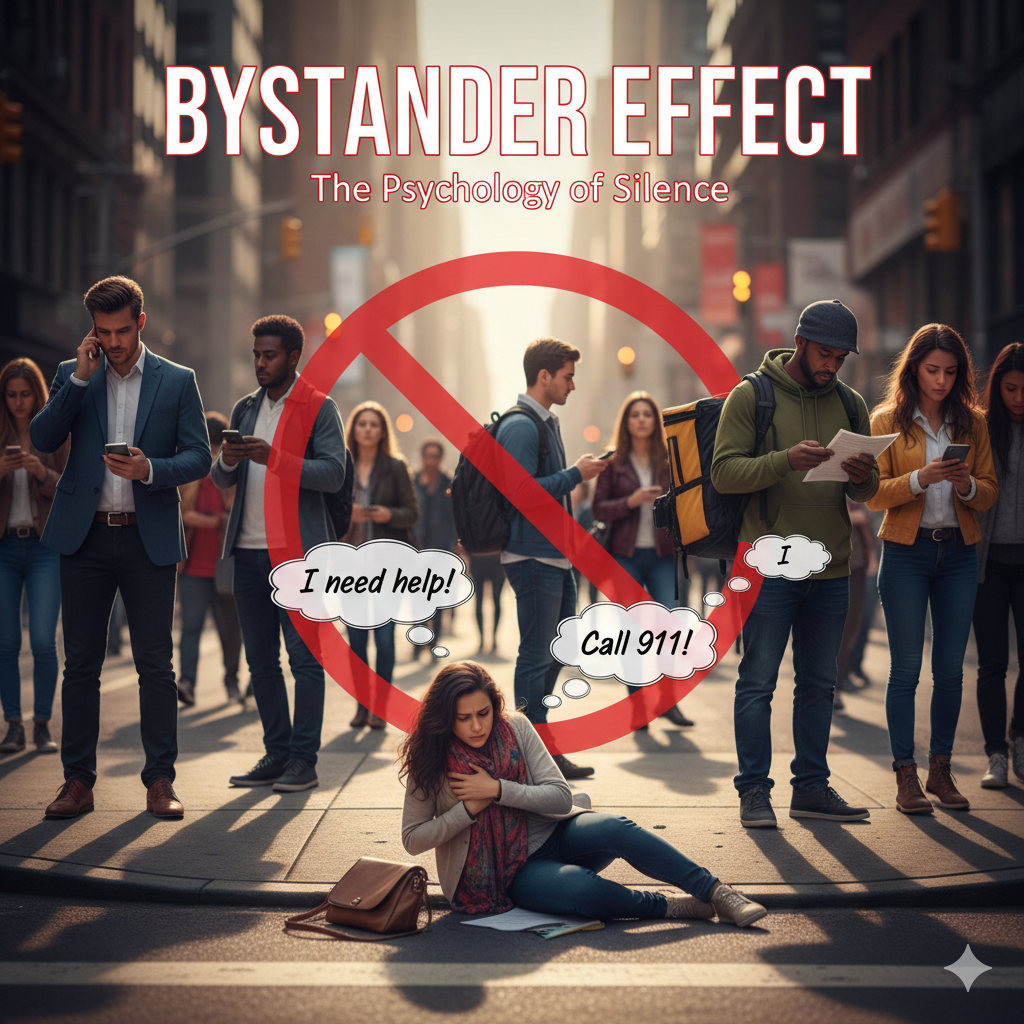

Have you ever seen someone struggling with a heavy suitcase on a busy street, or perhaps witnessed a minor car accident, and found yourself waiting for someone else to step in first? If you felt a strange paralysis despite knowing something was wrong, you weren’t being “cold”—you were experiencing a powerful psychological phenomenon known as the Bystander Effect.
What is the Bystander Effect?
The Bystander Effect is a social psychological theory stating that individuals are less likely to offer help to a victim when other people are present. Paradoxically, the greater the number of bystanders, the less likely any one of them is to help.
This concept suggests that we don’t just make decisions based on our own morality; we heavily weigh the behavior (or lack thereof) of the people around us.
The Catalyst: The Kitty Genovese Case
The study of bystander intervention began in earnest following the 1964 murder of Kitty Genovese in New York City. Initial reports claimed that 38 witnesses saw or heard the attack but failed to call the police.
While later investigations revealed that many neighbors did try to help or call for aid, the story prompted psychologists Bibb Latané and John Darley to investigate why groups often fail to act in emergencies.
Why Do We Freeze? The Core Mechanics
Psychologists have identified two primary internal hurdles that prevent us from acting in a crowd:
1. Diffusion of Responsibility
In a solo setting, the responsibility to help rests 100% on your shoulders. In a group of ten, you might feel only 10% responsible. We subconsciously assume that “someone else will call 911” or “there is surely a doctor in this crowd.”
2. Pluralistic Ignorance
When a situation is ambiguous (e.g., is that person fainting, or just taking a nap?), we look to others to see how they are reacting. If everyone else looks calm and unbothered, we conclude that the situation isn’t actually an emergency. Meanwhile, everyone else is looking at us for the same cues—creating a cycle of collective inaction.
The 5-Step Decision Model
Latané and Darley proposed that for a bystander to intervene, they must successfully pass through five mental stages. If the process breaks down at any step, help will not be given.
| Step | Action Required | The Mental Hurdle |
| 1 | Notice the event | Being in a hurry or “tunnel vision.” |
| 2 | Interpret as an emergency | Assuming it’s a joke or a private matter. |
| 3 | Assume Responsibility | Thinking someone else is better qualified. |
| 4 | Know How to help | Lacking CPR skills or knowledge of the area. |
| 5 | Implement the decision | Fear of social judgment or legal liability. |
How to “Break” the Effect
Understanding the bystander effect is the first step toward overcoming it. If you find yourself in an emergency, here is how to navigate the social pressure:
If You Are the Victim:
- Be Specific: Don’t just scream. Point to a specific person and say, “You in the red jacket, call 911!”
- Eliminate Ambiguity: Clearly state, “I need help, I am having a heart attack.”
If You Are the Bystander:
- Be the First: Once one person helps, others usually follow. You are the “social permission” others need to act.
- Safety First: You don’t have to be a hero. Helping can be as simple as calling emergency services or directing traffic.
“The world is a dangerous place, not because of those who do evil, but because of those who look on and do nothing.” — Albert Einstein
The Bystander Effect is a testament to how deeply social we are as a species. Our instinct to “fit in” is so strong it can override our instinct to help. By recognizing these patterns, we can consciously choose to step out of the crowd and provide the help someone desperately needs.



Leave a Comment